Syzygium hemilamprum
(F. Muell. ex Bailey) Merrill & Perry
Broad leafed lillypilly
iNaturalist· cc-by-nc
(c) Ian McMaster, some rights reserved (CC BY-NC), uploaded by Ian McMaster
iNaturalist· cc-by-nc
(c) ryanthughes, some rights reserved (CC BY-NC)
iNaturalist· cc-by-nc
(c) ryanthughes, some rights reserved (CC BY-NC)
Summary
Source: WikipediaSyzygium hemilamprum, commonly known as the broad-leaved lilly pilly, blush satinash, cassowary gum, Eungella gum, and treated as Acmena hemilampra in New South Wales and Queensland, is a species of flowering plant in the family Myrtaceae and is native to New South Wales, Queensland and the Northern Territory. It is a rainforest tree with broadly lance-shaped to elliptic leaves, panicles of white flowers and more or less spherical white fruit.
Description
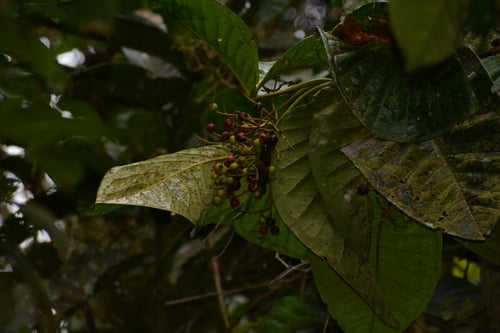
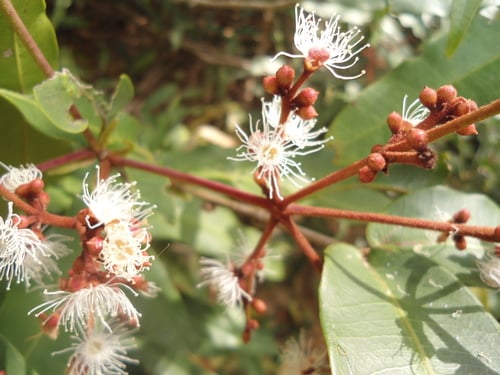
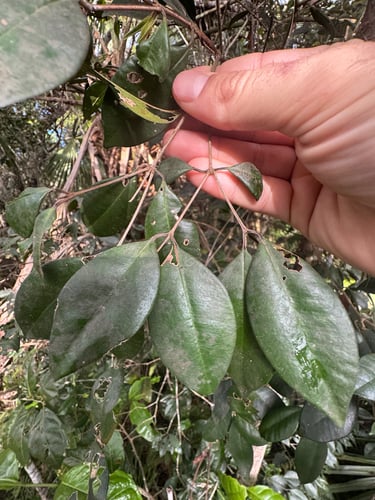
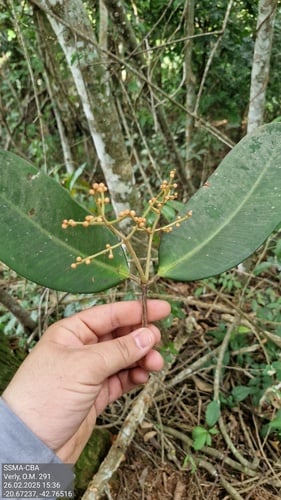
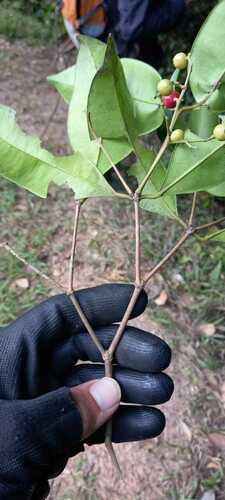
An evergreen tree. It grows to 20 m tall and spreads to 5 m wide. The stout stem has buttresses. The bark is grey. It has a dense bushy crown. The young shoots are dark red. The leaves are dark green and like an ellipse. They have a blunt tip. The top side of the leaf is glossy, while the underside is dull. There are very few oil glands visible. (These leaf characteristics help distinguish it from Acmena smithii.) The leaves are 4-12 cm long and 3-4 cm wide. The edge of the leaf often curves backwards. The flowers are small and white and with a fluffy appearance. They occur on branched flower stems near the ends of branches. The fruit are pale bluish purple berries. They are 1-2 cm across. They are globular in shape. The fruit stalks are round in cross section. The flesh is edible.
Edible Uses
Fruit - raw or cooked. The flesh is hard and acidic. The white globular fruits are about 11 - 17mm in diameter, enclosing a single seed about 7 - 13mm in diameter.
Traditional Uses
The fruit are eaten. It makes a good jam.
This uses section is brief — help expand it
Medicinal Uses
The fruit are used as food traditionally in Australia.
Distribution
It is a tropical and subtropical tree. It occurs naturally in New South Wales and Queensland in Australia. It also occurs in Papua New Guinea. It prefers a coastal rainforest position with a well-composted soil. It is drought and frost tender although established trees can survive moderate frosts. It needs watering during dry periods and probably benefits from fertiliser. It suits hardiness zones 10-12. Geelong Botanical Gardens. Mt Cootha Botanical Gardens.
Where It Grows
Australia*, Pacific, Papua New Guinea, PNG,
Cultivation
It is grown from fresh seed. Seeds germinate slowly. It can be grown by tip cuttings 10 cm long and taken when growth is slowest.
Propagation
Seed - slow to germinate, taking 2 - 24 months, but reliable. Cuttings are slow to root.
Other Uses
A useful structural timber. We do not have any more specific information for the wood of this species, but the various species of Syzygium tend to have somewhat similar timber. The general description of syzygium timber is as follows:- The heartwood is a golden brown, greyish brown or brown, with pink or purplish glints; it is not clearly demarcated from the 1 - 4cm wide band of sapwood. The texture is fine; the grain slightly interlocked, sometimes wavy or irregular; there are resin deposits. The wood is heavy; moderately hard; somewhat durable, being moderately resistant to fungi and termites, but susceptible to dry wood borers. It seasons slowly, with a high risk of checking and distortion; once dry it is moderately stable in service. It works well with ordinary tools, nailing and screwing are good so long as the wood is pre-bored; gluing is correct. The wood is used for musical instruments, tool handles, furniture components, ship building, heavy carpentry, flooring, joinery etc.
Production
Fruit ripen May to August. (January to September). Large fruited forms can be selected.
Other Information
It is used as a food in Australia, but it is not known if it is used for food in Papua New Guinea.
Notes
There are 15 Acmena species. They occur in tropical Asia and Australia.
Synonyms
Also Known As
Blush Satinash
References (19)
- Bodkin, F., 1991, Encyclopedia Botanica. Cornstalk publishing, p 45
- Cherikoff V. & Isaacs, J., The Bush Food Handbook. How to gather, grow, process and cook Australian Wild Foods. Ti Tree Press, Australia p 198
- Cooper, W. & Cooper, W. T., 1994, Fruits of the Rain Forest. RD Press p 14
- Cooper, W. and Cooper, W., 2004, Fruits of the Australian Tropical Rainforest. Nokomis Editions, Victoria, Australia. p 340
- Elliot, W.R., & Jones, D.L., 1982, Encyclopedia of Australian Plants suitable for cultivation. Vol 2. Lothian. p 139
Show all 19 references Hide references
- Etherington, K., & Imwold, D., (Eds), 2001, Botanica's Trees & Shrubs. The illustrated A-Z of over 8500 trees and shrubs. Random House, Australia. p 73
- Haslam, S., 2004, Noosa's Native Plants. Noosa Integrated Catchment Assn. Inc. p 320
- Hiddins, L., 1999, Explore Wild Australia with the Bush Tucker Man. Penguin Books/ABC Books. p 134
- Jackes, B.R., 2001, Plants of the Tropics. Rainforest to Heath. An Identification Guide. James Cook University. p 68
- Jones D, L, 1986, Ornamental Rainforest Plants in Australia, Reed Books, p 58
- Lamberton, K (Ed.), 2004, The Australian gardening encyclodepia. Murdoch Books, NSW Australia. p 142
- Low, T., 1991, Wild Food Plants of Australia. Australian Nature FieldGuide, Angus & Robertson. p 75
- Melzer, R. & Plumb, J., 2011, Plants of Capricornia. Belgamba, Rockhampton. p 266
- Nicholson, N & H., 1996, Australian Rainforest Plants 2, Terania Rainforest Publishing. NSW. p 4
- Price, S.H. & J.L., Wild Food, Medicine and useful plants of the Wet tropics. Kwik Kopy, Cairns. p 3
- Radke, P & A, Sankowsky, G & N., 1993, Growing Australian Tropical Plants. Frith & Frith, Australia. p 15
- Stanley, T. D. & Ross, E. M., 1986, Flora of south-eastern Queensland Volume 2. Queensland Government p 214 (As Acmena hemilampra)
- Williams, J.B., Harden, G.J., and McDonald, W.J.F., 1984, Trees and shrubs in rainforests of New South Wales and Southern Queensland. Univ. of New England, Armidale. p 109, 112
- World Checklist of Useful Plant Species 2020. Royal Botanic Gardens, Kew