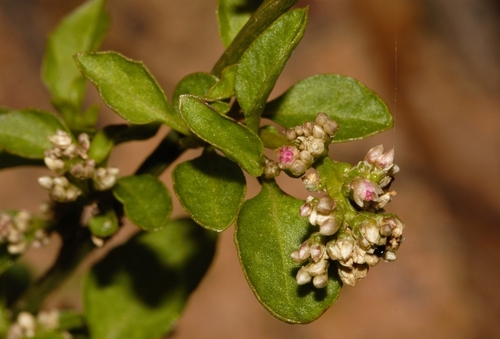
Arthrocnemum macrostachyum
(Moric.) K. Koch.
European glasswort
iNaturalist· cc-by-nc
(c) Sebastian J. Dunkl, some rights reserved (CC BY-NC)
iNaturalist· cc-by-nc
(c) Sebastian J. Dunkl, some rights reserved (CC BY-NC)
iNaturalist· cc-by-nc
(c) Sebastian J. Dunkl, some rights reserved (CC BY-NC)
Description
A shrub. It is succulent and jointed. It grows 80 cm tall. The leaves are opposite and very simple blade. The flowers have both sexes and are in the axils of cone like spikes. The seeds are very small.
Edible Uses
The leaves are eaten. The seeds are pressed for oil.
Distribution
It is a Mediterranean plant. It can grow in places that are occasionally waterlogged. It can grow in salty soils. It can grow in arid places. It can grow in deserts.
Where It Grows
Africa, Albania, Bahrain, Balkans, East Africa, Egypt, Ethiopia, Europe, France, Greece, India, Italy, Mediterranean, Middle East, North Africa, Portugal, Saudi Arabia, Spain, Sudan, United Arab Emirates, UAE,
Notes
Also put in the family Chenopodiaceae.
Synonyms
Also Known As
Shinan
References (4)
- Biscotti, N. et al, 2018, The traditional food use of wild vegetables in Apulia (Italy) in the light of Italian ethnobotanical literature. Italian Botanist 5:1-24 (As Arthrocnemum glaucum)
- Joshi, A., et al, 2018, Halophytes of Thar Desert: Potential source of nutrition and feedstuff. International Journal of Bioassays 8.1 (2018) pp. 5674-5683
- Karim, F. M. & Dakheel, A, J., 2006, Salt-tolerant plants of the United Arab Emirates. 2006. International Center for Biosaline Agriculture, Dubai, UAE.
- Royal Botanic Gardens, Kew (1999). Survey of Economic Plants for Arid and Semi-Arid Lands (SEPASAL) database. Published on the Internet; http://www.rbgkew.org.uk/ceb/sepasal/internet [Accessed 7th April 2011] (As Arthrocnemum glaucum)