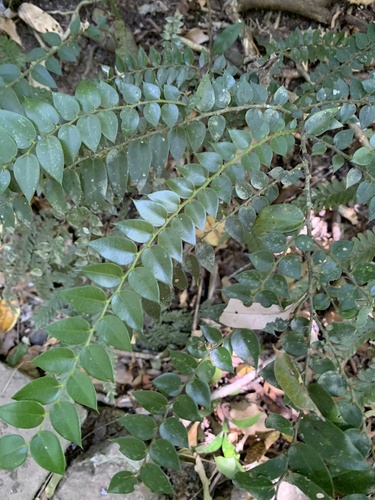
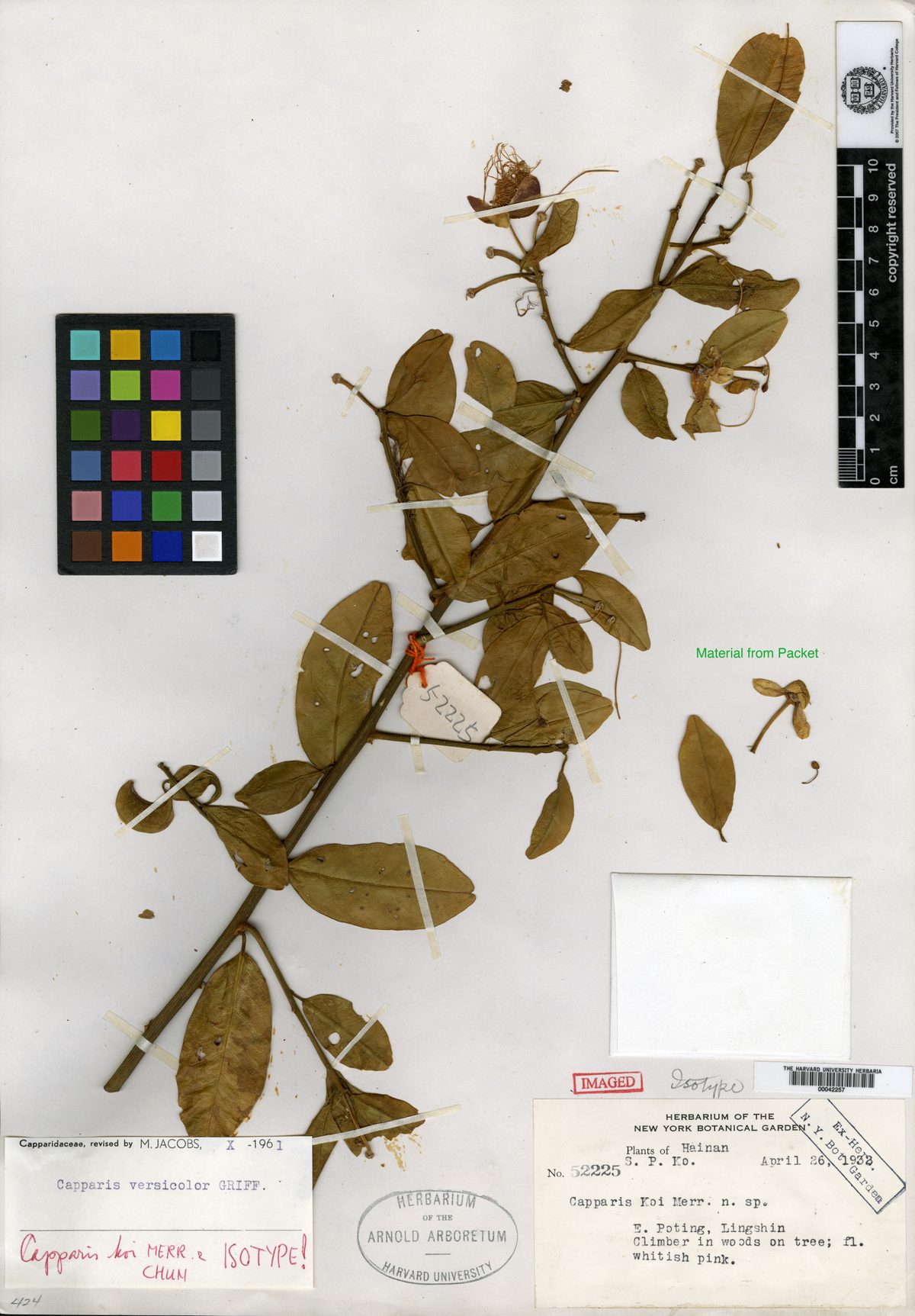
Capparis nummularia
L., (DC.) Bailey
Caper bush, Wild passionfruit, Flinder’s rose
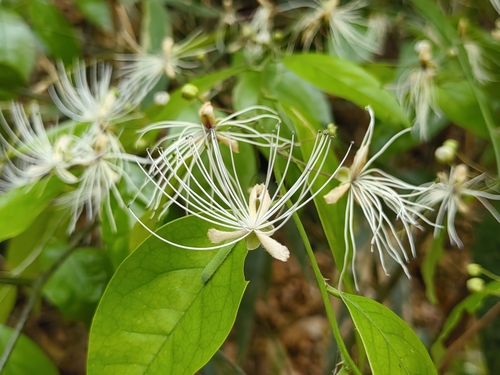
iNaturalist· cc-by-nc-sa
(c) caliologist, some rights reserved (CC BY-NC-SA), uploaded by caliologist
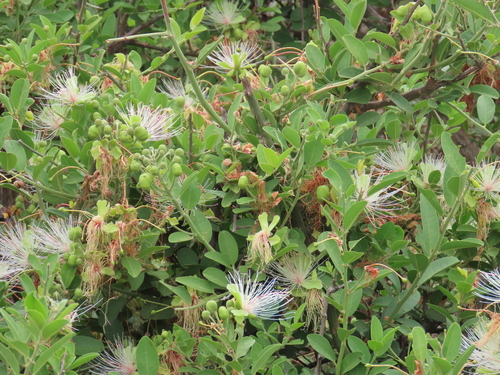
iNaturalist· cc-by-nc
(c) Pete Woodall, some rights reserved (CC BY-NC), uploaded by Pete Woodall
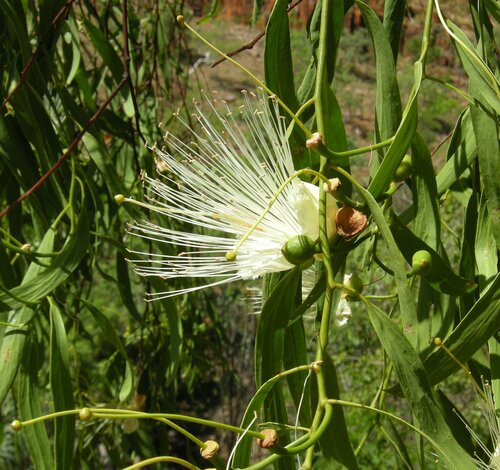
iNaturalist· cc-by-nc
(c) Pete Woodall, some rights reserved (CC BY-NC), uploaded by Pete Woodall
Description
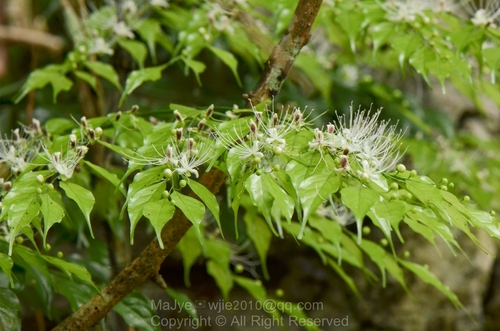
A small shrub. The branches are wiry and have spines. The spines curve backwards along the stems. The leaves are 2-4 cm across. They are rounded and have a thick texture. They are dull green. The leaf stalks are 1 cm long. The flowers are 6 cm across. They have 3 white petals. The flowers have a scent. The fruit is a berry 3 cm long. It bursts open when ripe. The fruit are edible. The buds are edible.
Edible Uses
The salted and pickled caper bud (simply called a "caper") is used as an ingredient, seasoning, or garnish. Capers are a common ingredient in Mediterranean cuisine, especially Cypriot, Italian, Aeolian Greek, and Maltese food. The immature fruit of the caper shrub are prepared similarly and marketed as "caper berries". Fully mature fruit are not preferred, as they contain many hard seeds. The buds, when ready to pick, are a dark olive green and range in size from under 7 mm (1⁄4 in) to more than 14 mm (1⁄2 in). Once the capers are picked, they are pickled in salt or a salt and vinegar solution, and drained. Intense flavour, sometimes described as being similar to black pepper or mustard, is developed as glucocapparin, a glycoside organosulfur molecule, is released from each caper bud. This enzymatic reaction leads to the formation of rutin, often seen as crystallized white spots on the surfaces of individual caper buds. Capers are a distinctive ingredient in Italian cuisine, especially in Sicilian, Aeolian and southern Italian cooking. They are commonly used in salads, pasta salads, meat dishes, and pasta sauces. Examples of uses in Italian cuisine are piccata dishes, vitello tonnato and spaghetti alla puttanesca. In Campania, the best capers are believed to grow on Pantelleria, an island off the region's coast. Capers are sometimes an ingredient in tartar sauce. They are often served with cold smoked salmon or cured salmon dishes, especially lox and cream cheese. Capers and caper berries are sometimes substituted for olives to garnish a martini. Capers are categorized and sold by their size, defined as follows, with the smallest sizes being the most desirable: non-pareil (up to 7 mm), surfines (7–8 mm), capucines (8–9 mm), capotes (9–11 mm), fines (11–13 mm), and grusas (14+ mm). If the caper bud is not picked, it flowers and produces a caper berry. The fruit can be pickled and then served as a Greek mezze. Caper leaves, which are hard to find outside of Greece or Cyprus, are used particularly in salads and fish dishes. They are pickled or boiled and preserved in jars with brine—like caper buds. Dried caper leaves are also used as a substitute for rennet in manufacturing high-quality cheese.
Traditional Uses
The fruit are eaten. They are harvested after they split open when ripe. The buds are pickled as capers.
This uses section is brief — help expand it
Distribution
A tropical plant. It grows along stream banks and rocky coastal areas in northern Australia. It has salt tolerance to sea spray. It can grow in arid places.
Where It Grows
Australia*,
Cultivation
Plants are grown from seed or cuttings.
Notes
There are about 250 Capparis species. There are about 50 Capparis species in tropical America.
Synonyms
Also Known As
Arrweneng, Pajilla
References (21)
- Bindon, P., 1996, Useful Bush Plants. Western Australian Museum. p 71 (As Capparis spinosa var. nummularia)
- Bonney, N., 2012, Edible Wild Native Plants for Southern Australia. p 110
- Cancilla, D., 2018, Ethnobotanical and Ethnozoological Values Desktop Assessment - Eliwana Project. p 10 (As Capparis spinosa var. nummularia)
- Cherikoff V. & Isaacs, J., The Bush Food Handbook. How to gather, grow, process and cook Australian Wild Foods. Ti Tree Press, Australia p 189 (As Capparis spinosa var. nummularia)
- Elliot, W.R., & Jones, D.L., 1982, Encyclopedia of Australian Plants suitable for cultivation. Vol 2. Lothian. p 460 (As Capparis spinosa var. nummularia)
Show all 21 references Hide references
- Flora of Australia, Volume 8, Lecythidales to Batales, Australian Government Publishing Service, Canberra (1982) p 210 (As Capparis spinosa var. nummularia)
- Green, J., (Ed.), 2003, Anmatyerr Plant Stories. AID Press. p 2 (As Capparis spinosa var. nummularia)
- Hall, N. et al, 1972, The Use of Trees and Shrubs in the Dry Country of Australia, AGPS, Canberra. p 357 (As Capparis spinosa var. nummularia)
- Hiddins, L., 1999, Explore Wild Australia with the Bush Tucker Man. Penguin Books/ABC Books. p 168 (As Capparis spinosa var. nummularia)
- Kenneally, K.E., Edinger, D. C., and Willing T., 1996, Broome and Beyond, Plants and People of the Dampier Peninsula, Kimberley, Western Australia. Department of Conservation and Land Management. p 81 (As Capparis spinosa var. nummularia)
- Latz, P.K., 1996, Bushfires and Bushtucker: Aboriginal plant use in Central Australia. IAD Press Alice Springs p 141 (As Capparis spinosa var. nummularia)
- Lavelle, M., 2008, Wild Flowers of Australia and Oceania. Southwater. p 64 (As Capparis spinosa var. nummularia)
- Lazarides, M. & Hince, B., 1993, Handbook of Economic Plants of Australia, CSIRO. p 47 (As Capparis spinosa var. nummularia)
- Low, T., 1991, Wild Food Plants of Australia. Australian Nature FieldGuide, Angus & Robertson. p 173 (As Capparis spinosa var. nummularia)
- Miers, G., 2004, Cultivation and sustainable wild harvest of Bushfoods by Aboriginal Communities in Central Australia. RIRDC report W03/124 p 19 (As Capparis spinosa var. nummularia)
- Milson. J., 2000, Trees and Shrubs of north-west Queensland. DPI p 38 (As Capparis spinosa var. nummularia)
- Paczkowska, G. & Chapman, A.R., 2000, The Western Australian Flora. A Descriptive Catalogue. Western Australian Herbarium. p 195 (As Capparis spinosa var. nummularia)
- Urban, A., 1990, Wildflowers of Inland Australia. Portside editions. p 57 (As Capparis spinosa var. nummularia)
- Wheeler, J.R.(ed.), 1992, Flora of the Kimberley Region. CALM, Western Australian Herbarium, p 259 (As Capparis spinosa var. nummularia)
- World Checklist of Useful Plant Species 2020. Royal Botanic Gardens, Kew
- www.theplantlist.org