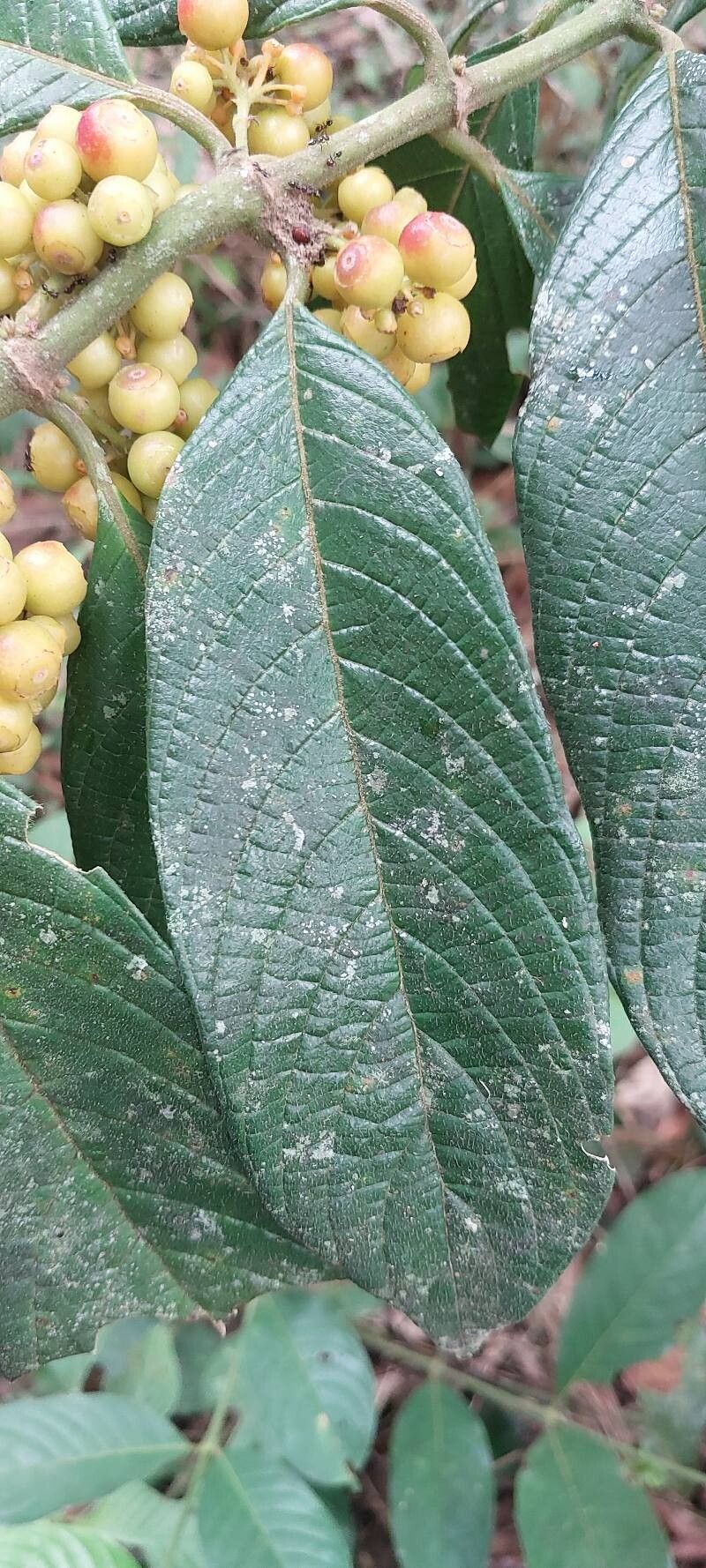
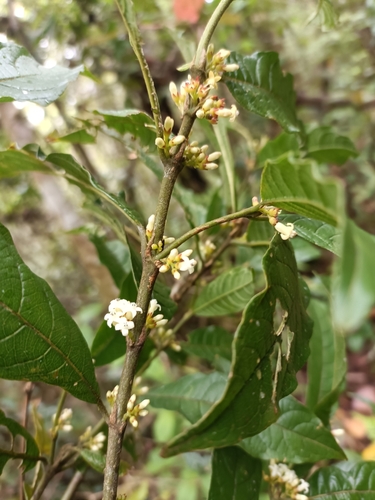
Afrocanthium lactescens
(Hiern) Lantz
Gummy canthium
iNaturalist· cc-by-nc
(c) Diana Charsley, some rights reserved (CC BY-NC), uploaded by Diana Charsley
iNaturalist· cc-by-nc
(c) robburrett, some rights reserved (CC BY-NC)
Description
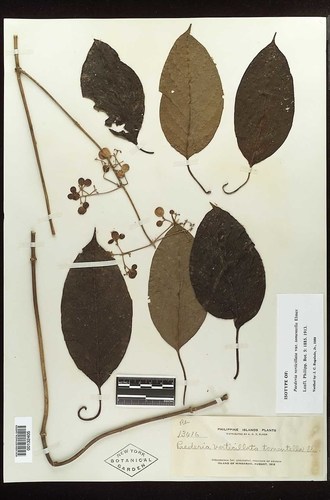
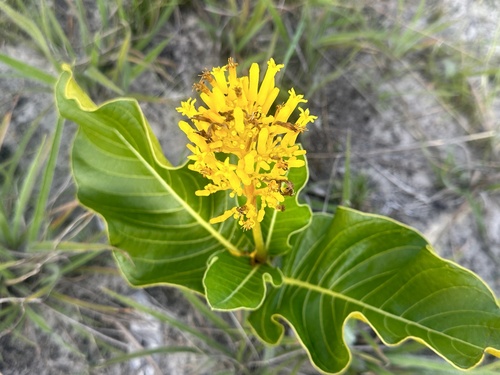
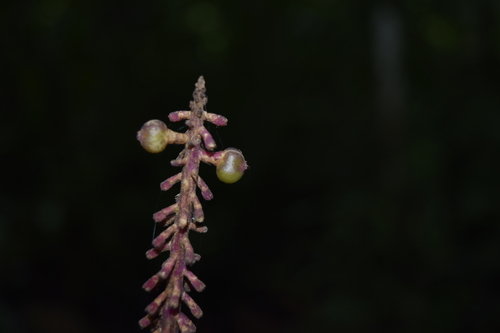
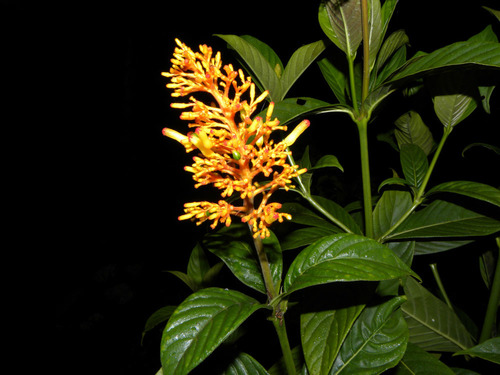
A small tree. It grows to 5-10 m high. The branches are horizontal. The bark is dark grey. It is smooth but becomes rough with age. The leaves are produced in side spur shoots. One pair of leaves and one internode are added each year. Leaves are oval and 19 cm long by 16 cm wide. They have a smooth feel. They are pale to dark green and turn yellow in autumn. The base is lobed. The leaf stalk is thick and 1.5 cm long. The flowers are small and white or pale yellow. They have a sweet scent. They occur in loose open sprays in the clusters of leaves. The fruit are oval and unequal. They are 7-10 mm long. Sometimes they have 2 lobes. They are brown to purple when mature. They are edible.
Edible Uses
Fruit - raw. Sweet but slightly acidic, they are eaten as snacks when travelling. The brown-purple, oval fruit is about 10mm long, containing a single seed.
Traditional Uses
The ripe fruit are eaten raw. They are sweet.
This uses section is brief — help expand it
Medicinal Uses
The roots are pounded and soaked in warm water. The decoction is drunk twice a day as a purgative.
Distribution
A tropical plant. It grows in deciduous woodland. It is often protected amongst rocks. In Kenya it grows between 1,000-2,300 m altitude. In Tanzania it grows in areas with a rainfall between 1,000-1,300 mm.
Where It Grows
Africa, Angola, Central Africa, East Africa, Ethiopia, Kenya, Malawi, Mozambique, Southern Africa, Sudan, Tanzania, Uganda, Zambia, Zimbabwe,
Cultivation
Plants can be grown from fresh seed.
Other Uses
The wood is hard. It is used for building poles, withies and tool handles. The wood is used for fuel.
Production
In Tanzania fruit are collected from April to June.
Other Information
The fruit are especially eaten by children.
Notes
There are about 200 Canthium species.
Synonyms
Also Known As
Amalerh, Bolocket, Buterwo, Emaler, Kaibetwa, Keipetwo, Kerbatwa, Kimolwet, Komolwo, Kunkomwo, Larugach, Mukumbulu, Munkolo-bondo, Olkumi, Ol-maldei
References (16)
- Ashagre, M., et al, 2016, Ethnobotanical study of wild edible plants in Burji District, Segan Area Zone of Southern Nations, Nationalities and Peoples Region (SNNPR), Ethiopia. Journal of Ethnobiology and Ethnomedicine (2016) 12:32 (As Canthium lactescens)
- Fowler, D. G., 2007, Zambian Plants: Their Vernacular Names and Uses. Kew. p 55
- Glover et al, 1966b,
- Goode, P., 1989, Edible Plants of Uganda. FAO p 30 (As Canthium lactescens)
- Grivetti, L. E., 1980, Agricultural development: present and potential role of edible wild plants. Part 2: Sub-Saharan Africa, Report to the Department of State Agency for International Development. p 45 (As Canthium lactescens)
Show all 16 references Hide references
- Jardin, C., 1970, List of Foods Used In Africa, FAO Nutrition Information Document Series No 2.p 124
- Kenya Trees, Shrubs, Lianas, 1994, nzdl.org (As Canthium lactescens)
- Lovett, J. C. et al, Field Guide to the Moist Forest Trees of Tanzania. p 127
- Maundu, P. et al, 1999, Traditional Food Plants of Kenya. National Museum of Kenya. 288p
- Mutie, F. M., et al, 2023, Important Medicinal and Food Taxa (Orders and Families) in Kenya, Based on Three Quantitative Approaches. Plants 2023, 12, 1145
- Ojelel, S., et al, 2019, Wild edible plants used by communities in and around selected forest reserves of Teso-Karamoja region, Uganda. Journal of Ethnobiology and Ethnomedicine (2019) 15:3 (As Canthium lactescens)
- Palgrave, K.C., 1996, Trees of Southern Africa. Struik Publishers. p 882
- Peters, C. R., O'Brien, E. M., and Drummond, R.B., 1992, Edible Wild plants of Sub-saharan Africa. Kew. p 168
- Ruffo, C. K., Birnie, A. & Tengnas, B., 2002, Edible Wild Plants of Tanzania. RELMA p 180 (As Canthium lactescens)
- Termote, C., et al, 2014, Assessing the potential of wild foods to reduce the cost of a nutritionally adequate diet: An example from eastern Baringo District, Kenya. Food and Nutrition Bulletin, vol. 35, no. 4 (As Canthium lactescens)
- World Checklist of Useful Plant Species 2020. Royal Botanic Gardens, Kew