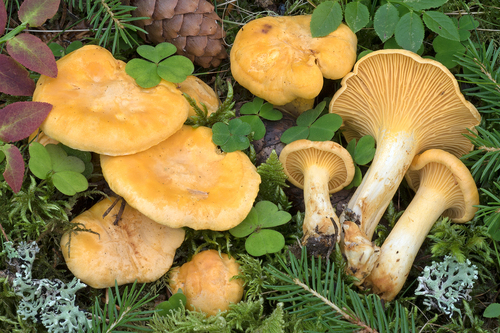
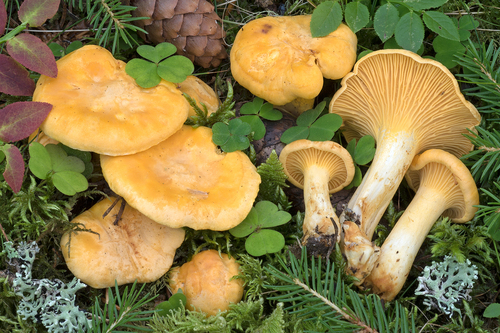
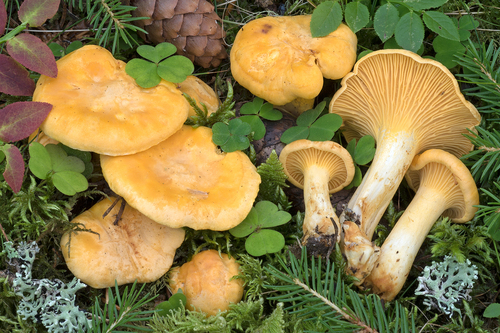
Cantharellus cibarius
L.:Fries
Chanterelle, Golden chanterelle
wikimedia· cc-by-sa
Wikimedia Commons (via Wikimedia Commons)
wikimedia· cc-by-sa
Sven Manguard (via Wikimedia Commons)
gbif· cc-by-nc
Paulo da Silva
iNaturalist· cc-by-nc
(c) Federico Calledda, some rights reserved (CC BY-NC), uploaded by Federico Calledda
iNaturalist· cc-by-nc
(c) Jeroen Van Akkeren, some rights reserved (CC BY-NC), uploaded by Jeroen Van Akkeren
iNaturalist· cc-by-sa
(c) Björn S..., some rights reserved (CC BY-SA)
Summary
Source: WikipediaCantharellus cibarius (Latin: cantharellus, "chanterelle"; cibarius, "culinary") is the golden chanterelle, the type species of the chanterelle genus Cantharellus. It is also known as girolle (or girole). Despite its characteristic features, C. cibarius can be confused with species such as the poisonous Omphalotus illudens. The golden chanterelle is a commonly consumed and choice edible species.
Description
A mushroom. It grows on rotting logs and mossy ground under leafy trees. The cap is shallow in the middle and smooth. It is funnel shaped and sunken in the middle and wavy at the edge. It is 3-7.5 cm across. What look like gills are forked ridges that extend down the stem. The stalk is 4 cm long and 1-2.5 cm across. It is light yellow. The fresh fungus smells of apricot.
Edible Uses
A commonly eaten and favored mushroom, the chanterelle is typically harvested from late summer to late fall in its European distribution. Chanterelles are used in many culinary dishes, but watery specimens are more susceptible to rot. The mushrooms can be preserved by either drying or freezing. The use of an oven for drying is not recommended because it can make the mushroom bitter.
Traditional Uses
The fruiting body is eaten steamed or blanched with rice. They can be preserved in oil. It is also dried for later use. The dried powder is sprinkled on omelettes, salads, pastas, soups etc. The fruiting bodies are used in stews, soups, omelettes, grain dishes, sauces and sauteed in butter or oil.
Distribution
It can grow in tropical and temperate places. It grows on rotting logs in deciduous forest. It is eaten by the Dani in Papua Indonesia. It can grow on termite mounds. It grows in Miombo woodland. In Yunnan.
Where It Grows
Africa, Andorra, Armenia, Asia, Australia, Austria, Balkans, Belarus, Belgium, Bhutan, Britain, British Indian Ocean Terr., BIOT, Bulgaria, Canada, Caucasus, Central Africa, Central America, China, Congo DR, Costa Rica, Croatia, East Africa, Europe, Finland, Georgia, Germany, Greece, Guatemala, Himalayas, Hungary, India, Indochina, Indonesia, Italy, Japan, Jordan, Kosovo, Kyrgyzstan, Latvia, Liberia, Macedonia, Malawi, Malaysia, Mediterranean, Mexico, Middle East, Morocco, Mozambique, Nepal, Netherlands, Nigeria, North Africa, North America, Northeastern India, Norway, Poland, Portugal, Romania, Russia, Scandinavia, SE Asia, Serbia, Sicily, Slovenia, Spain, Sweden, Switzerland, Tanzania, Tasmania, Thailand, Turkey, Türkiye, Ukraine, USA, West Africa, Zambia, Zimbabwe,
Cultivation
It is harvested from the wild.
Other Information
It is sold in local markets.
Dangerous Lookalikes
This plant can be confused with the following toxic species. Always verify identification carefully before consuming any wild plant.
Jack-O'-Lantern Mushroom
Omphalotus olearius
Antonio Abbatiello
Chanterelle
Cantharellus cibarius
Wikimedia Commons (via Wikimedia Commons)
Jack-O'-Lantern Mushroom: True knife-like gills, grows in clusters on wood/stumps, glows in the dark, orange throughout.
Chanterelle: Blunt forked ridges (not true gills), grows singly from soil, apricot/fruity smell, solid flesh.
Also Known As
Aghvesasunk, Cantharellen, Carne de puerco, Dhingri, Durazni-llo y enchilado, Galletto, Girolle, Gul kantarell, Hed man poo yai, Hed manphu, Huangsijun, Jiyoujun, Kan-nay chaew, Kantarell, Kanttarelli, Kikilo, Lisicarka, Melakuda, Pfiffer-ling, Ser, Sese shamong, Simot, Sulpeuu, Sunsulit, Tit khangai pylleng, Va cy hmu, Xochiltnanacatl
References (84)
- Adhikari, M. K., 2014, Addition and correction to the knowledge on edibility of wild mushrooms in Nepal: a discussion. Bul. Dept. Pl. Res. N. 36, Nepal p 4
- Akata, I., et al, 2012, Chemical Composition and Antioxidant Activities of 16 Wild Edible Mushroom Species Grown in Anatolia. International Journal of Pharmacology 8(2): 134-138
- Alexopoulos, C.J., 1962, Introductory Mycology. Wiley Toppan. p 501
- Ambasta S.P. (Ed.), 2000, The Useful Plants of India. CSIR India. p 101
- Bianchini, F., Corbetta, F., and Pistoia, M., 1975, Fruits of the Earth. Cassell. p 124
Show all 84 references Hide references
- Boa, E. R., Wild edible fungi and their importance to people. FAO Non Wood Forest Products Booklet 17
- Brouk, B., 1975, Plants Consumed by Man. Academic Press, London. p 58
- Bussman, R. W., et al, 2016, A comparative ethnobotany of Khevsureti, Samtskhe-Javakheti, Tusheti, Svaneti, and Racha-Lechkhumi, Republic of Georgia (Sakartvelo), Caucasus. Journal of Ethnobiology and Ethnomedicine (2016) 12:4
- Bussman, R. W. et al, 2017, Ethnobotany of Samtskhe-Javakheti, Sakartvelo (Republic of Georgia), Caucasus. Indian Journal of Traditional Knowledge Vol. 16(1) pp 7-24
- Bussman, R. W., et al, 2021, Unity in diversity—food plants and fungi of Sakartvelo (Republic of Georgia), Caucasus. Journal of Ethnobiology and Ethnomedicine (2021) 17:72 p 16
- Cherubini, A. & Landi, S., Andar per Funghi, Edizioni DieRre, p 48
- Christanell, A., et al, 2010, The Cultural Significance of Wild Gathered Plant Species in Kartitsch (Eastern Tyrol, Austria) and the Influence of Socioeconomic Changes on Local Gathering Practices. Chapter 3 in Ethnobotany in the New Europe. Berghahn Books.
- Christensen, M., et al, 2008, Collection and Use of Wild Edible Fungi in Nepal. Economic Botany, 62(1), 2008, pp. 12–23
- Cortes, L.E.U., et al, 2018, Ethnomycology and mushroom selling in a market from Northwest Puebla, México. Scientia Fungorum vol. 47: 47-55
- Degreef, J., et al, 1997, Edible Mushrooms of the Zambezian woodland area. A nutritional and ecological approach. Biotechnol. Agron. Soc. Envir. 1(3): 221-231
- Denchev, C. M., et al, The wild edible mushrooms in Bulgaria. Bulgarian Academy of Science.
- Devkota, S., 2008, Distribution and Status of Highland mushrooms: A study from Dolpa, Nepal. J.Nat.Hist.Mus.Vol.23,2008, 51-59
- Dolina, K. & Luczaj, L., 2014, Wild food plants used on the Dubrovnik coast (south-eastern Croatia) Acta Soc Bot Pol 83(3):175–181
- Dongol, et al, 1995, Edible Mushrooms in Nepal
- Estrada-Martinez, E., et al, 2009, Contribucion al conocimiento etnomicologico de los Hongos Comestibles Silvestres de Mercados Regionales y Comunidades de la Sierra Nevada (Mexico). Intercienca Jan 2009 Vol. 34 No. 1
- Facciola, S., 1998, Cornucopia 2: a Source Book of Edible Plants. Kampong Publications, p 251
- Fuhrer, B & Robinson, R., 1992, Rainforest Fungi of Tasmania and SE Australia, CSIRO p 25
- Garibay-Orijel, R., et al, 2007, Understanding cultural significance, the edible mushrooms case. Journal of Ethnobiology and Ethnomedicine. 3:4
- Genccelep, H. et al, 2009, Determination of mineral contents of wild-grown edible mushrooms. Food Chemistry 113: 1033-1036
- Geng, Y., et al, 2016, Traditional knowledge and its transmission of wild edibles used by the Naxi in Baidi Village, northwest Yunnan province. Journal of Ethnobiology and Ethnomedicine. 12:10
- Grivetti, L. E., 1980, Agricultural development: present and potential role of edible wild plants. Part 2: Sub-Saharan Africa, Report to the Department of State Agency for International Development. p 34 (var. latifolius)
- Guedes de Piniho, P., et al, 2008, Correlation between the Pattern Volatiles and the Overall Aroma of Wild Edible Mushrooms. Journal of Agricultural and Food Chemistry. 56: 1704-1712
- Hall, I. R., et al, 2003, Edible and Poisonous Mushrooms of the World. Timber Press. p 217
- Harter, J.(Ed.), 1988, Plants. 2400 copyright free illustrations. Dover p 4.1
- http://www.mykoweb.com/CAF/edible.html
- Hwang, L. C., et al, 2020, Traditional Botanical Uses of Non-Timber Forest Products (NTFP) in Seven Counties in Liberia. ACS Symposium Series; American Chemical Society: Washington, DC, 2020.
- Imai, 1938,
- Jacquat, C., 1990, Plants from the Markets of Thailand. D.K. Book House p 30
- Jordan, P., 2000, The Mushroom Guide and Identifier, Hermes House, p 48
- Joshi, K. and Joshi, A. R., 2008, Ethnobotanical Studies on Some Lower Plants of the Central Development Region, Nepal. Ethnobotanical Leaflets 12:832-40
- Kang, Y., et al, 2012, Wild food plants and wild edible fungi in two valleys on the Qinling Mountains (Shaanxi, central China) Journal of Ethnobiology and Ethnomedicine; 9:26
- Kaufmann, B. et al, 1999, The Great Encyclopedia of Mushrooms. Konemann. p 202
- Khaund, P., & Joshi, S. R., 2013, Wild edible macrofungal species consumed by the Khasi tribe of Meghalaya, India. Indian Journal of Natural Products and Resources. 4(2) pp 197-204
- Kiple, K.F. & Ornelas, K.C., (eds), 2000, The Cambridge World History of Food. CUP p 318, 1749, 1818
- Kozarski, M., et al, 2015, Antioxidants in Edible Mushrooms. Molecules 20, 19489-19525
- Kulip, J., 2003, An ethnobotanical survey of medicinal and other useful plants of Muruts in Sabah, Malaysia. Telopea 10(1) p 92
- Lentini, F. and Venza, F., 2007, Wild food plants of popular use in Sicily. J Ethnobiol Ethnomedicine. 3: 15
- Liu, D., et al, 2018, An ethnobotanical survey of edible fungi in Chuxiong City, Yunnan, China. Journal of Ethnobiology and Ethnomedicine (2018) 14:42
- Luczaj, L., et al, 2015, Wild food plants and fungi used by Ukrainians in the western part of the Maramureş region in Romania. Acta Soc Bot Pol 84(3):339–346
- Mdachi, S. J. et al, 2004, Amino acid composition of some Tanzanian wild mushrooms. Food Chemistry 86: 179-182
- Montoya, A., et al, 2003, Traditional Knowledge about Mushrooms in a Nahua Community in the State of Tlaxcala, Mexico. Mycologia 95(5) pp. 793-806 Mycologia 94(2) p 190-199
- Montoya, A., et al, 2014, Availability of Wild Edible Fungi in La Malinche National park, Mexico. Journal of Mycology. Article ID 241896, 15 pages
- Mabey, R., 1973, Food for Free. A Guide to the edible wild plants of Britain, Collins. p 41
- Michael, P., 2007, Edible Wild Plants and Herbs. Grub Street. London. p 51
- Mulherin, J., 1994, Spices and natural flavourings. Tiger Books, London. p 61
- Mukhia, P.K., et al, 2013, Wild plants as Non Wood Forest Products used by the rural community of Dagana, a southern foothill district of Bhutan, SAARC Journal, 27 pages
- Nanagulyan, S., et al, 2020, Wild plants and fungi sold in the markets of Yerevan (Armenia). Journal of Ethnobiology and Ethnomedicine 16:26
- Ostry, M. E., et al, 2010, Field Guide to Common Macrofungi in Eastern Forests and Their Ecosystem Functions. USDA Forest Service General Technical Report NRS-79 p 53
- Pace, G., 1998, Mushrooms of the world. Firefly books. p 224
- Pegler, D. N. & Piearce, G. D., 1980, The Edible Mushrooms of Zambia. Kew Bulletin. 35(3): 475-491
- Pelkonen, R., et al, 2008, Element Concentrations in Wild Edible Mushrooms in Finland. The Finnish Environment 25
- Penjor, D. et al, 2014 Wild mushrooms and their contribution to livelihoods and diet in Bhutan. in Promotion of Underutilized Indigenous Food Resources for Food Security and Nutrition in Asia and Pacific. FAO. Bangkok p 70
- Perez-Moreno, J. et al, 2008, Wild Mushroom Markets in Central Mexico and a Case Study at Ozumba. Economic Botany, 62(3), 2008, pp. 425–436
- Pieroni, A., 1999, Gathered wild food plants in the Upper Valley of the Serchio River (Garfagnana), Central Italy. Economic Botany 53(3) pp 327-341
- Pieroni, A. et al, 2013, One century later: the folk botanical knowledge of the last remaining Albanians of the upper Reka Valley, Mount Korab, Western Macedonia. Journal of Ethnobiology and Ethnomedicine. 9:22
- Perez-Moreno, J., et al, 2009, Social and Biotechnological Studies of Wild Edible Mushrooms in Mexico. Acta Botanica Yunnanica Suppl. XV1: 55-61
- Ponce, J. P. M. et al, 2019, Ethnomycological knowledge among Kaqchikel, indigenous Maya people of Guatemalan Highlands. Journal of Ethnobiology and Ethnomedicine (2019) 15:36
- Purkayastha, 1978,
- Quinonez-Martinez, M., et al, 2014, Knowledge and use of edible mushrooms in two municipalities of the Sierra Tarahumara, Chihuahua, Mexico. Journal of Ethniobiology and Ethnomedicine 10:6
- Radomir, M., et al, 2018, Conservation and trade of wild edible mushrooms of Serbia – history, state of the art and perspectives. Nature Conservation 25: 31–53
- Sanmee, R. et al, 2003, Nutritive value of popular wild edible mushrooms from northern Thailand. Food Chemistry 82: 527-532
- Santiago, F, H., et al, Traditional knowledge and use of wild mushrooms by Mixtecs or Ñuu savi, the people of the rain, from Southeastern Mexico. Journal of Ethnobiology and Ethnomedicine (2016) 12:35 p 8
- Schneider, E., 2001, Vegetables from Amaranth to Zucchini: The essential reference. HarperCollins. p 168
- Schunko, C., et al, 2010, Organic farmers use of wild food plants and fungi in a hilly area in Styria (Austria). Journal of Ethnobiology and Ethnomedicine 6:17
- Semwal, K. C., et al, 2014, Edible mushrooms of the Northwestern Himalaya, India: a study of indigenous knowledge, distribution and diversity. Mycosphere 5(3): 440–461
- Stryamets, N., et al, 2015, From economic survival to recreation: contemporary uses of wild food and medicine in rural Sweden, Ukraine and NW Russia. Journal of Ethnobiology and Ethnomedicine 11:53
- Sunrinrut, P. et al, 1987, Protein, amino acids and some major and trace elements in Thai and Norwegian mushrooms. Plant Foods for Human Nutrition. 37:117-125
- Solomon, C., 2001, Encyclopedia of Asian Food. New Holland. p 238
- Srichaiwong, P., et al, 2014, A Study of the Biodiversity of Natural Food Production to Support Community Upstream of Chi Basin, Thailand. Asian Social Science 10 (2):
- Stoyneva-Gartner, M.P. & Uzunov, B.A., 2015, An Ethnobiological Glance on Globalization Impact on the Traditional Use of Algae and Fungi as Food in Bulgaria. J Nutr Food Sci 2015, 5:5
- Svanberg, I., & Lindh, H., 2019, Mushroom hunting and consumption in twenty-first century post-industrial Sweden. Journal of Ethnobiology and Ethnomedicine (2019) 15:42
- Szanto, Zs et al, 2007, Current Radioactivity Content of Wild Edible Mushrooms. Journal of Radioanalytical and Nuclear Chemistry, Vol. 273, No. 1: 167–170
- Thatoi, H. & Singdevsachan, S. K., 2014, Diversity, nutritional composition and medicinal potential of Indian mushrooms: A review. African Journal of Biotechnology 13(4): 523-545
- Turner, N., 1997, Food Plants of Interior First Peoples. Royal BC Museum Handbook p 39
- Uphof,
- Vetner, J., 2004, Arsenic content of some edible mushroom species. Eur. Food Res. Technol. 219: 71-74
- Vorstenbosch, T., et al, 2017, Famine food of vegetal origin consumed in the Netherlands during World War II. Journal of Ethnobiology and Ethnomedicine (2017) 13:63
- Walulo, E. B., 2008, Review: Research Ethnobotany in Indonesia and the Future Perspectives. Biodiversitas Vol. 9 Nomor 1. Halaman 59-63 http://www.unsjournals.com/D/D0901/D090114.pdf
- www.plantnames.unimelb.edu.au