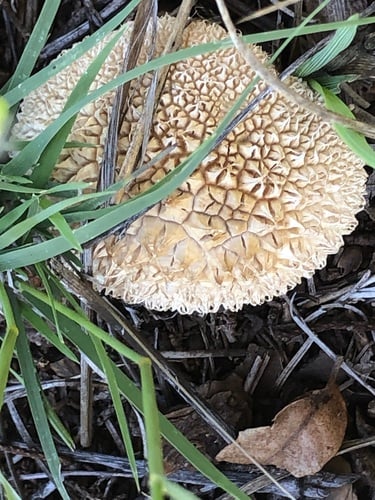
Calvatia cyathiformis
(Bosc.) Morgan
Purple-spored puffball
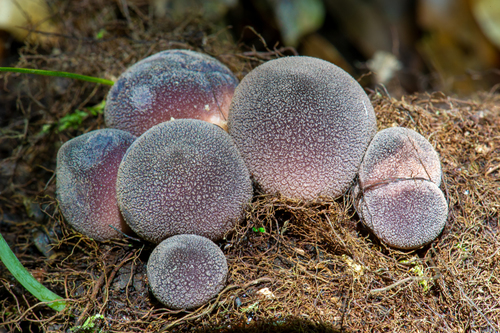
iNaturalist· cc-by-nc
(c) Randy Bodkins, some rights reserved (CC BY-NC), uploaded by Randy Bodkins
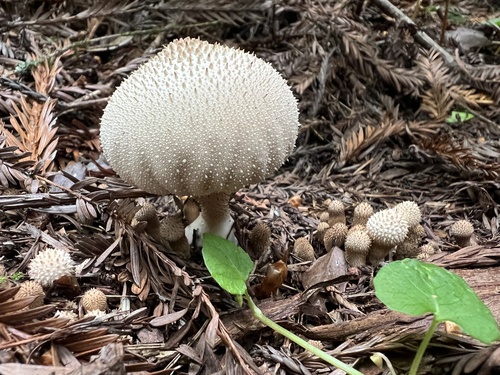
iNaturalist· cc-by-nc
(c) Christian Schwarz, some rights reserved (CC BY-NC), uploaded by Christian Schwarz
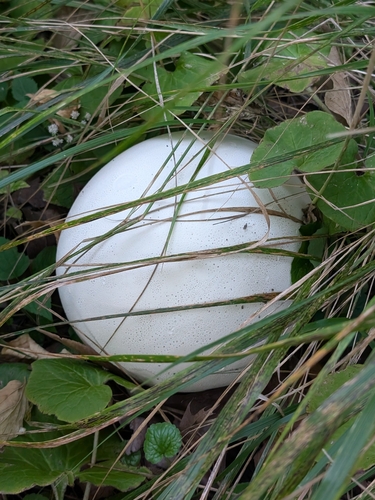
iNaturalist· cc-by-sa
(c) Douglas Goldman, some rights reserved (CC BY-SA), uploaded by Douglas Goldman
Summary
Source: WikipediaCalvatia cyathiformis, or purple-spored puffball, is a large saprobic species of Calvatia. This terrestrial puffball has purplish or purple-brown spores, which distinguish it from other large Agaricales. It is found in North America and Australia, mostly in prairie or grassland environments. It is reportedly edible when young.
Description
A mushroom. It is a puffball fungus.
This description is brief — help expand it
Edible Uses
It is said to be edible until the flesh begins to turn to a tan colour. The puffball has not been noted to have a distinctive odor or taste.
Traditional Uses
It is eaten when very young.
This uses section is brief — help expand it
Distribution
It grows in tropical and subtropical places.
Where It Grows
Africa, Asia, China, Hong Kong, India, Malaysia, Mexico, Nigeria, North America, SE Asia, USA, West Africa,
Notes
There are about 35 Calvatia species. All puffballs or Lycoperdiaceae are considered edible. See Alexopoulos, C.J., 1962, Introductory Mycology. Wiley Toppan. p 521
Dangerous Lookalikes
This plant can be confused with the following toxic species. Always verify identification carefully before consuming any wild plant.
Death Cap (button stage)
Amanita phalloides
Archenzo
Purple-spored puffball
Calvatia cyathiformis
(c) Randy Bodkins, some rights reserved (CC BY-NC), uploaded by Randy Bodkins
Death Cap (button stage): When cut in half reveals developing gills, stem, and cap outline inside the round exterior.
Purple-spored puffball: Uniform pure white flesh when cut in half, no internal structures visible, very large when mature.
Nutrition
| Part | Moisture | kJ | kcal | Protein | Vit A | Vit C | Iron | Zinc |
|---|---|---|---|---|---|---|---|---|
| Mushroom | 5.3 | — | — | 13.2 | — | — | — | — |
Also Known As
Beixing tumabo, Pumus
References (12)
- Abdullah, F. & Rusea, G., 2009, Documentation of inherited knowledge on wild edible fungi from Malaysia. Blumea 54, 35-38
- Aletor, V. A., 1995, Compositional studies on edible tropical species of mushrooms. Food Chemistry 54 (1995) 265-268
- Alonso-Aguilar, L. E., et al, 2014, The cultural significance of wild mushrooms in San Mateo Huexoyucan, Tlaxcala, Mexico. Journal of Ethnobiology and Ethnomedicine, 10:27
- Beckstrom-Sternberg, Stephen M., and James A. Duke. "The Foodplant Database." http://probe.nalusda.gov:8300/cgi-bin/browse/foodplantdb.(ACEDB version 4.0 - data version July 1994)
- Boa, E. R., Wild edible fungi and their importance to people. FAO Non Wood Forest Products Booklet 17
Show all 12 references Hide references
- Hall, I. R., et al, 2003, Edible and Poisonous Mushrooms of the World. Timber Press. p 273
- Kiple, K.F. & Ornelas, K.C., (eds), 2000, The Cambridge World History of Food. CUP p 318
- Purkayastha, 1978,
- Ruan-Soto, F. et al, 2009, Use and handling of wild fungi in two communities of the Lacandona Rainforest, Chiapas, Mexico. Revista Mexicana de Micologia. 29, 2009
- Santiago, F, H., et al, 2016, Traditional knowledge and use of wild mushrooms by Mixtecs or Ñuu savi, the people of the rain, from Southeastern Mexico. Journal of Ethnobiology and Ethnomedicine 12:35 p 8
- Schneider, E., 2001, Vegetables from Amaranth to Zucchini: The essential reference. HarperCollins. p 509
- Yanovsky, E., 1936, Food Plants of the North American Indians. United States Department of Agriculture Miscellaneous Publication No 237. Washington, D.C. p 2