Ehretia cymosa
Thonn.
iNaturalist· cc-by-nc
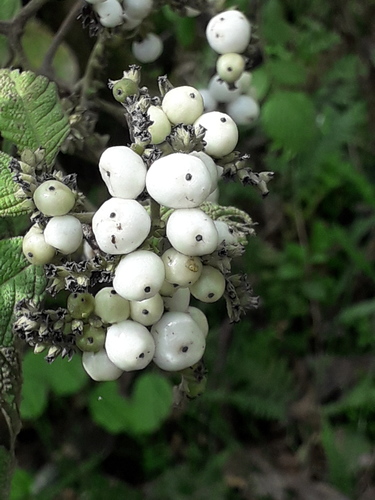
(c) Solofo Eric Rakotoarisoa, some rights reserved (CC BY-NC), uploaded by Solofo Eric Rakotoarisoa
iNaturalist· cc-by-nc
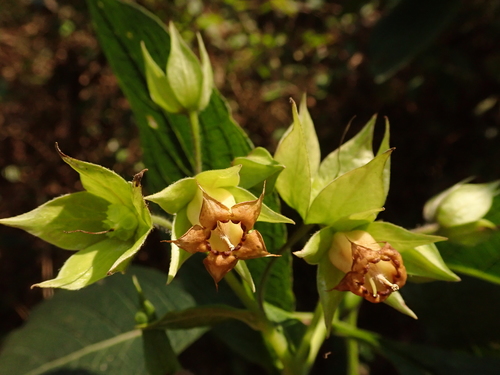
(c) Stephane Philizot, some rights reserved (CC BY-NC), uploaded by Stephane Philizot
iNaturalist· cc-by-nc
(c) merveille, some rights reserved (CC BY-NC)
Summary
Source: WikipediaEhretia cymosa is a small tree belonging to the family Ehretiaceae. It occurs over a wide range of habitat throughout of western, central and eastern Africa, including Benin, Côte d'Ivoire, Cameroon, Ethiopia, Kenya, Comoros, Madagascar, Mascarenes, Zimbabwe and Mozambique.
Description
A shrub or tree. It grows 7 m high. It can have drooping branches. The flowers are small and white. They have a scent. The fruit are red. There are several botanical varieties.
Edible Uses
The small red fruit are eaten, though they have little taste. The leaves are also edible. It serves as a famine food.
Traditional Uses
The small fruit are eaten. They have little taste.
This uses section is brief — help expand it
Medicinal Uses
The leaves are febrifuge, haemostatic and laxative. Sap from the fresh leaves is used as a mild laxative for children. The leaves are commonly used in an infusion with other plants, taken orally and also used as a wash, to treat fevers, children’s convulsions, etc. Leaf poultices are applied to fractured bones to promote healing. The leaf, usually after pounding with that of Newbouldia laevis and a guinea pepper, is tied on the head as a remedy for headaches. The crushed roots, mixed in water, are taken as a treatment against stomach complaints. The root juice is applied to wounds. A decoction of the roots and leaves is used as a treatment for infantile tetanus and dysentery. A decoction of the bark is taken as a remedy for amenorrhoea, and the decoction when left to cool separates to a supernatant layer of oil which is applied to skin-affections. A trace of alkaloid has been detected in the plant (? Leaves).
Known Hazards
The people in some areas of Africa consider the roots and leaves to be toxic to grazing animals, but the leaves are grazed without reports of adverse effects in other areas on the continent.
Distribution
It is a tropical plant. It grows in savannah and secondary jungle.
Where It Grows
Africa, Benin, Central Africa, Central African Republic, CAR, Comoros, Congo, Côte d'Ivoire, East Africa, Ethiopia, Gabon, Ghana, Ivory Coast, Kenya, Mozambique, Nigeria, Rwanda, Sierra Leone, Uganda, West Africa, Zimbabwe,
Cultivation
A fast-growing plant. Trees can be coppiced or pollarded. A variable species with two varieties, var. cymosa and var. zenkeri (Gur?ke) Brenan, recognized in the Region, the former extending to Uganda, the latter to E Cameroon and S. Tome. Other varieties occur in tropical Africa outside the Region.
Propagation
Seed - usually sown in situ within its native range. When sown fresh, the seed can start germinating within 3 days, with some seed taking up to 35 days. The seed can be stored for some time.
Other Uses
The stems are sometimes used as chewsticks to clean the teeth and maintain healthy gums. Ropes can be made from the fibrous bark. The greyish brown wood has alternate darker and lighter bands. It is lustrous; texture is moderately fine and even; the wood is moderately lightweight; and is not durable. The wood is described as perishable. It is, however, used locally to make furniture, cabinet making, poles, tool handles and yokes. The wood is used for fuel and to make charcoal. A natural pioneer species within its native range, where it is often found in secondary forest formations. The tree is sometimes grown to provide shade in coffee plantations. The leaves make a good mulch. The flowers are a good forage for bees.
Other Information
It is a famine food.
Synonyms
Also Known As
Abovro, Alebe, Beleku, Borborrissa, Borborta, Gidiincho, Gotue, Graku, Itriwanje, Jaoke, Kbaasaatso, Kolisha, Lauso, Maqaya, Mine Gure, O-koni, Okosua, Ulaga, Umuruundambaazo
References (14)
- Achigan-Dako, E, et al (Eds), 2009, Catalogue of Traditional Vegetables in Benin. International Foundation for Science.
- Addis, G., Asfaw, Z & Woldu, Z., 2013, Ethnobotany of Wild and Semi-wild Edible Plants of Konso Ethnic Community, South Ethiopia. Ethnobotany Research and Applications. 11:121-141
- Addis, G., et al, 2013, The Role of Wild and Semi-wild Edible Plants in Household Food Sovereignty in Hamer and Konso Communities, South Ethiopia. Ethnobotany Research & Applications. 11:251-271
- Ashagre, M., et al, 2016, Ethnobotanical study of wild edible plants in Burji District, Segan Area Zone of Southern Nations, Nationalities and Peoples Region (SNNPR), Ethiopia. Journal of Ethnobiology and Ethnomedicine (2016) 12:32
- Bahru, T., et al, 2013, Wild Edible Plants: Sustainable Use and Management by Indigenous Communities in and the Buffer Area of Awah National Park, Ethiopia. Ethiop. J. Sci., 36(2): 93-108
Show all 14 references Hide references
- Balemie, K., & Kebebew, F., 2006, Ethnobotanical study of wild edible plants in Derashe and Kucha Districts, South Ethiopia. Journal of Ethnobiology and Ethnomedicine. p 4
- Burkill, H. M., 1985, The useful plants of west tropical Africa, Vol. 1. Kew.
- Dansi, A., et al, 2008, Traditional leafy vegetables and their use in the Benin Republic. Genet Resour Crop Evol (2008) 55:1239–1256
- Le Houerou, H. N., (Ed.), 1980, Browse in Africa. The current state of knowledge. International Livestock Centre for Africa, Ethiopia. p 161
- Lulekal, E., et al, 2011, Wild edible plants in Ethiopia: a review on their potential to combat food insecurity. Afrika Focus - Vol. 24, No 2. pp 71-121
- Ocho, D. L., et al, 2012, Assessing the levels of food shortage using the traffic light metaphor by analyzing the gathering and consumption of wild food plants, crop parts and crop residues in Konso, Ethiopia. Journal of Ethnobiology and Ethnomedicine 8:30
- Sina, B. & Degu, H. D., 2015, Knowledge and use of Wild Edible Plants in the Hula District of the Sidama Zone. International Journal of Bio-resource and Stress Management 6(3):352-365
- von Katja Rembold, 2011, Conservation status of the vascular plants in East African rain forests. Dissertation Universitat Koblenz-Landau p 166
- World Checklist of Useful Plant Species 2020. Royal Botanic Gardens, Kew