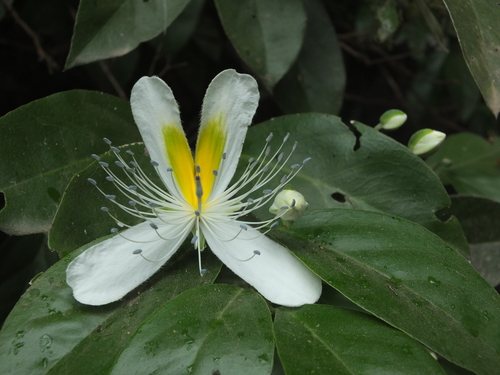
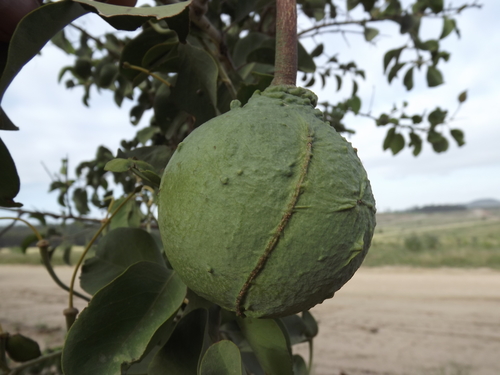
Maerua parvifolia
Pax
Dwarf cherry-bush, Small-leaved maerua
iNaturalist· cc-by-nc
(c) pawsafaris, some rights reserved (CC BY-NC)
iNaturalist· cc-by-nc
(c) Dewald du Plessis, some rights reserved (CC BY-NC)
iNaturalist· cc-by-nc
(c) Dewald du Plessis, some rights reserved (CC BY-NC)
Description
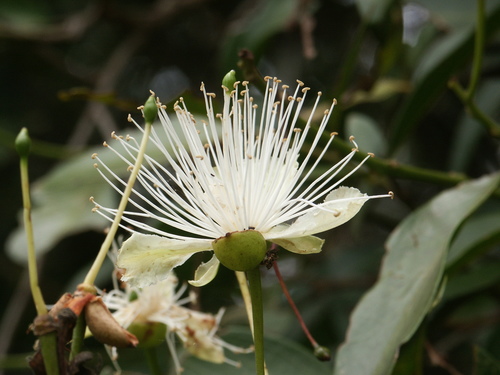
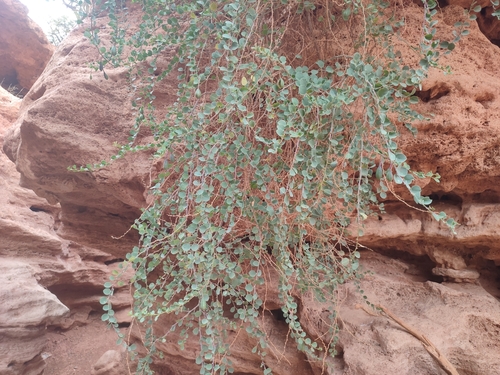
A small shrub. It grows 2 m tall. The branches are stiff and rigid. There can be hairs. The leaves are alternate on short side branches. The leaf is simple and up to 1,5 cm long by 0.5 cm wide. They are narrowly oval. The flowers occur singly or in pairs on short side shoots. The fruit are 4.5 cm long by 0.7 cm wide. They are hairy. They hang down and are constricted between the seeds.
Edible Uses
The fruit are eaten as a snack, and the root is used as a substitute for chicory.
Traditional Uses
The root is used as a substitute for chicory. The fruit are eaten as a snack.
This uses section is brief — help expand it
Distribution
It is a tropical plant. It grows in drier types of woodland. It also grows on termite mounds. It grows from low altitude up to 1,200 m altitude. It grows in areas with a rainfall of between 100-350 mm per year. It grows in areas with a dry season of 8-11 months. It re-grows after fire. It can grow in arid places.
Where It Grows
Africa, Angola, Botswana, Central Africa, East Africa, Eswatini, Kenya, Malawi, Mozambique, Namibia, South Africa, Southern Africa, Sudan, Swaziland, Tanzania, Uganda, Zambia, Zimbabwe,
Synonyms
Also Known As
Mnogonogo, Msingisa, Nongonongo, Pisipisi
References (8)
- Fowler, D. G., 2007, Zambian Plants: Their Vernacular Names and Uses. Kew. p 16
- Fox, F. W. & Young, M. E. N., 1982, Food from the Veld. Delta Books. p 145
- Long, C., 2005, Swaziland's Flora - siSwati names and Uses http://www.sntc.org.sz/flora/
- Mannheimer, C. A. & Curtis. B.A. (eds), 2009, Le Roux and Muller's Field Guide to the Trees and Shrubs of Namibia. Windhoek: Macmillan Education Namibia. p 68
- Royal Botanic Gardens, Kew (1999). Survey of Economic Plants for Arid and Semi-Arid Lands (SEPASAL) database. Published on the Internet; http://www.rbgkew.org.uk/ceb/sepasal/internet [Accessed 7th April 2011]
Show all 8 references Hide references
- Ruiters-Welcome, A. K., 2019, Food plants of southern Africa. Ph.D. thesis. Univ. of Johannesburg p 42
- Welcome, A. K. & Van Wyk, B.-E., 2019, An inventory and analysis of the food plants of southern Africa. South African Journal of Botany 122 (2019) 136–179
- World Checklist of Useful Plant Species 2020. Royal Botanic Gardens, Kew