Callistemon citrinus
(Curtis) Skeels
Lemon-scented Bottlebrush
iNaturalist· cc-by-nc
(c) Taylor, some rights reserved (CC BY-NC)
iNaturalist· cc-by-nc
(c) Taylor, some rights reserved (CC BY-NC)
iNaturalist· cc-by-nc
(c) Taylor, some rights reserved (CC BY-NC)
Summary
Source: WikipediaEvergreen shrub reaching 4.5 m tall and 2.5 m wide, growing at medium rate. Year-round foliage with hermaphroditic flowers July to August. Hardy to UK zone 9. Accommodates light sandy, medium loamy, and heavy clay soils with good drainage. Grows in mildly acid, neutral, and very acid conditions. Requires full sun and tolerates dry, moist, or wet soils, including drought.
Description
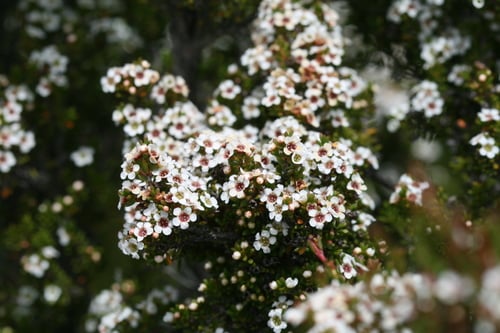
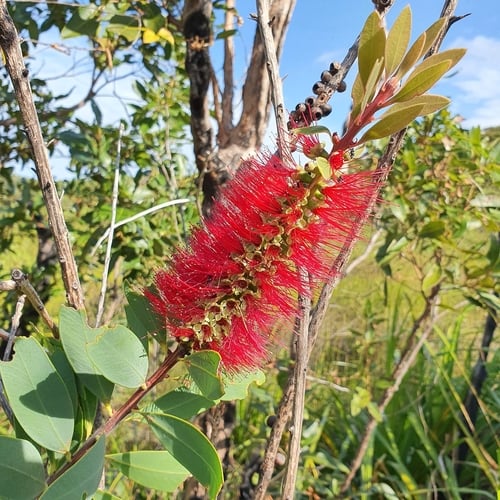
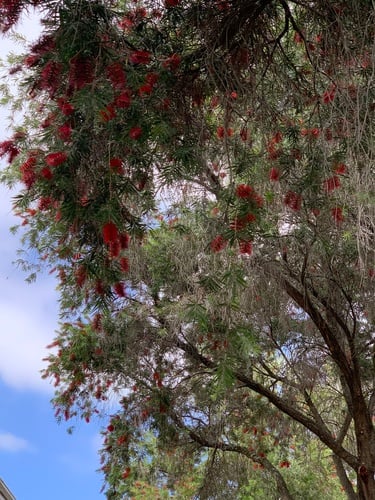
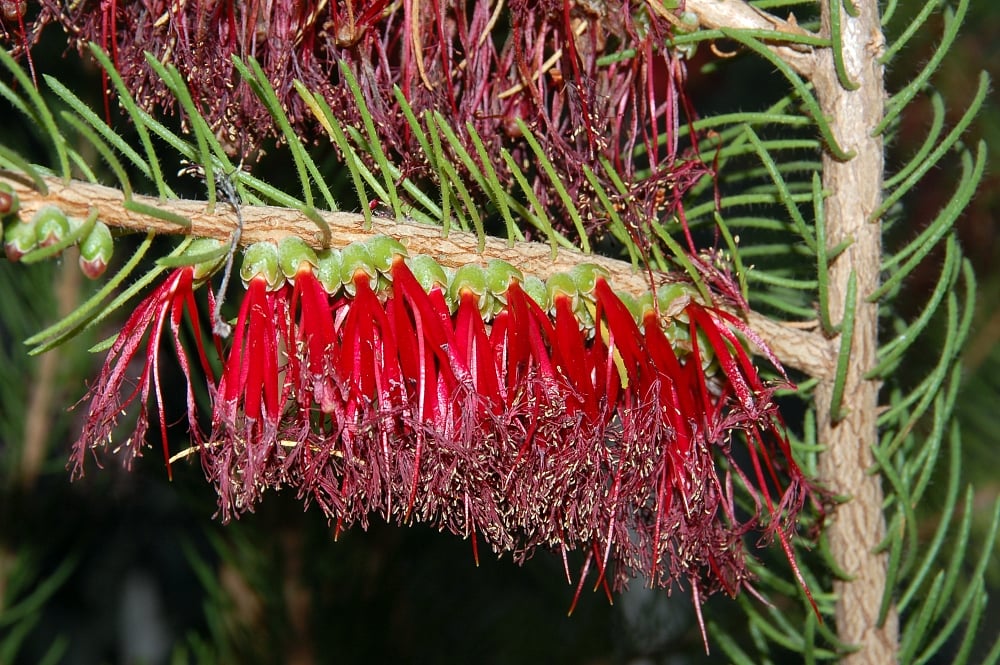
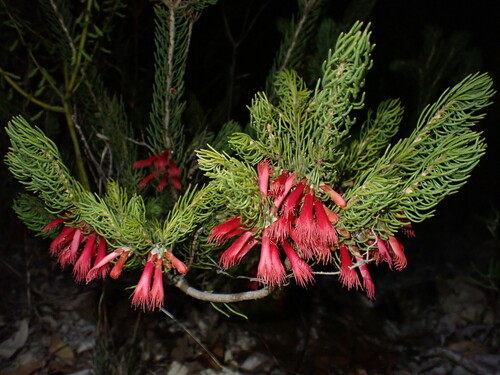
An erect shrub or small tree. It grows 2-6 m high. The branches are rigid. The leaves are broadly sword shaped. They are 3-7 cm long and 8 mm wide. They have a prominent midrib ending in a small point. The bruised leaves have a lemon scent. The flowers are deep red and in dense spikes. These are 6-10 cm long and 6 cm wide. The fruit is a woody capsule 7 mm across. It is rounded but slightly flattened at the top.
Edible Uses
Edible Parts: Edible Uses: Tea The leaves are a tea substitute and have a delightfully refreshing flavour.
Medicinal Uses
None known
Distribution
It is common in coastal districts. It is usually in swampy situations and along streams. It can grow in moderate to poor soils as long as they are well-drained. It needs full sun. It can stand some coastal exposure. It is moderately salt tolerant. It can stand temperatures down to near 0°C. It suits hardiness zones 8-11. Adelaide Botanical Gardens. Arboretum Tasmania.
Where It Grows
Africa, Asia, Australia*, Canada, East Africa, Hawaii, India, Indochina, Indonesia, Laos, Marquesas, Mediterranean, Mozambique, Myanmar, Nepal, New Zealand, North America, Pacific, Pakistan, SE Asia, Tanzania, Tasmania, United Arab Emirates, UAE, USA,
Cultivation
They can be grown from seed or tip cuttings. It can also be grown by air-layering.
Propagation
Seed - surface sow in February in a shaded part of the greenhouse. Cover with paper and stand the pots in a few centimetres of water until germination takes place. Remove from the water tray as soon as the seed germinates. Seedlings are prone to damp off and must be watered with care and kept well ventilated. When large enough to handle, prick the seedlings out into individual pots and grow them on in the greenhouse for at least their first winter, planting them out into their permanent positions in late spring or early summer, after the last expected frosts. Cuttings of half-ripe wood,7 - 10cm with a heel, July/August in a frame. Poor results.
Other Uses
Dye Wood A tan dye is obtained from the flowers, it does not require a mordant, and is green when mordanted. Other members of this genus can also be used. A cinnamon dye is obtained from the leaves. Other members of this genus can also be used. Wood - hard, heavy, tough, close grained, but too small for economic use. Used for tool handles etc. It is also used for fuel. Special Uses Espalier Scented Plants
Production
It is fast growing.
Notes
There are about 25-30 Callistemon species.
Synonyms
Also Known As
Crimson Bottlebrush, Fershet al-zejaj, Kalki phul, Payoksi-bin, Pohon sikatbotol merah, Scarlet bottlebrush
References (29)
- Blamey, M and Grey-Wilson, C., 2005, Wild flowers of the Mediterranean. A & C Black London. p 151
- Blomberry, A.M., 1979, Australian Native Plants. Angus and Robertson p
- Bodkin, F., 1991, Encyclopedia Botanica. Cornstalk publishing, p 195
- Brickell, C. (Ed.), 1999, The Royal Horticultural Society A-Z Encyclopedia of Garden Plants. Convent Garden Books. p 207
- Cronin, L., 1989, The Concise Australian Flora. Reed. p 59
Show all 29 references Hide references
- Cundall, P., (ed.), 2004, Gardening Australia: flora: the gardener's bible. ABC Books. p 284
- Dharani, N., 2002, Field Guide to common Trees & Shrubs of East Africa. Struik. p 62
- Elliot, W.R., & Jones, D.L., 1982, Encyclopedia of Australian Plants suitable for cultivation. Vol 2. Lothian. p 413
- Etherington, K., & Imwold, D., (Eds), 2001, Botanica's Trees & Shrubs. The illustrated A-Z of over 8500 trees and shrubs. Random House, Australia. p 157
- Greig, D., 1996, Flowering Natives for Home Gardens. Angus & Robertson. p 94
- Grieg, D., 2002, A photographic guide to Wildflowers of South-eastern Australia. New Holland. p 77
- Hibbert, M., 2002, The Aussie Plant Finder 2002, Florilegium. p 49
- Holliday, I., 1979, A Field Guide to Australian Native Shrubs. Rigby. p 44
- Jabeen, A., et al, 2009, Indigenous uses of economically important flora of Margallah Hills National Park, Islamabad, Pakistan. African Journal of Biotechnology Vol. 8 (5), pp. 763-784
- Joyce, D., 1998, The Garden Plant Selector. Ryland, Peters and Small. p 127
- Karim, F. M. & Dakheel, A, J., 2006, Salt-tolerant plants of the United Arab Emirates. 2006. International Center for Biosaline Agriculture, Dubai, UAE. p 131
- Lazarides, M. & Hince, B., 1993, Handbook of Economic Plants of Australia, CSIRO. p 42
- Llamas, K.A., 2003, Tropical Flowering Plants. Timber Press. p 283
- Lord, E.E., & Willis, J.H., 1999, Shrubs and Trees for Australian gardens. Lothian. p 153
- Mbuya, L.P., Msanga, H.P., Ruffo, C.K., Birnie, A & Tengnas, B., 1994, Useful Trees and Shrubs for Tanzania. Regional Soil Conservation Unit. Technical Handbook No 6. p 154
- Molyneux, B & Forrester, S., 1997, The Austraflora A-Z of Australian Plants. Reed. p 59
- Purseglove, J.W., 1968, Tropical Crops Dicotyledons, Longmans. p 398
- Smith, K & I., 1999, Grow your own bushfoods. New Holland. Australia. p 109
- Staples, G.W. and Herbst, D.R., 2005, A tropical Garden Flora. Bishop Museum Press, Honolulu, Hawaii. p 418
- Steenbeeke, Greg as part of the Plants Directory project. List of plant species from northern NSW that may be used as food plants p 14
- Swaminathan, M.S., and Kochnar, S.L., 2007, An Atlas of Major Flowering Trees in India. Macmillan. p 147
- U.S.D.A. Bur. Pl. Industr. Bull. 282:49. 1913 (Stapf, Bot. Mag. 150: t. 9050. 1925)
- World Checklist of Useful Plant Species 2020. Royal Botanic Gardens, Kew (As Melaleuca citrina)
- Young, J., (Ed.), 2001, Botanica's Pocket Trees and Shrubs. Random House. p 165