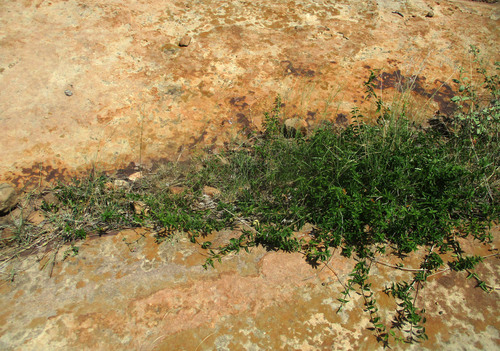
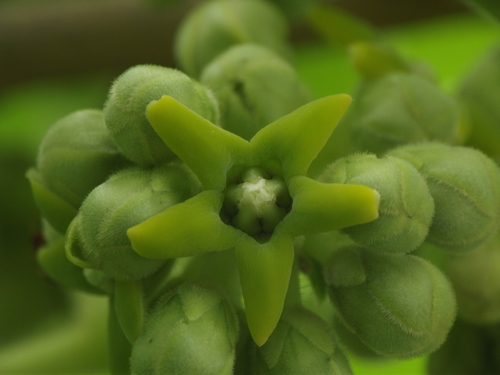
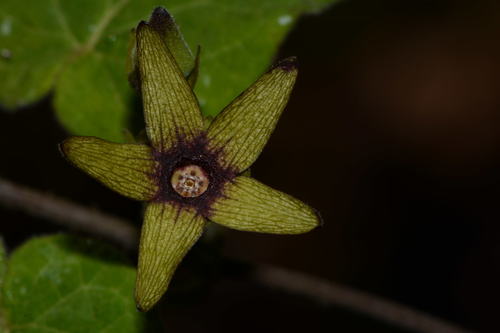
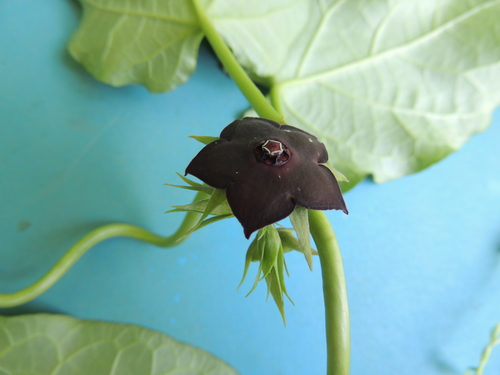
Ceropegia linearis
E. Mey.
Rosary vine, Chain of hearts
iNaturalist· cc-by-nc
(c) João Loureiro, some rights reserved (CC BY-NC), uploaded by João Loureiro
iNaturalist· cc-by-nc
(c) Roddy CJ Ward, some rights reserved (CC BY-NC), uploaded by Roddy CJ Ward
iNaturalist· cc-by-nc
(c) thinus, some rights reserved (CC BY-NC), uploaded by thinus
Summary
Source: WikipediaCeropegia linearis, also known as string-of-needles, is a species of flowering plant in the family Apocynaceae, native to Southern Africa. The popular houseplant Ceropegia woodii is sometimes treated as a subspecies of C. linearis, as C. linearis subsp. woodii. It has gained the Royal Horticultural Society's Award of Garden Merit.
Description
A creeping and climbing herb. It is often grown as a hanging basket. The leaves can be 3-4 cm long.
This description is brief — help expand it
Edible Uses
The stems are valued for their water content, and the roots and tubers are edible.
Medicinal Uses
A decoction of leafy stems is taken to treat chest complaints.
Distribution
It is a subtropical plant.
Where It Grows
Africa, East Africa, Eswatini, Kenya, Mozambique, South Africa*, Southern Africa, Swaziland, Tanzania, Zimbabwe,
Cultivation
Succeeds in full sun and in light shade. Requires a well-drained soil[. The amount of moisture available to the plant determines the colour and thickness of the leaves. Plants kept moist have thin, solid green leaves. When it gets drier, the leaves thicken and get their silvery coating - this is probably used to reflect some of the sun to decrease temperature stress.
Propagation
Seed - best sown as soon as it is ripe. Division of the small tubers which form along the stem at the leaf bases. These tubers can be planted to produce new vines - just press them into the soil, and keep moist but not wet. The tubers root more quickly if they are still attached to the mother plant. Once rooted and growing, the new plant can be easily severed from the parent.
Other Uses
The stem tubers are used as stock for grafting difficult stem succulents..
Notes
Also put in the family Asclepiadaceae.
Synonyms
References (1)
- Long, C., 2005, Swaziland's Flora - siSwati names and Uses http://www.sntc.org.sz/flora/