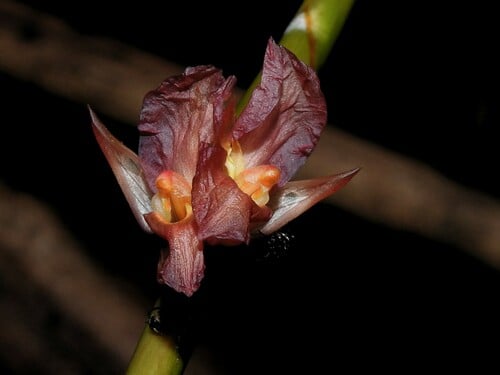
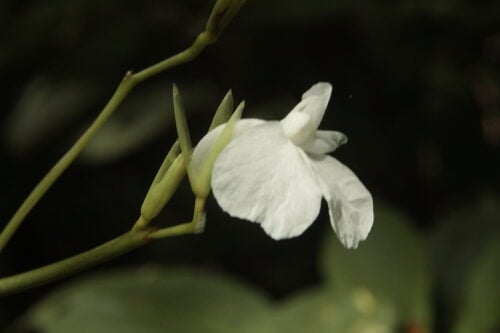
Calathea allouia
(Aubl.) Lindl.
Guinea arrowroot
iNaturalist· cc0
no rights reserved
iNaturalist· cc-by-nc
(c) Luis Humberto Vicente-Rivera, some rights reserved (CC BY-NC)
iNaturalist· cc-by-nc
(c) Luis Humberto Vicente-Rivera, some rights reserved (CC BY-NC)
Summary
Calathea allouia is a tender evergreen perennial reaching 2 m tall by 1 m wide at moderate growth rate, hardy to UK zone 10 only. It accommodates light sandy, medium loamy, and heavy clay soils with good drainage and grows across a wide pH range from very acid to very alkaline. The plant tolerates semi-shade to full light and prefers consistently moist soil.
Description
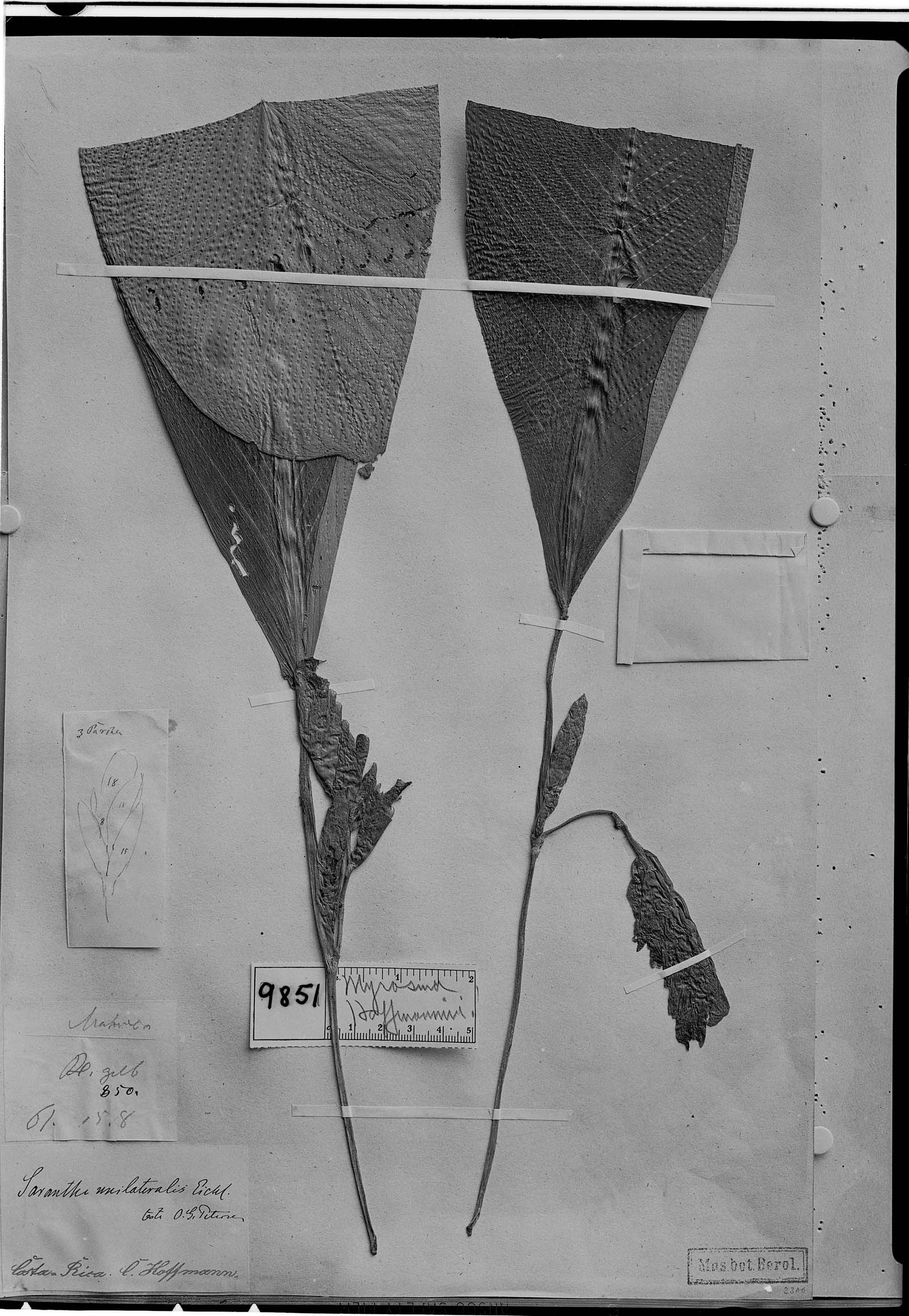
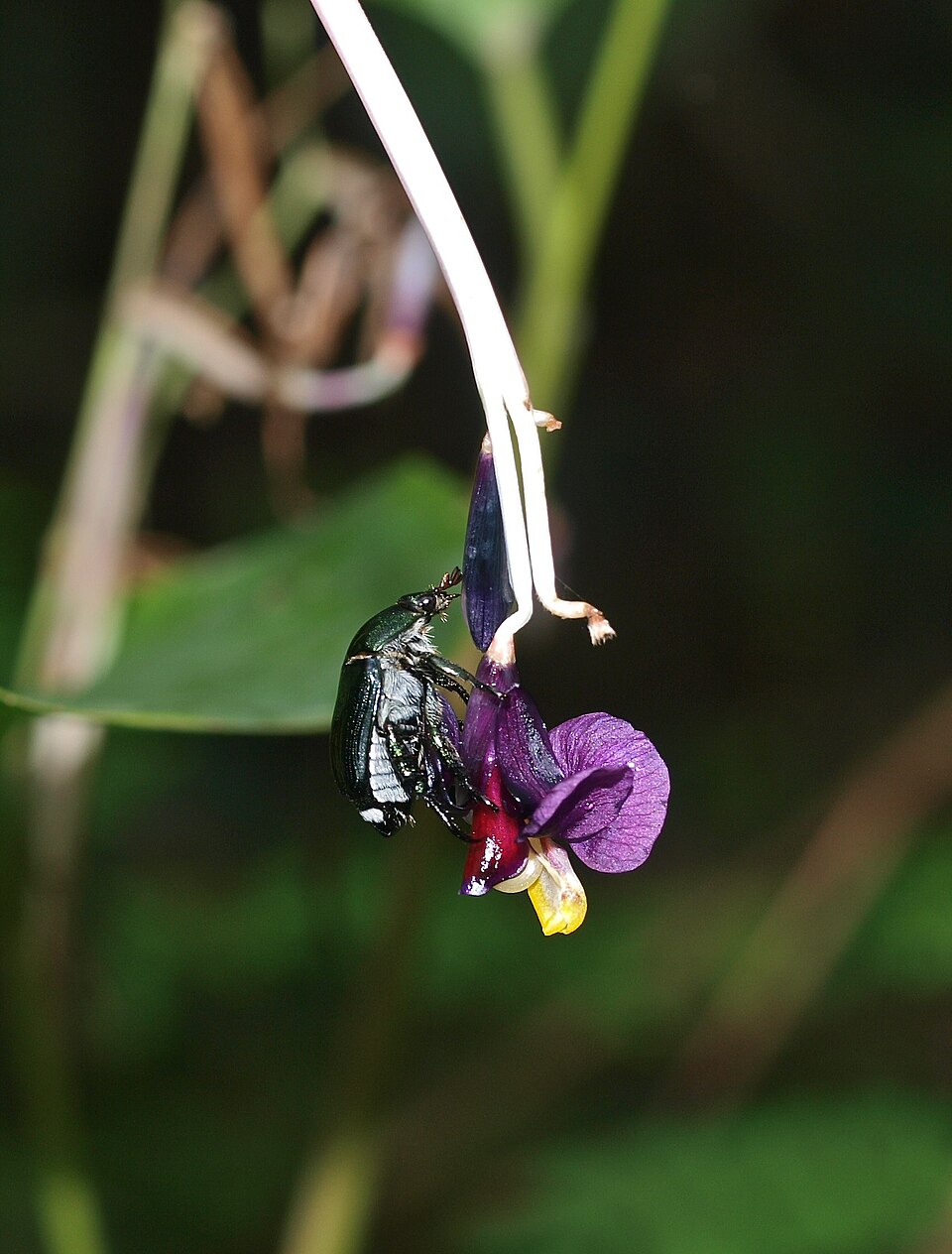
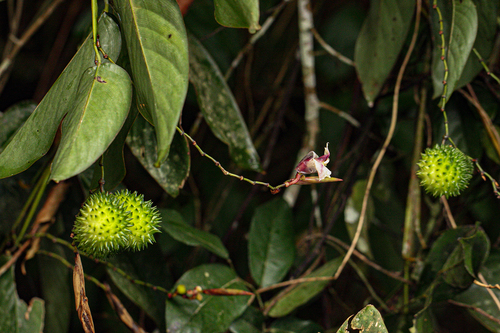
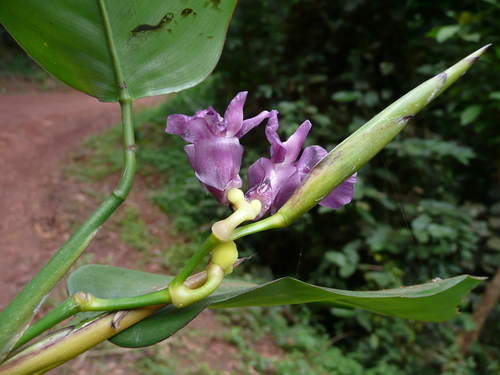
A herb. It keeps growing from year to year. It grows 1.5 m high. It has an underground rhizome or stem. There are several large leaves. The leaf is oblong and 20-60 cm long by 5-20 cm wide. The flowering stalk is 5-10 cm long. The flowers are in a spiral. They are white. The underground tubers are 1-5 cm long and 0.5-3 cm wide. They can be larger. They are covered with a yellowish-grey paper like skin. The tubers develop at the ends of the fibrous roots.
Edible Uses
Edible Parts: Flowers Leaves Root Edible Uses: Edible portion: Tubers, Root, Flowers, Leaves - flavour, Vegetable. Root - cooked. Rich in starch. The crisp cooked tubers are very agreeable with a flavour like sweetcorn. It is used in salads, stews and fish dishes. Their unique texture makes them a gourmet item. Used in similar ways to potatoes. A commercially cultivated vegetable. The tubers are 2 - 8cm long and 2 - 4cm in diameter. Young tender flower spikes - cooked. The leaves are used for wrapping tamales and other foods, to which they impart flavour. Tubers are 6.6% protein on a dry matter basis.
Traditional Uses
The tubers are cooked and eaten. It is used in salads, stews and fish dishes. Young flower clusters are cooked and eaten. The leaves are used to wrap food to add flavour.
Medicinal Uses
None known
Distribution
It is a tropical plant. It requires a hot, even temperature. It does best with temperatures between 25-30°C. It needs a moderate rainfall. (1500-2000 mm). When there is plenty of humidity, nutrients and good soil drainage, plants do best in full sunlight. It is often grown in shade. They need soils rich in organic matter. In SE Asia it probably grows up to 600 m altitude. In Guatemala it grows to 1,400 m above sea level. Brisbane Botanical Gardens.
Where It Grows
Africa, Amazon, Antilles, Asia, Australia, Belize, Brazil, Caribbean, Central America, Colombia, Costa Rica, Cuba, Dominican Republic, East Africa, Ecuador, Egypt, El Salvador, Grenada, Guadeloupe, Guatemala, Guiana, Guyana, Haiti, Hispaniola, Honduras, India, Indochina, Indonesia, Madagascar, Malaysia, Martinique, Mexico, Nicaragua, North Africa, North America, Pacific, Panama, Peru, Philippines, Puerto Rico, SE Asia, South America, Sri Lanka, St Lucia, St. Vincent and Grenadines, Trinidad and Tobago, Trinidad, Venezuela, Vietnam, West Indies,
Cultivation
Plants are grown from rhizomes, suckers or offshoots. Plants only occasionally flower and do not produce viable seed. The tuberous roots are stored in a coo, dry place until they are transplanted. Plants are spaced about 0.5 m apart. The rhizomes produce about 20 shoots around them.
Propagation
Seed - Division of tubers Cuttings of basal shoots.
Other Uses
Basketry Other uses rating: Low (1/5). In former times, the plant played a more important role for making blankets, mattresses, pillows, baskets and umbrellas. Special Uses
Production
A crop of tubers is ready 10-12 months after planting. Yields of 10 tonnes per hectare are possible. Yields per plant vary between 100 and 2,200 g.
Other Information
It is a commercially cultivated vegetable. They are sold in street markets.
Notes
Tubers are 6.6% protein on a dry matter basis. There are 260-300 Calathea species in tropical America.
Synonyms
Also Known As
Agua bendita, Allelouia, Alleluia, Alluia, Aria, Chufle, Cocurito, Curcuma d'Amerique, Dale dale, Dali dali, Guinea arrowroot, Lairem, Laren, Leren, Lerenes, Lleren, Sweet corn root, Sweet corn tuber, Sweet-corm-root, Toompinanpur, Topee Tambu, Topi-tambu, Topinambour, Sehui
References (27)
- Bircher, A. G. & Bircher, W. H., 2000, Encyclopedia of Fruit Trees and Edible Flowering Plants in Egypt and the Subtropics. AUC Press. p 73 (Also as Calathea violacea)
- Bot. Reg. 14: t. 1210. 1829
- Burkill, I.H., 1966, A Dictionary of the Economic Products of the Malay Peninsula. Ministry of Agriculture and Cooperatives, Kuala Lumpur, Malaysia. Vol 1 (A-H) p 406
- Cobley, L.S. (rev. Steele, W.M.) 2nd Ed., 1976, An Introduction to the Botany of Tropical Crops. Longmans. p 127
- Ekman Herbarium records Haiti
Show all 27 references Hide references
- Facciola, S., 1998, Cornucopia 2: a Source Book of Edible Plants. Kampong Publications, p 148
- Gragson, T. L., 1997, The Use of Underground Plant Organs and Its Relation to Habitat Selection among the Pume Indians of Venezuela. Economic Botany, Vol. 51, No. 4, pp. 377-384
- Hedrick, U.P., 1919, (Ed.), Sturtevant's edible plants of the world. p 142
- Hermandez Bermejo, J.E., and Leon, J. (Eds.), 1994, Neglected Crops. 1492 from a different perspective. FAO Plant Production and Protection Series No 26. FAO, Rome. p 20, 239
- INFOODSUpdatedFGU-list.xls
- Kay, D.E., 1973, Root Crops, Digest 2, Tropical Products Institute, London, p 180
- Kays, S. J., and Dias, J. C. S., 1995, Common Names of Commercially Cultivated Vegetables of the World in 15 languages. Economic Botany, Vol. 49, No. 2, pp. 115-152
- Kiple, K.F. & Ornelas, K.C., (eds), 2000, The Cambridge World History of Food. CUP p 1782
- Lim, T. K., 2015, Edible Medicinal and Non Medicinal Plants. Volume 9, Modified Stems, Roots, Bulbs. Springer p 20
- Macmillan, H.F. (Revised Barlow, H.S., et al) 1991, Tropical Planting and Gardening. Sixth edition. Malayan Nature Society. Kuala Lumpur. p 336
- Martin, F.W., and Cabanillas, E., 1976, Leren (Calathea allouia), a little known tuberous Root crop of the Caribbean. Economic Botany 30:249-256.
- PROSEA handbook Volume 9 Plants yielding non-seed carbohydrates. p168
- Purseglove, J.W., 1972, Tropical Crops. Monocotyledons. Longmans p 335
- Smith, N., Mori, S.A., et al, 2004, Flowering Plants of the Neotropics. Princeton. p 459
- Smith, P.M., 1979, Topee tambu, in Simmonds, N.W., (ed), Crop Plant Evolution. Longmans. London. p 316
- Staples, G.W. and Herbst, D.R., 2005, A tropical Garden Flora. Bishop Museum Press, Honolulu, Hawaii. p 697
- Terra, G.J.A., 1973, Tropical Vegetables. Communication 54e Royal Tropical Institute, Amsterdam, p 34
- Torre, de la, L., et al, 2008, Enciclopedia de las Plantas Útiles del Ecuador. Herbario QCA. Pontificia Universidad Católica del Ecuador. p 416
- USDA, ARS, National Genetic Resources Program. Germplasm Resources Information Network - (GRIN). [Online Database] National Germplasm Resources Laboratory, Beltsville, Maryland. Available: www.ars-grin.gov/cgi-bin/npgs/html/econ.pl (10 April 2000)
- Vael, L., 2015, Ethnobotanical study of the plant use in the natural landscape of two mestizo communities in the Ucayali region of the Peruvian Amazon. Universiteit Gent.
- van Wyk, B., 2005, Food Plants of the World. An illustrated guide. Timber press. p 386
- Villachica, H., (Ed.), 1996, Frutales Y hortalizas promisorios de la Amazonia. FAO, Lima. p 323