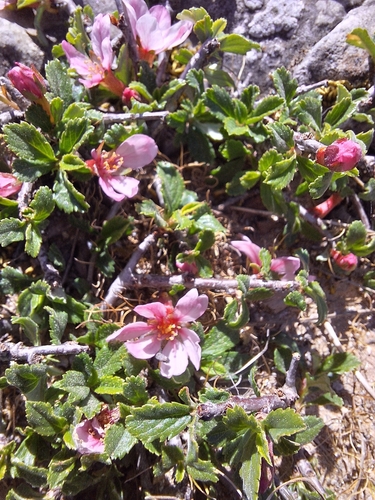
Rubus leucanthus
Hance
iNaturalist· cc-by-nc
(c) travischung, some rights reserved (CC BY-NC)
iNaturalist· cc-by-nc
(c) Outdoor Wildlife Learning Hong Kong, some rights reserved (CC BY-NC), uploaded by Outdoor Wildlife Learning Hong Kong
Description
A climbing shrub. It grows 1-3 m tall. The branches are brown with sparse curved prickles. The leaves have leaflets along the stalk and one at the end. There are 3 leaflets. The leaflets are narrowly oval and 4-8 cm long by 2-4 cm wide. The flowers are in groups or 3-8 at the ends of branches. The flowers are 1-1.5 cm across and the petals are white. The fruit is aggregate and red. They are 1-1.5 cm across.
Edible Uses
Fruit - raw or cooked. A raspberry-like fruit. The red, subglobose fruit is around 10 - 15mm in diameter.
Medicinal Uses
The roots are used medicinally.
Distribution
In China it grows in southern provinces between 1,000-2,500 m altitude. In Yunnan.
Where It Grows
Asia, Cambodia, China, Indochina, Laos, SE Asia, Thailand, Vietnam,
Cultivation
Rubus leucanthus is native to the warm temperate and tropical zones from southern China into southeast Asia. It only succeeds outdoors in the mildest regions of the temperate zone. Species in this genus are generally easily grown in a good well-drained loamy soil in sun or semi-shade. Plants in this genus are notably susceptible to honey fungus.
Propagation
Seed - germinates best if given a period of cold stratification prior to sowing in containers. Stored seed requires one month stratification at about 3°c and is best sown as early as possible in the growing season. Prick out the seedlings when they are large enough to handle and grow on until large enough to plant out. Cuttings of half-ripe wood in a frame. Tip layering towards the end of the growing season Division just before the plant comes into new growth or as it enters dormancy.
Production
In China plants flower in April to May and fruit in June to July.
Dangerous Lookalikes
This plant can be confused with the following toxic species. Always verify identification carefully before consuming any wild plant.
Red Baneberry
Actaea rubra
Walter Siegmund (talk)
Rubus leucanthus
Rubus leucanthus
(c) travischung, some rights reserved (CC BY-NC)
Red Baneberry: Short herbaceous plant (no thorns), berries on thick red stems, each berry has a single seed, compound sharply-toothed leaves.
Rubus leucanthus: Thorny woody canes (brambles), aggregate berry made of many drupelets, berries pull easily from receptacle.
Synonyms
Also Known As
Bai hua xuan gou zi, Dum hoa-trang, Ngay trang
References (1)
- Flora of China. 9:195-285, 2003