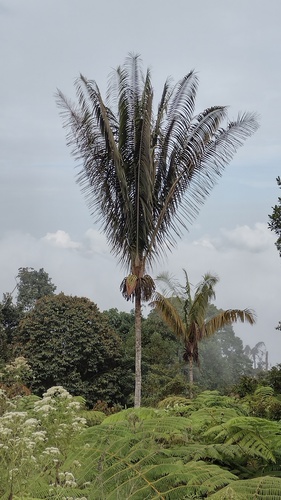
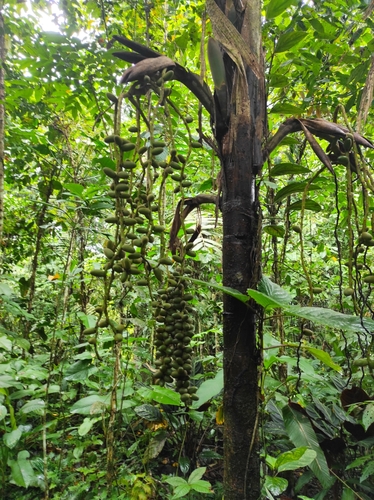
Calamus muelleri
H. Wendl.
Wait-a-while, Southern Lawyer vine
iNaturalist· cc-by-sa
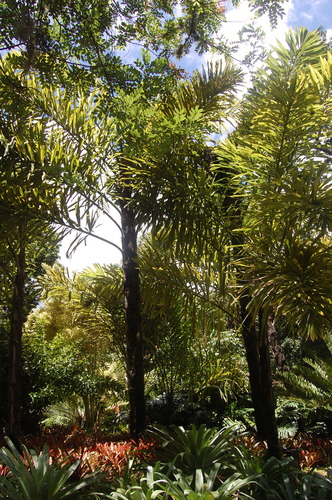
(c) Greg Tasney, some rights reserved (CC BY-SA), uploaded by Greg Tasney
iNaturalist· cc-by-nc
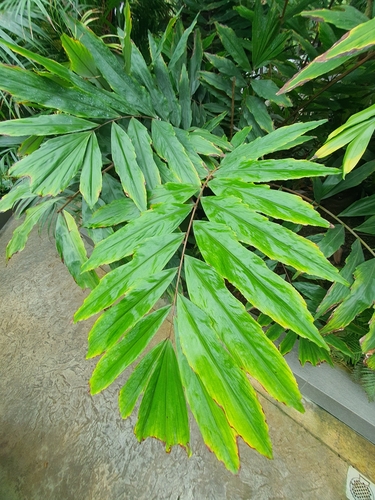
(c) kaiyapaige, some rights reserved (CC BY-NC)
iNaturalist· cc-by-nc
(c) Martin Bennett, some rights reserved (CC BY-NC)
Summary
Source: WikipediaCalamus muelleri, commonly known as southern lawyer cane or wait-a-while, is a climbing palm with a vine-like habit, endemic to the subtropical coastal rainforests of northern New South Wales and southern Queensland. Sharp hooks on the plant can snag the clothing of walkers in these forests, giving rise to the name "wait-a-while".
Description
A tall slender palm or rattan. It forms clumps and climbs. A number of stems arise each year from an underground rhizome. The stems are thorny. They are green but turn brown with age. Stems can be 10-15 m long. They can grow to 180 m long. Stems are about 1 cm wide. There are slender, flexible climbing structures growing from the leaf sheath opposite the leaf. These can be 1-2 m long and have backwards curving thorns. The leaves are distributed along the stem at fairly wide intervals. The leaves are 30-100 cm long divided into 10-19 leaflets along the stalk. These are dark green on both surfaces. The 4 leaflets at the end are in a group. The leaflets are 10-20 cm long and 15-20 mm wide. The flowering stalk is long and slender and hangs downwards. It has a thorny stalk at the end which can be 3 m long. Several flowering stalks normally occur on the same plant at the one time. The flowers are 3-4 mm across. Male and female flowers occur on separate plants. The fruit are cream or green and round. They are 8-15 mm across and covered with overlapping scales. They have a thin dry outer coat over one seed.
Edible Uses
The fleshy layer of the fruit is eaten.
Traditional Uses
The fleshy layer of the fruit is eaten.
This uses section is brief — help expand it
Distribution
It is a subtropical plant. It grows in wet rainforests. They do best in a warm, shady site. They need a rich, well-drained soil. They will tolerate mild frosts when older. Melbourne Botanical Gardens. It suits hardiness zones 9-12.
Where It Grows
Australia*,
Cultivation
Plants can be grown from seed which should be sown while fresh. Seed normally germinate within 6 months. Seedlings do not transplant easily.
Notes
There are 375-400 Calamus species. There are 175 species in tropical Asia.
Synonyms
References (14)
- Blomberry, A. & Rodd, T., 1982, Palms. An informative practical guide. Angus & Robertson. p 70
- Cribb, A.B. & J.W., 1976, Wild Food in Australia, Fontana. p 63
- Cronin, L., 1989, The Concise Australian Flora. Reed. p 234
- Cronin, L., 2000, Australian Palms, Ferns, Cycads and Pandans. Cronin Publications. p 74
- Cundall, P., (ed.), 2004, Gardening Australia: flora: the gardener's bible. ABC Books. p 278
Show all 14 references Hide references
- Edible and Useful Native Plants (off internet)
- Greig, D., 1996, Flowering Natives for Home Gardens. Angus & Robertson. p 92
- Haslam, S., 2004, Noosa's Native Plants. Noosa Integrated Catchment Assn. Inc. p 328
- Hibbert, M., 2002, The Aussie Plant Finder 2002, Florilegium. p 48
- Jones, D.L. & Gray, B., 1977, Australian Climbing Plants. Reed. p 82
- Jones, D.L., 1994, Palms throughout the World. Smithtonian Institution, Washington. p 157
- Jones, D.L., 2000, Palms of Australia 3rd edition. Reed/New Holland. p 81
- Nicholson, N & H., 1996, Australian Rainforest Plants 3, Terania Rainforest Publishing. NSW. p 12
- Riffle, R.L. & Craft, P., 2003, An Encyclopedia of Cultivated Palms. Timber Press. p 285