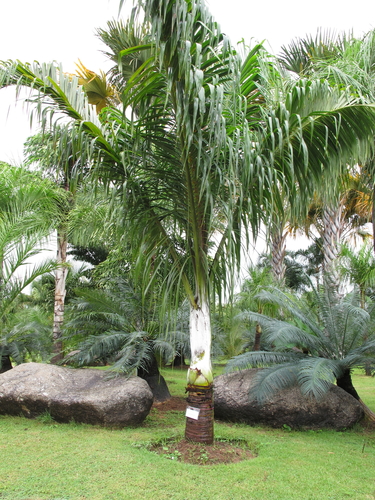
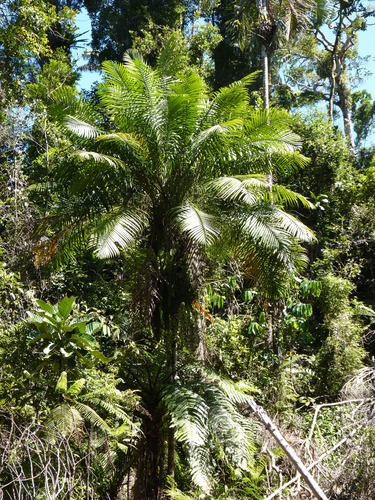
Calamus hollrungii
Becc.
Papuan white rattan
gbif· cc0
President and Fellows of Harvard College
gbif· cc0
President and Fellows of Harvard College
gbif· cc0
President and Fellows of Harvard College
Description
A vigorous climbing palm 10-15 m tall. The stems are 2.5 cm wide. It can be 26 m long. It produces side roots at the nodes and can have stilt roots at the base. The stalk usually ends with a tendril like structure up to 1 m long. The fronds are 3-4 m long and usually without a leaf stalk. The sheath around the stem is armed with spines up to 4 cm long. The leaflets are 20-40 in number and are broad, long, smooth and dark green. They are 25 cm long. They have small spines along the main veins towards the base of the leaflet. The flower branch is a large hanging branched flower stalk. The fruit are 0.8-1.2 cm across and cream in colour.
Edible Uses
The fruit are edible, possibly the flesh.
Traditional Uses
Unknown what part is edible. Possibly flesh of fruit.
This uses section is brief — help expand it
Known Hazards
Very frost sensitive.
Distribution
A tropical plant. It is very frost sensitive. It is mostly found growing in lowland rainforest. It needs a shady position and well-drained soil. It is often along stream banks.
Where It Grows
Australia, Pacific, Papua New Guinea, PNG, Solomon Islands,
Cultivation
Plants can be grown from seed. Seed germinate in 3-4 months. Seed should be sown fresh.
Notes
There are 375-400 Calamus species. There are 175 species in tropical Asia. Probably now Calamus aruensis Becc.;
Synonyms
References (9)
- Elliot, W.R., & Jones, D.L., 1982, Encyclopedia of Australian Plants suitable for cultivation. Vol 2. Lothian. p 405
- French, B.R., 2010, Food Plants of Solomon Islands. A Compendium. Food Plants International Inc. p 277
- Jones, D.L., 1994, Palms throughout the World. Smithtonian Institution, Washington. p 157
- Jones, D.L., 2000, Palms of Australia 3rd edition. Reed/New Holland. p 80
- Peekel, P.G., 1984, (Translation E.E.Henty), Flora of the Bismarck Archipelago for Naturalists, Division of Botany, Lae, PNG. p 61, 60
Show all 9 references Hide references
- Riffle, R.L. & Craft, P., 2003, An Encyclopedia of Cultivated Palms. Timber Press. p 284
- Townsend, K., 1994, Across the Top. Gardening with Australian Plants in the tropics. Society for Growing Australian Plants, Townsville Branch Inc. p 110
- Tucker, R., 1988, The Palms of Subequatorial Queensland. Palm and Cycad Society of Australia, Milton, Queensland. p 36
- World Checklist of Useful Plant Species 2020. Royal Botanic Gardens, Kew (As Calamus aruensis)