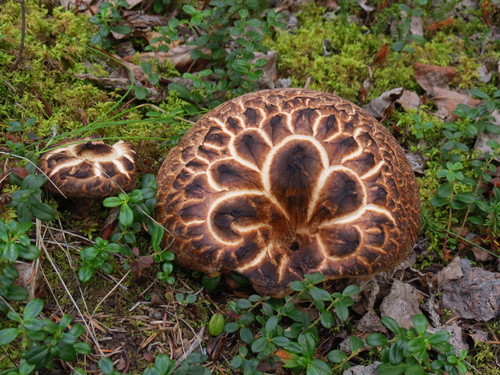
Sarcodon imbricatus
(L. ex Fr.) Karsten
Shingled hedgehog, Scaly hedgehog
iNaturalist· cc-by-sa
(c) Jerzy Opioła, some rights reserved (CC BY-SA)
iNaturalist· cc-by-nc
(c) jerfbabb, some rights reserved (CC BY-NC)
iNaturalist· cc-by
(c) Aerin Jacob, some rights reserved (CC BY), uploaded by Aerin Jacob
Summary
Source: WikipediaSarcodon imbricatus, commonly known as the shingled hedgehog or scaly hedgehog, is a species of tooth fungus in the order Thelephorales. The mushroom has a large, brownish cap with large brown scales and may reach 30 cm (12 in) in diameter. On the underside it sports greyish, brittle teeth instead of gills, and has white flesh. Its spore print is brown. It ranges throughout Europe and North America, while collections from the British Isles are now assigned to Sarcodon squamosus. It appears in autumn and is associated with spruce (Picea). The mushroom is edible, but it may be bitter and possibly causes gastrointestinal upset.
Description
A mushroom.
This description is brief — help expand it
Edible Uses
Some sources (in the United States) report that the fungus is edible but of poor quality; some others consider it edible and delicious. It may cause gastrointestinal upset. The mushrooms can be bitter, especially older specimens. This can be mitigated by submerging them in boiling water. Some suspect that bitter specimens may actually be related species. The mushroom can be pickled or dried and used as flavouring. In Bulgaria, it is collected, dried and finely ground to be used as an aromatic mushroom flour. In Korea, mushroom tea is made from it. The distinctive spicy aroma of fried younger specimens has made it an expensive delicacy in Japan.
Distribution
It is a Mediterranean climate plant. It grows in forests in damp soil.
Where It Grows
Asia, Austria, Balkans, Bulgaria, Caucasus, Central Asia, China, Europe, Georgia, Italy, Kyrgyzstan, Mediterranean, Mexico, North America, Portugal, Russia, Scandinavia, Sicily, Sweden, USA,
Also Known As
Fjallig taggsvamp, Hu zhang jun, Irema-so'ko
References (9)
- Boa, E. R., 2004, Wild edible fungi and their importance to people. FAO Non Wood Forest Products Booklet 17
- Bussman, R. W., et al, 2016, A comparative ethnobotany of Khevsureti, Samtskhe-Javakheti, Tusheti, Svaneti, and Racha-Lechkhumi, Republic of Georgia (Sakartvelo), Caucasus. Journal of Ethnobiology and Ethnomedicine (2016) 12:4
- Bussman, R. W. et al, 2017, Ethnobotany of Samtskhe-Javakheti, Sakartvelo (Republic of Georgia), Caucasus. Indian Journal of Traditional Knowledge Vol. 16(1) pp 7-24
- Bussman, R. W., et al, 2021, Unity in diversity—food plants and fungi of Sakartvelo (Republic of Georgia), Caucasus. Journal of Ethnobiology and Ethnomedicine (2021) 17:72 p 16
- Hall, I. R., et al, 2003, Edible and Poisonous Mushrooms of the World. Timber Press. p 237
Show all 9 references Hide references
- http://www.mykoweb.com/CAF/edible.html
- Lentini, F. and Venza, F., 2007, Wild food plants of popular use in Sicily. J Ethnobiol Ethnomedicine. 3: 15
- Liu, D., et al, 2018, An ethnobotanical survey of edible fungi in Chuxiong City, Yunnan, China. Journal of Ethnobiology and Ethnomedicine (2018) 14:42
- Svanberg, I., & Lindh, H., 2019, Mushroom hunting and consumption in twenty-first century post-industrial Sweden. Journal of Ethnobiology and Ethnomedicine (2019) 15:42