Vernonia hymenolepis
A. Rich.
Sweet bitterleaf
gbif· cc-by-sa
chrisbriggs42
gbif· cc-by-sa
chrisbriggs42
gbif· cc-by-sa
chrisbriggs42
Description
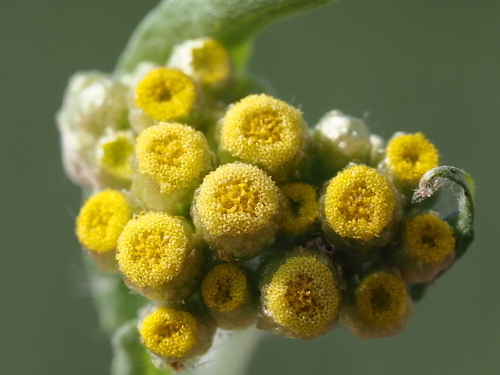
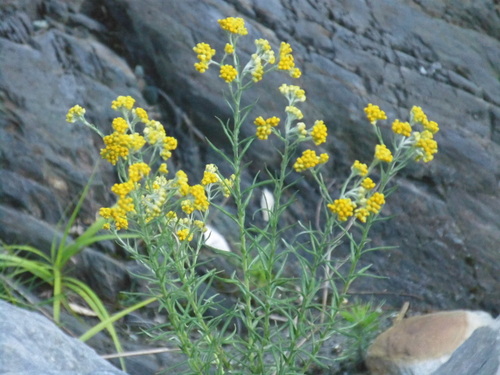
A shrub. It keeps growing from year to year. It can grow 12 m tall. The young branches have a dense covering. The leaves are simple and alternate. They are 6-34 cm long by 1-10 cm wide. They can taper to the base of be wedge shaped. There are small teeth along the edge. Leaves are hairy underneath. The flower heads are compound and at the top of the plant. The flowers have both sexes. The fruit is ribbed and dry. It is 3-6 mm long. It has bristles.
Edible Uses
The leaves are cooked and eaten fresh, or dried for use in salads and as a potherb. Leaves are sold at local markets and exported.
Traditional Uses
The leaves are cooked and eaten fresh. They are also dried and used in salads and as a potherb.
This uses section is brief — help expand it
Medicinal Uses
The leaves have anti-tumour or anticancer properties.
Distribution
It is a tropical plant. It grows along river beds and on the edges of forests. It can also be in mountain forests. They thrive at temperatures below 30°C. They grow between 1,400-3,000 m above sea level. They grow well in loose, moist, humus rich soil.
Where It Grows
Africa, Asia, Cameroon, Central Africa, Congo, East Africa, Ethiopia, Equatorial Guinea, Kenya, Mozambique, Nigeria, Southern Africa, Sudan, Taiwan, Tanzania, Uganda, West Africa, Zimbabwe,
Cultivation
It is planted as a hedge around houses. Plants can be grown from seeds. Seeds are collected from dry flower heads by rubbing and blowing away the chaff. Seeds are usually broadcast but can be sown in nursery beds. They can be transplanted after 2-3 weeks. Seedlings with bitter leaves are not used. A spacing of 30 cm is suitable. Seeds emerge 5 days after planting. Plants can be grown from cuttings. Cuttings with 4 buds taken from a mature plant are suitable. They are planted at an angle. Growth of cuttings is slow.
Production
Plants grow very rapidly. They can be 40-50 cm high in 4 weeks.
Other Information
The leaves are sold at local markets. It is a cultivated food plant. Leaves are exported. It is a much appreciated food plant.
Notes
It has anti tumour or anticancer properties.
Nutrition
| Part | Moisture | kJ | kcal | Protein | Vit A | Vit C | Iron | Zinc |
|---|---|---|---|---|---|---|---|---|
| Leaves | 86.4 | — | — | 4.2 | — | — | 2 | 0.4 |
Synonyms
References (5)
- AVRDC files
- Grubben, G. J. H. and Denton, O. A. (eds), 2004, Plant Resources of Tropical Africa 2. Vegetables. PROTA, Wageningen, Netherlands. p 544
- Noumedem, J. AK., 2013, Antibacterial activities of the methanol extracts of ten Cameroonian vegetables against Gram-negative multidrug-resistant bacteria. BMC Complementary & Alternative Medicine. 13:26
- Ucheck Fomum, F., 2004. Vernonia amygdalina Delile. [Internet] Record from Protabase. Grubben, G.J.H. & Denton, O.A. (Editors). PROTA (Plant Resources of Tropical Africa), Wageningen, Netherlands. < http://database.prota.org/search.htm>. Accessed 23 October 2009
- Yang, R, et al, 2008, Content and distribution of flavonoids among 91 edible plant species. Asia Pac J Clin Nutr 2008;17(S1):275-279