Oxygonum alatum
Burch.
Salt of the tortoise
iNaturalist· cc0
no rights reserved
iNaturalist· cc-by-nc
(c) fmop_lages, some rights reserved (CC BY-NC), uploaded by fmop_lages
iNaturalist· cc-by-nc
(c) Pieter, some rights reserved (CC BY-NC), uploaded by Pieter
Description
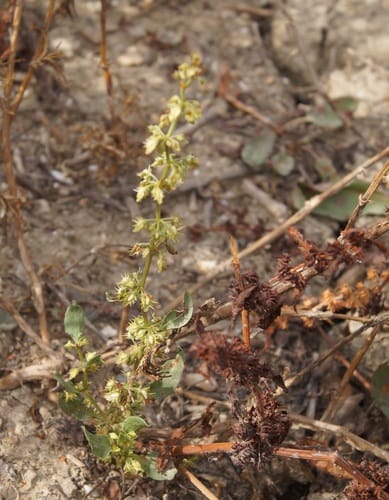
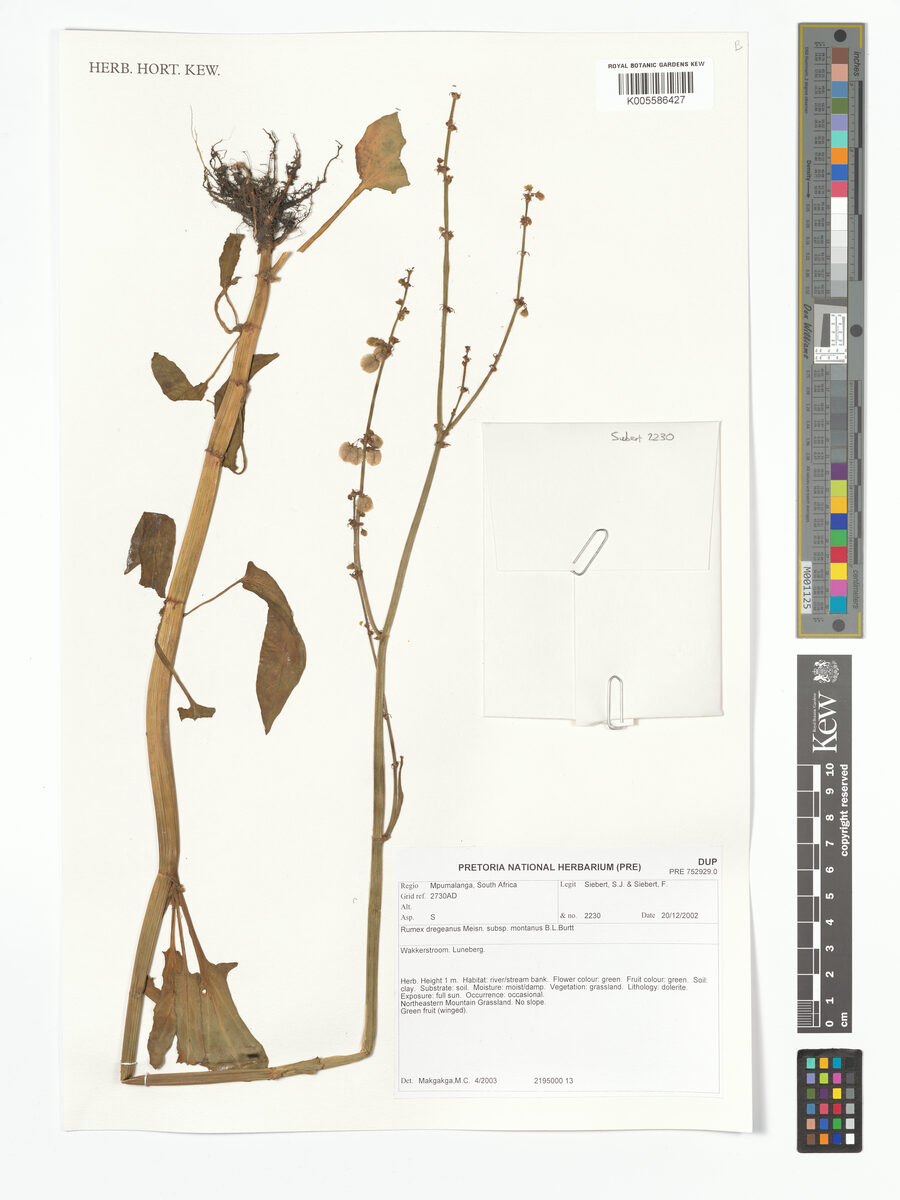
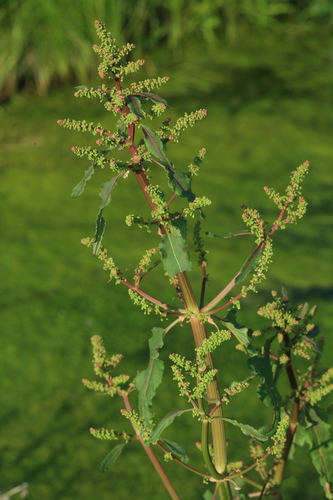
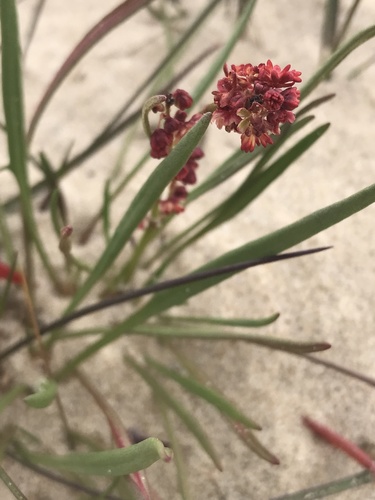
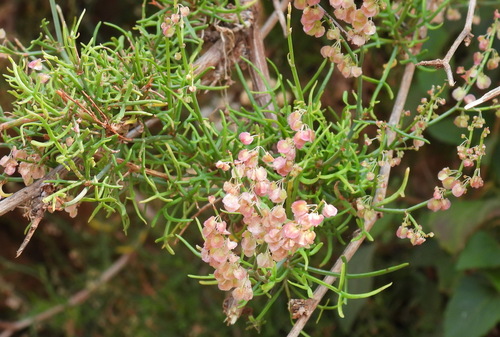
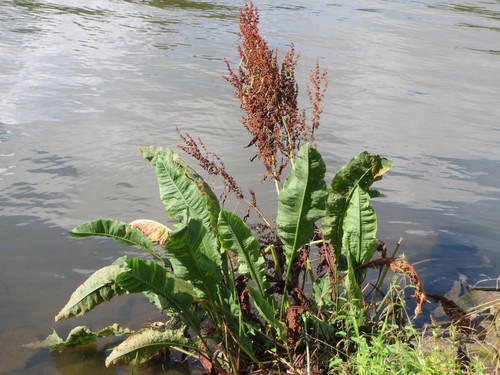
An annual herb. It grows 30-70 cm high. It branches from teh crown of the root. The leaves are small and sword shaped and about 5 cm long. Along the stem and leaf stalk there are cup like scales. The flowers are in a loose group 10-20 cm long. They are in clusters of 3. The flowers are star shaped and pinkish white. The fruit is a nut with 3 wings.
Edible Uses
The leaves are eaten raw or cooked. The stems are cooked as a vegetable. The seeds are eaten as a snack and used for flavouring.
Traditional Uses
The leaves are eaten raw or cooked. The stems are cooked as a vegetable. The seeds are eaten as a snack and used for flavouring.
This uses section is brief — help expand it
Medicinal Uses
It is a locally useful vegetable in dry areas with poor soil and is collected from the wild.
Distribution
It is a tropical and subtropical plant. It grows in the Kalahari. It grows in hot arid places with a marked dry season. The dry season can be 6-11 months. It grows in stony and sandy soils. It grows between 500-2,000 m above sea level. It can tolerate shade. It can grow in arid places.
Where It Grows
Africa, Angola, Botswana, Central Africa, East Africa, Namibia, South Africa, Southern Africa, Zambia, Zimbabwe,
Cultivation
Succeeds in poor, sandy soils. The plants are polygamous - the flowers can be either bisexual or unisexual.
Other Information
It is collected from the wild. It is a locally useful vegetable in dry areas with poor soil.
Synonyms
Also Known As
Oikanda jomafuma, Sefuma, Suring
References (9)
- Fox, F. W. & Young, M. E. N., 1982, Food from the Veld. Delta Books. p 305
- Grubben, G. J. H. and Denton, O. A. (eds), 2004, Plant Resources of Tropical Africa 2. Vegetables. PROTA, Wageningen, Netherlands. p 406
- Leger, S., 1997, A Description of Today's Use of Plants in West Bushmanland (Namibia). German Development Service. PO Box 220035, 14061 Berlin, Germany. http://www.sigridleger.de/book/
- Royal Botanic Gardens, Kew (1999). Survey of Economic Plants for Arid and Semi-Arid Lands (SEPASAL) database. Published on the Internet; http://www.rbgkew.org.uk/ceb/sepasal/internet [Accessed 4th June 2011]
- Ruiters-Welcome, A. K., 2019, Food plants of southern Africa. Ph.D. thesis. Univ. of Johannesburg p 91
Show all 9 references Hide references
- van Wyk, Be., & Gericke, N., 2007, People's plants. A Guide to Useful Plants of Southern Africa. Briza. p 72
- van Wyk, B-E., 2011, The potential of South African plants in the development of new food and beverage products. South African Journal of Botany 77 (2011) 857–868
- Welcome, A. K. & Van Wyk, B.-E., 2019, An inventory and analysis of the food plants of southern Africa. South African Journal of Botany 122 (2019) 136–179
- World Checklist of Useful Plant Species 2020. Royal Botanic Gardens, Kew