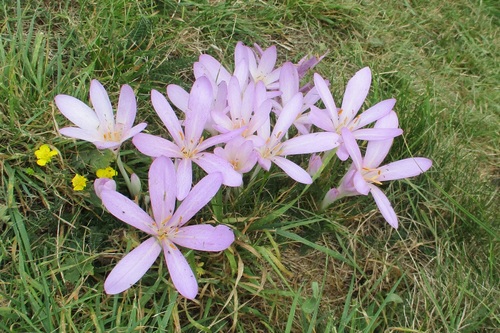
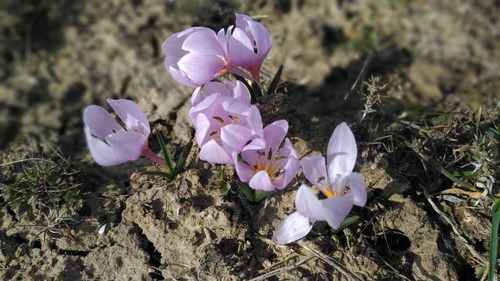
Camptorrhiza strumosa
(Baker) Oberm.
iNaturalist· cc-by-nc
(c) Duncan McKenzie, some rights reserved (CC BY-NC), uploaded by Duncan McKenzie
Description
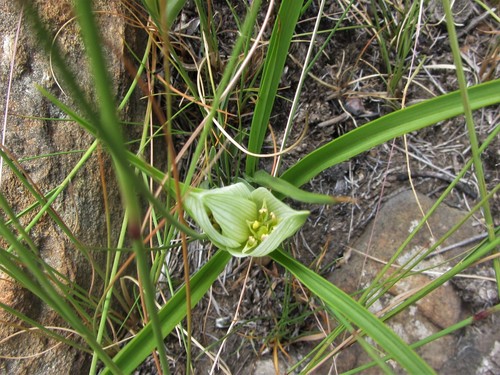
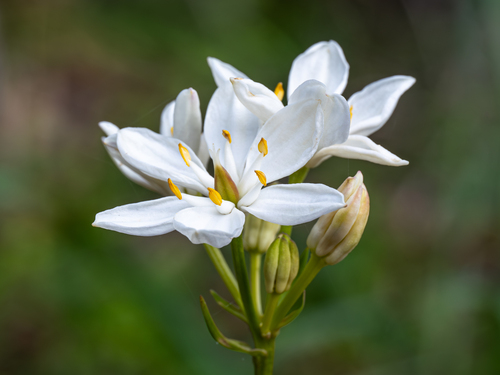
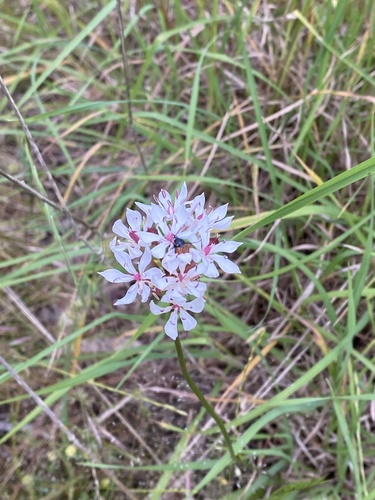
A small herb. It grows 20 cm high. It has an underground stem about 20 cm long and this has 2 oval corms at the end. The plant keeps growing from year to year. The leaves are narrow. They are in a zigzag pattern in 2 distinct rows. The lower leaves are 9-11 cm long by 5 mm wide. They become smaller higher up. The flowers are 50 mm long. They are pale red to brown. They occur singly in the axils of the upper leaves.
Edible Uses
The corms are the edible portion and can be eaten raw or baked in hot ashes.
Traditional Uses
The corms are eaten raw or baked in the hot ashes.
This uses section is brief — help expand it
Distribution
It is a subtropical plant. It grows in hot arid areas. It grows in areas with a marked dry season. The dry season can be 6-11 months. It grows in dry sandy soils. It grows between 45-1,530 m above sea level. It can grow in arid places.
Where It Grows
Africa, Botswana, East Africa, Mozambique, Namibia, South Africa, Southern Africa, Zimbabwe,
Cultivation
A plant of semi-arid areas in the tropics and subtropics, where it can be found at elevations from 45 - 1,530 metres.
Production
Corms are available in the rainy season.
Notes
There are at least 5 Camptorrhiza species.
Synonyms
Also Known As
Froetang, Shung
References (5)
- Leger, S., 1997, A Description of Today's Use of Plants in West Bushmanland (Namibia). German Development Service. PO Box 220035, 14061 Berlin, Germany. http://www.sigridleger.de/book/
- Royal Botanic Gardens, Kew (1999). Survey of Economic Plants for Arid and Semi-Arid Lands (SEPASAL) database. Published on the Internet; http://www.rbgkew.org.uk/ceb/sepasal/internet [Accessed 10th April 2011]
- Ruiters-Welcome, A. K., 2019, Food plants of southern Africa. Ph.D. thesis. Univ. of Johannesburg p 44
- Welcome, A. K. & Van Wyk, B.-E., 2019, An inventory and analysis of the food plants of southern Africa. South African Journal of Botany 122 (2019) 136–179
- World Checklist of Useful Plant Species 2020. Royal Botanic Gardens, Kew