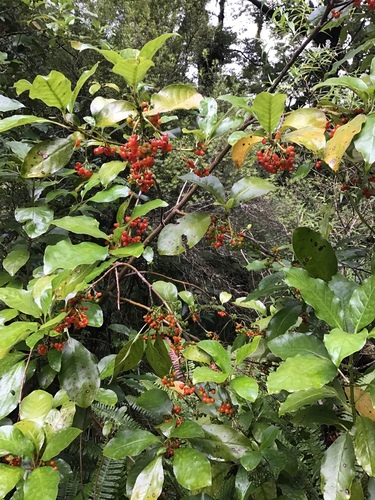
Craterispermum laurinum
(Poir.) Benth.
iNaturalist· cc-by-nc
(c) Carel Jongkind, some rights reserved (CC BY-NC), uploaded by Carel Jongkind
gbif· cc-by-sa
Saint Fédriche NDZAI
gbif· cc-by-sa
Saint Fédriche NDZAI
Description
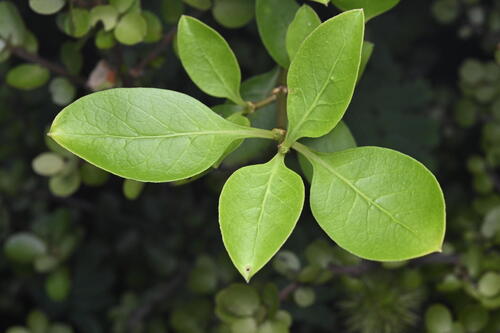
A shrub or small tree. It grows 7 m tall. The leaves are simple, entire and opposite. The leaf blade is broadly oval and 10-20 cm long by 4-9 cm wide. The leaves narrow towards the base. The flowers are in groups near the axils of the leaves. The flowers are yellow or white and have a waxy covering inside the funnel shaped tube. The fruit are fleshy and 5 mm across. They are blue to black with one seed inside.
Edible Uses
The bark is considered sweet and edible.
Traditional Uses
The bark is considered sweet and edible.
This uses section is brief — help expand it
Medicinal Uses
The plant has many traditional medicinal uses. A bark, leaf or root infusion or decoction is taken against cough, toothache, fever (including malaria), venereal diseases, high blood pressure and intestinal parasites. The powdered bark, leaves or roots are applied to wounds and sores.
Distribution
It is a tropical plant. It grows in forests, thickets and along river banks and in palm groves. In Nigeria it is recorded at 1,440 m above sea level.
Where It Grows
Africa, Angola, Central Africa, Côte d'Ivoire, East Africa, Ethiopia, Gambia, Ghana, Guinea, Guinée, Guinea-Bissau, Ivory Coast, Madagascar, Malawi, Mozambique, Nigeria, Senegal, Sierra Leone, Southern Africa, Togo, West Africa, Zambia, Zimbabwe,
Cultivation
It is easily grown from cuttings.
Propagation
Seed - It propagates easily by cuttings.
Other Uses
A brownish yellow dye is prepared from the bark and leaves. It is used to dye cotton. The bark and leaves are sometimes pounded with grass and boiled in order to prepare a yellow dye. The plant often contains high levels of aluminium and moderate levels of silicon, especially in the leaves. Aluminium accumulating plants are used as mordants instead of alums in traditional dyeing techniques in different parts of the world. The yellow colours they often impart to textiles come from the combination of the organic mordant and dye components such as flavonoids. The recipe combining the bark and leaves with an unspecified grass reported for Sierra Leone most probably implies such a combination of a mordant and yellow colouring compounds. The stems split easily and are used in hut building to make woven networks of twigs to hold a mud cover or thatch. The plant is used for live fencing as it is fire resistant and easily propagates from cuttings. Craterispermum laurinum is a strong aluminium and a moderate silicon accumulator. Of these elements about 36 g/kg and 13 g/kg respectively were measured in the leaves. It is possible that an Al-Si complex is formed in the shoot tissues which may contribute to Al detoxification.
Notes
It accumulates aluminium and silicon from the soil.
Synonyms
Also Known As
Famio, Hazombary, Landam-edi
References (3)
- Chapman, J. D. & Chapman, H. M., 2001, The Forest Flora of Taraba and Andamawa States, Nigeria. WWF & University of Canterbury. p 197
- Jansen, P.C.M., 2005. Craterispermum laurinum (DC.) Benth. [Internet] Record from Protabase. Jansen, P.C.M. & Cardon, D. (Editors). PROTA (Plant Resources of Tropical Africa), Wageningen, Netherlands. < http://database.prota.org/search.htm>. Accessed 15 October 2009.
- White, F., Dowsett-Lemaire, F. and Chapman, J. D., 2001, Evergreen Forest Flora of Malawi. Kew. p 474