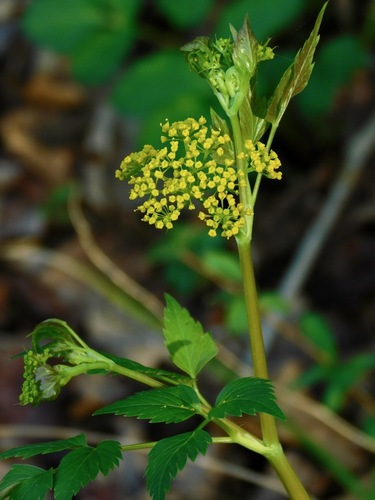
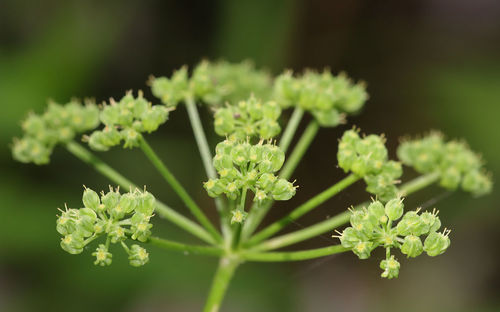
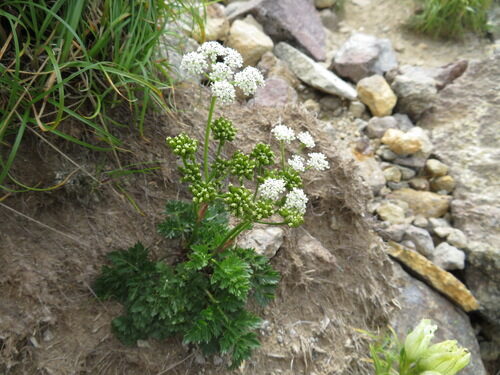
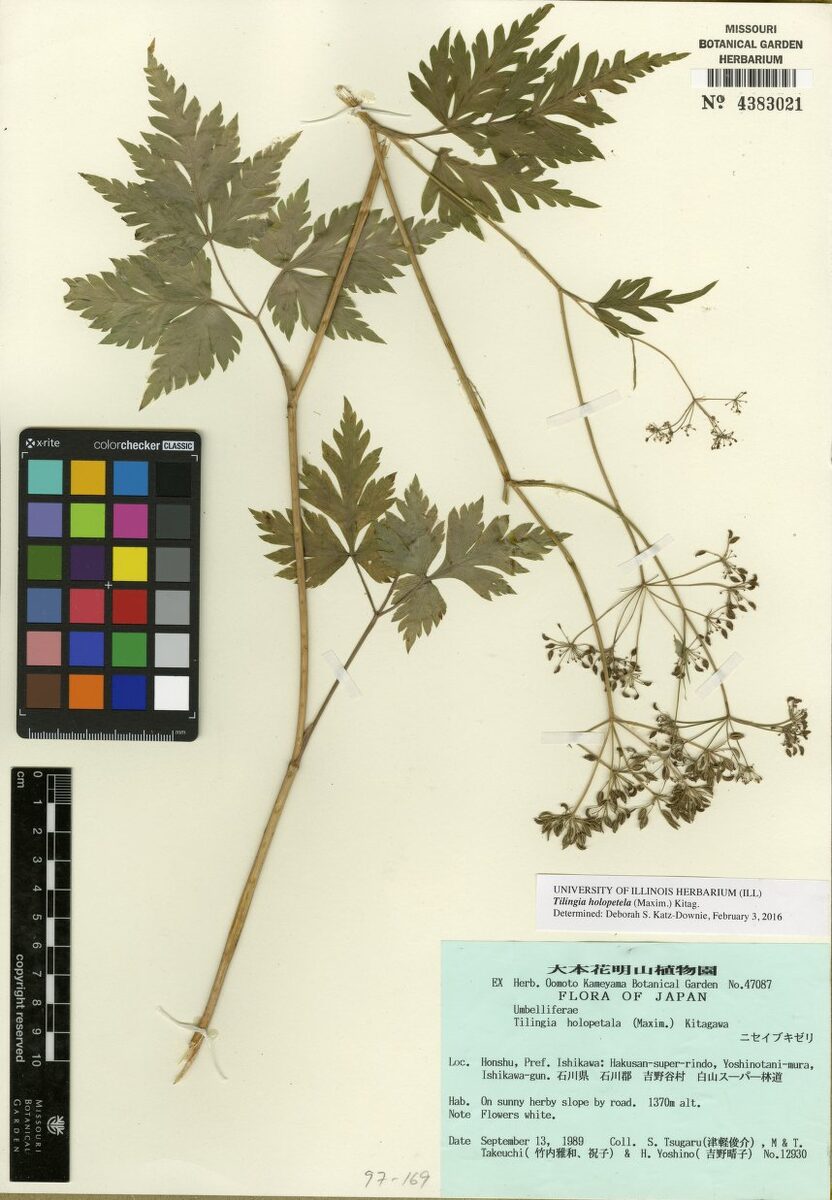
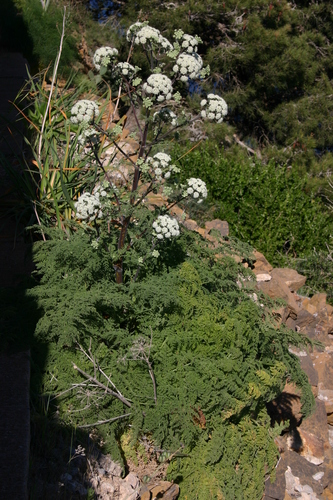
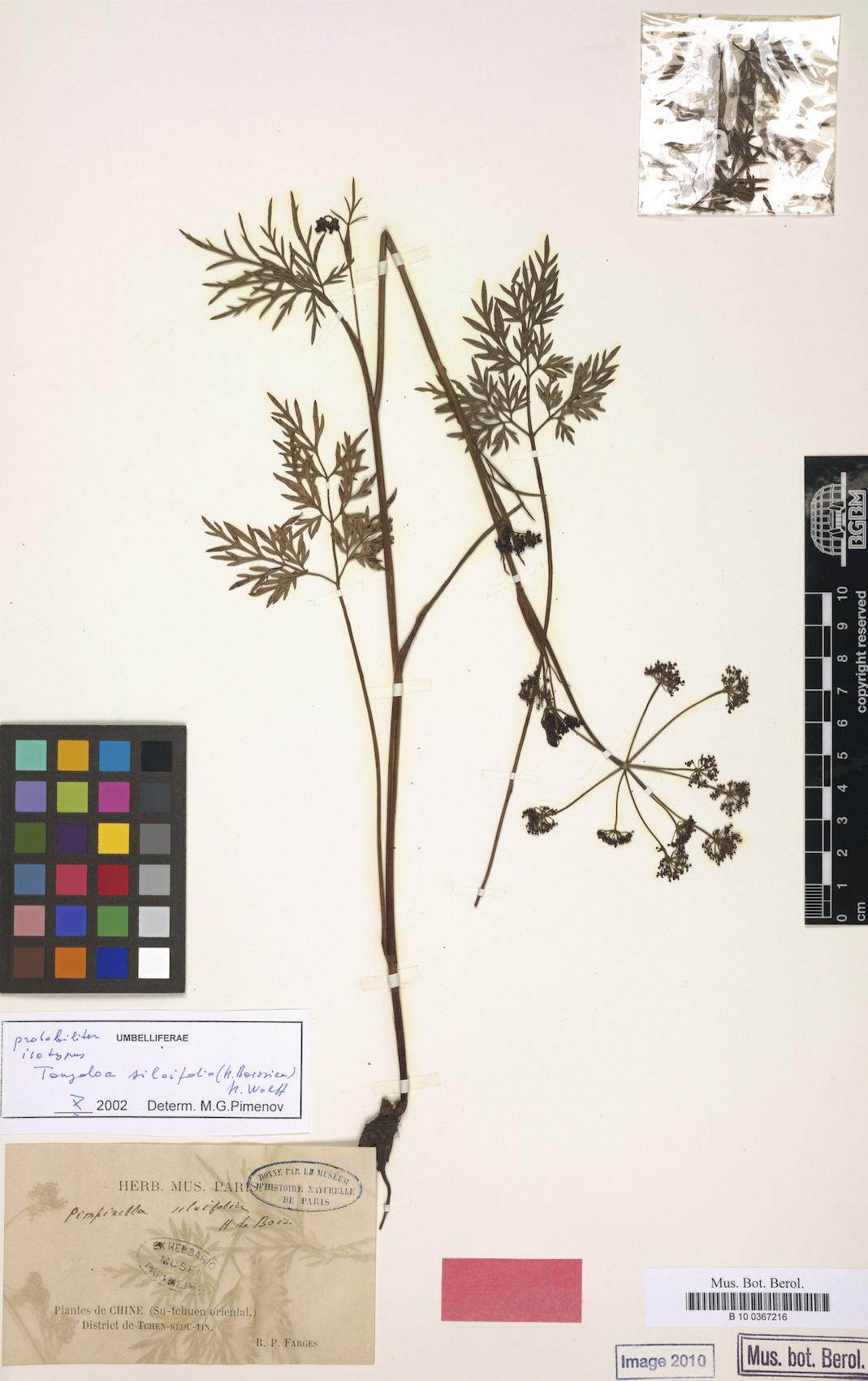
Elwendia persica
(Boiss.) Pimenov & Kljuykov
Black caraway, Black cumin
iNaturalist· cc-by
(c) Badagnani, some rights reserved (CC BY)
iNaturalist· cc-by-nc
(c) fz_nakhaei, some rights reserved (CC BY-NC)
Summary
Source: WikipediaElwendia persica is a plant species in the family Apiaceae. It is related to cumin (Cuminum cyminum) and sometimes called black cumin, or black caraway, and has a smoky, earthy taste. It is often confused with Nigella sativa (which is also called black cumin, black caraway, or black seed), by which it is often substituted in cooking. Dried E. persica fruits are used as a culinary spice in northern India, Pakistan, Bangladesh, Afghanistan, Tajikistan, and Iran. It is practically unknown outside these areas.
Description
A herb. It keeps growing from year to year. It grows 60 cm tall. The seeds are a similar shape to cumin (Cuminum cyminum).
This description is brief — help expand it
Edible Uses
The plant bears slender, elongate, ribbed fruits which are harvested once the plant has become very dry. Not more than 5 to 8 g can be plucked from each plant, contributing to their high price. The seeds are most valued as a garnish to high value, very special Indian dishes; they should not be ground, as their flavour would be reduced.
Traditional Uses
The starchy tubers are edible. They are boiled and eaten as a vegetable. The seeds are used as a spice. They are used to flavour curries.
This uses section is brief — help expand it
Distribution
It is a temperate plant. It grows between 3,000-3,800 m above sea level in the Himalayas in India. It grows on dry shrubby slopes.
Where It Grows
Afghanistan, Asia, Bangladesh, Caucasus, Central Asia, Himalayas, India, Iran, Middle East, Pakistan, Siberia, Tajikistan, Uzbekistan,
Notes
There are 45-50 Bunium species.
Synonyms
Also Known As
Junjun, Kala-jirah, Kala-zirah, Kalazira, Korneet, Pilappu, Shahi jeera, Shemai-shiragam, Shime jeerige, Shiragam, Siah-zirah, Simajilakara, Siyah jeera, Torazera, Zankai, Zeera, Zeur, Zira
References (20)
- Altschul, S.V.R., 1973, Drugs and Foods from Little-known Plants. Notes in Harvard University Herbaria. Harvard Univ. Press. Massachusetts. no. 3152 (As Bunium persicum)
- Ambasta S.P. (Ed.), 2000, The Useful Plants of India. CSIR India. p 91 (As Bunium persicum)
- Arora, R. K., 2014, Diversity in Underutilized Plant Species - An Asia-Pacific Perspective. Bioversity International. p 101 (As Bunium persicum)
- Dobriyal, M. J. R. & Dobriyal, R., 2014, Non Wood Forest Produce an Option for Ethnic Food and Nutritional Security in India. Int. J. of Usuf. Mngt. 15(1):17-37 (As Bunium persicum)
- Facciola, S., 1998, Cornucopia 2: a Source Book of Edible Plants. Kampong Publications, p 16 (As Bunium persicum)
Show all 20 references Hide references
- Hemphill, I, 2002, Spice Notes. Macmillan. p 157 (As Bunium persicum)
- Khojimatov, O. K. et al, 2015, Some wild growing plants in traditional foods of Uzbekistan. Journal of Ethnic Foods. 2 (2015) 25-28 (As Bunium persicum)
- Lim, T. K., 2015, Edible Medicinal and Non Medicinal Plants. Volume 9, Modified Stems, Roots, Bulbs. Springer p 19 (As Bunium persicum)
- Murugan, Pal M., et al, 2010, Phytofoods of Nubra valley, Ladakh - The cold desert. Indian Journal of Traditional Knowledge. Vol. 9(2): 303-308 (As Bunium persicum)
- Negi, P. S. & Subramani, S. P., 2015, Wild Edible Plant Genetic Resources for Sustainable Food Security and Livelihood of Kinnaur District, Himachal Pradesh, India, International Journal of Conservation Science. 6 (4): 657-668 (As Bunium persicum)
- Plants for a Future database, The Field, Penpol, Lostwithiel, Cornwall, PL22 0NG, UK. http://www.scs.leeds.ac.uk/pfaf/ (As Bunium persicum)
- Rana, J.C. et al, 2011, Genetic resources of wild edible plants and their uses among tribal communities of cold arid regions of India. Genetic Resources and Crop Evolution. 59:135-149 (As Bunium persicum)
- Rast. Turkest. 612. 1915 (As Bunium persicum)
- Seidemann J., 2005, World Spice Plants. Economic Usage, Botany, Taxonomy. Springer. p 71 (As Bunium persicum)
- Sharma, L. et al, 2018, Diversity, distribution pattern, endemism and indigenous uses of wild edible plants in Cold Desert Biosphere Reserve of Indian Trans Himalaya. Indian Journal of Traditional Knowledge. Vol 17(1) January 2018 pp 122-131 (As Bunium persicum)
- Sher, H. et al, 2011, Ethnobotanical and Economic Observations of Some Plant Resources from the Northern Parts of Pakistan. Ethnobotany research & Applications 9:027-041 (As Bunium persicum)
- Singh, H.B., Arora R.K.,1978, Wild edible Plants of India. Indian Council of Agricultural Research, New Delhi. p11 (As Bunium persicum)
- Tareen, N. M., et al, 2016, Ethnomedicinal Utilization of Wild Edible Vegetables in District Harnai of Balochistan Province - Pakistan. Pakistan Journal of Botany 48(3): 1159-1171 (As Bunium persicum)
- Tyagi, R. K., et al, 2004, Conservation of Spices Germplasm in India. Indian J. Plant Genet. Resour. 17(3): 163-174 (As Bunium persicum)
- World Checklist of Useful Plant Species 2020. Royal Botanic Gardens, Kew