Obetia tenax
(N. E. Br.) Friis
Rock tree nettle, Mountain nettle
iNaturalist· cc-by-nc-nd
(c) David Gwynne-Evans, some rights reserved (CC BY-NC-ND), uploaded by David Gwynne-Evans
iNaturalist· cc-by-nc-nd
(c) David Gwynne-Evans, some rights reserved (CC BY-NC-ND), uploaded by David Gwynne-Evans
iNaturalist· cc-by-nc
(c) setlhare, some rights reserved (CC BY-NC)
Description
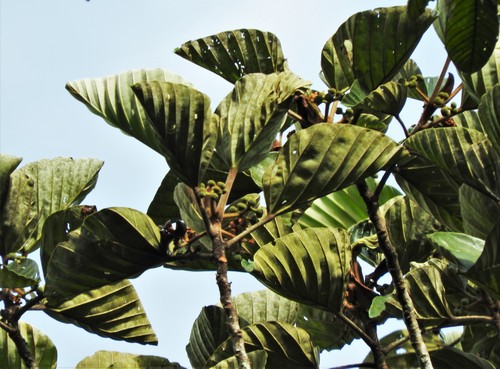
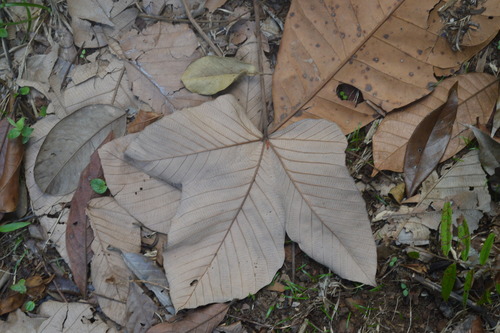
A small tree. It loses its leaves during the year. It grows 2-7 m tall. It has soft wood. The bark is pinkish-brown and smooth. The branches have stinging hairs. Male and female flowers are probably on separate trees. The leaves are simple and alternate. They are round or heart shaped with deep teeth along the edge. The leaves are 5-15 cm long by 3-10 cm wide. They are oval but can have 3 lobes. The flowers are in short clusters in the axils of leaves. They are pinkish-green.
Edible Uses
Leaves - cooked and eaten as a vegetable. It is often mixed with the leaves of Pouzolzia mixta and eaten with porridge.
Traditional Uses
The leaves are cooked and eaten as a spinach.
This uses section is brief — help expand it
Medicinal Uses
The root pulp is applied on snakebites.
Known Hazards
Contact with the stinging hairs causes intense itching and burning, and may result in blisters on the skin.
Distribution
It is a subtropical plant. It grows in rocky ravines in bushland. It is often on granite outcrops between 1,000-1,400 m above sea level. It is often in hot dry places.
Where It Grows
Africa, Botswana, East Africa, Eswatini, Mozambique, South Africa, Southern Africa, Swaziland, Zimbabwe,
Cultivation
Grows best in a sunny position. Prefers a moist but well-drained soil. A moderately fast-growing plant. This species is presumed to be dioecious, in which case both male and female forms need to be grown if fruit and seed are required.
Propagation
Seed - The plant is easily propagated.
Other Uses
A strong fibre of good colour is obtained from the bark. It is used traditionally for making sleeping mats. The fibre is made into tough cords, ropes, nets and mats. The stripped bast resembles China grass, but is more brittle and is not so lustrous. The bark is used for thatching. The wood is soft and fibrous, with a spongy pith or hollow centre.
Synonyms
Also Known As
Bongozimbi, Gukhunya, Lusotfo, Lutontfo, Lutiya, Mountain nettle, Mucucula, Muugana, Muvhazwi, Nmabi, Ruvashe, Thanga, Vuvatsane, Zavhazavha
References (9)
- Fox, F. W. & Young, M. E. N., 1982, Food from the Veld. Delta Books. p 359 (As Urera tenax)
- Long, C., 2005, Swaziland's Flora - siSwati names and Uses http://www.sntc.org.sz/flora/
- Magwede, K., van Wyk, B.-E., & van Wyk, A. E., 2019, An inventory of Vhavenḓa useful plants. South African Journal of Botany 122 (2019) 57–89
- Ruiters-Welcome, A. K., 2019, Food plants of southern Africa. Ph.D. thesis. Univ. of Johannesburg p 106
- Schmidt, E., Lotter, M., & McCleland, W., 2007, Trees and shrubs of Mpumalanga and Kruger National Park. Jacana Media p 82
Show all 9 references Hide references
- Shackleton, S. E., et al, 1998, Use and Trading of Wild Edible Herbs in the Central Lowveld Savanna Region, South Africa. Economic Botany, Vol. 52, No. 3, pp. 251-259
- Welcome, A. K. & Van Wyk, B.-E., 2019, An inventory and analysis of the food plants of southern Africa. South African Journal of Botany 122 (2019) 136–179
- World Checklist of Useful Plant Species 2020. Royal Botanic Gardens, Kew
- www.zimbabweflora.co.zw 2011