Mucuna poggei
Taub.
Buffalo bean
iNaturalist· cc-by-nc
(c) Mark Hyde, Bart Wursten and Petra Ballings, some rights reserved (CC BY-NC)
iNaturalist· cc-by-nc
(c) Babajide Agboola, some rights reserved (CC BY-NC)
Description
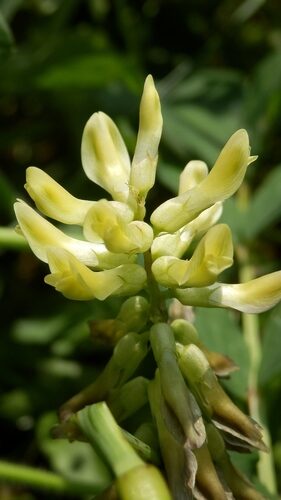
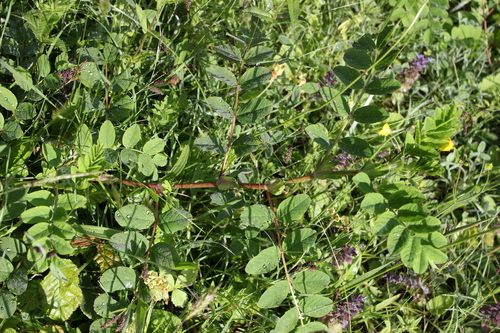
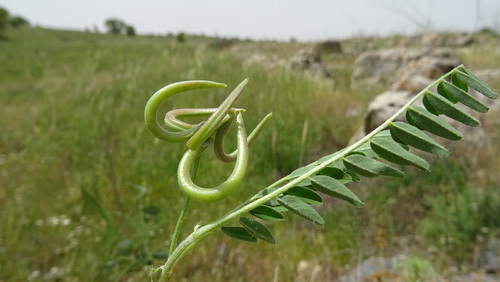
A bean. It is a woody creeper with stem up to 30 m long. The stems can be 20 cm across. The sap stains things dark brown. The leaves are alternate and have leaflets along the stalk. The leaflets can be 10-19 cm long by 6-19 cm wide. The side leaflets are unequal. The flowers hang in a group in the axils of leaves. The flowers have orange-red hairs. The fruit is an oblong pod 5-20 cm long by 4 cm wide. It is covered with red bristles that irritate the skin. The pod contains 1-5 seeds. The seeds are curved and 2.5 cm long by 2 cm wide and flattened. They are purple with brown marks.
Edible Uses
The seeds are eaten.
Medicinal Uses
A decoction of the stem is said to cure spear wounds. The crushed bark and leaves are astringent and applied as a poultice to sores, wounds and burns. A leaf decoction or the young leaves are applied externally against herpes. A root decoction or extract is used to treat dysentery, diarrhoea, malaria, gonorrhoea, hookworm and schistosomiasis. Root shavings are applied as an analgesic against toothache. A root decoction is used as a wash to treat paralysis of the legs and yellow fever. A flower decoction is used as a treatment for headache. The seeds may contain the amino acid L-dopa (levodopa).
Known Hazards
The pounded stems are cast into streams to stupefy fish. Mucuna species often possess irritant hairs on the seedpods and sometimes on the flowers and other parts. These hairs consist of 1-2 small basal cells and a large needle-like top cell. The top cell breaks off easily, piercing the skin and injecting chemical compounds that are present in the hairs. The proteolytic enzyme 'Mucunain' is said to be the active agent. The hairs can contaminate clothes or other objects, and remain active when dried, though they can be destroyed by heat. Intense itching, with reddening of the skin and small papules or urticaria occur a few minutes after contact with the hairy parts of the plant. There is no serious danger, unless the hairs get into the eye, in which case, in extreme situations, they have caused blindness. To remove the hairs from the skin, adhesive tape and washing with water and soap are considered useful. Dermatitis can be treated with corticosteroid ointment. See a doctor immediately if hairs go into the eyes.
Distribution
It is a tropical plant. It grows near rivers and swamps from sea level to 2,000 m altitude.
Where It Grows
Africa, Angola, Burkina Faso, Cameroon, Central Africa, Congo, Côte d'Ivoire, East Africa, Guinea, Guinée, Guinea-Bissau, Ivory Coast, Malawi, Mali, Mozambique, Nigeria, Sierra Leone, Southern Africa, Sudan, Tanzania, Togo, West Africa, Zambia, Zimbabwe,
Cultivation
Mucuna species generally grow best in a shady position in a humus-rich, moist but well-drained soil. Contact with the sap stains hands and iron implements brown-red. This species has a symbiotic relationship with certain soil bacteria; these bacteria form nodules on the roots and fix atmospheric nitrogen. Some of this nitrogen is utilized by the growing plant but some can also be used by other plants growing nearby.
Other Uses
The stems are used to prepare a black dye. A black ink is prepared from the leaf sap. The chemical constituents are unknown. Tannins, cyanogenic glycosides and indolic alkaloids have been reported in various other Mucuna species, and may also be present in this species, contributing to the colouring effect of the sap and leaves. The ash of the plant is used to chase snakes. The thinner branches are used for tying.
Notes
It is used as a dye plant.
Nutrition
| Part | Moisture | kJ | kcal | Protein | Vit A | Vit C | Iron | Zinc |
|---|---|---|---|---|---|---|---|---|
| Leaves | 8.3 | — | — | 32.4 | — | — | 10.6 | 0.24 |
Synonyms
Also Known As
Ghanhima, Mafurae, Ngerehe, Talicoedje
References (6)
- Burkill, H. M., 1985, The useful plants of west tropical Africa, Vol. 3. Kew.
- Fowler, D. G., 2007, Zambian Plants: Their Vernacular Names and Uses. Kew. p 38
- Jansen, P.C.M., 2005. Mucuna poggei Taub. [Internet] Record from Protabase. Jansen, P.C.M. & Cardon, D. (Editors). PROTA (Plant Resources of Tropical Africa), Wageningen, Netherlands. < http://database.prota.org/search.htm>. Accessed 20 October 200919 October 2009.
- Johns, T., Mhoro, E. B. and Sanaya, P., 1996, Food Plants and Masticants of the Batemi of Ngorongoro District, Tanzania. Economic Botany, Vol. 50, No. 1, pp. 115-121
- White, F., Dowsett-Lemaire, F. and Chapman, J. D., 2001, Evergreen Forest Flora of Malawi. Kew. p 330
Show all 6 references Hide references
- World Checklist of Useful Plant Species 2020. Royal Botanic Gardens, Kew