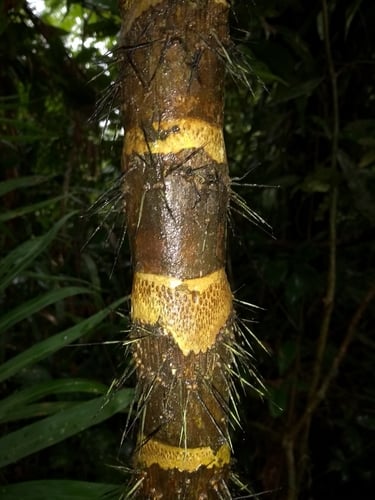
Myrialepis paradoxa
(Kurz) J. Dransf.
Rotan kertong
iNaturalist· cc-by-sa
(c) Omegorge, some rights reserved (CC BY-SA)
iNaturalist· cc-by-nc
(c) Gavin, some rights reserved (CC BY-NC)
Description
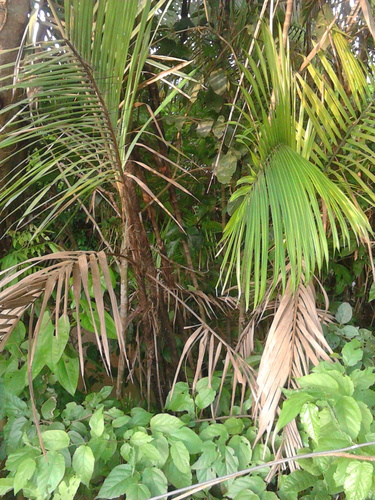
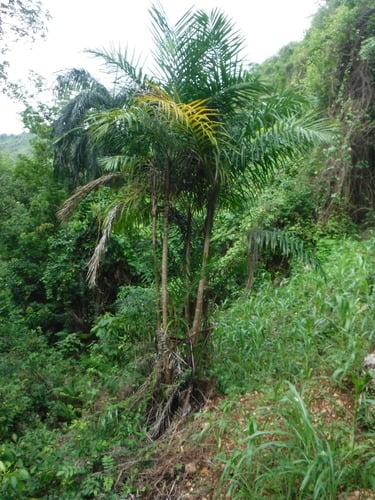
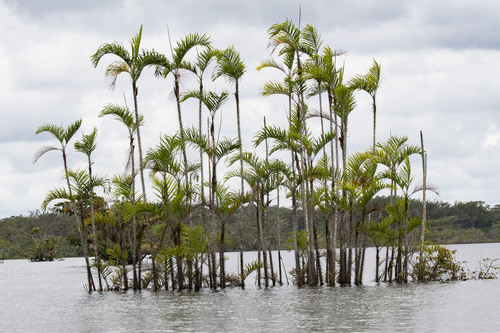
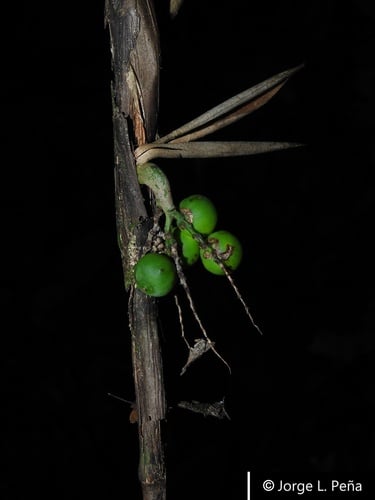
A rattan. It grows in clusters and climbs 7 m tall. There are rings of sharp spines. The leaves are 3 m long. There are leaflets along the stalk. They are dark green. Male and female flowers are on separate plants. The flowering shoots are branched and 60 cm long. The fruit is shiny and green to brown and covered with scales. There is one seed.
Edible Uses
The apical bud is cooked and eaten as a vegetable. The palm heart (the inner core and growing bud of the plant) is harvested[ 763]. It provides a crispy food, rich in nutrients, that can be eaten raw or cooked. Harvesting the heart will lead to the death of the stem it was harvested from, though in multi-stemmed plants such as this the rest of the plant will continue to grow and often produce new stems.
Distribution
It is a tropical plant. In Indochina it grows in evergreen forest between 100-300 m altitude. In warmer places it grows to 1,000 m altitude.
Where It Grows
Asia, Cambodia, Indochina, Indonesia, Laos, Malaysia, Myanmar, SE Asia, Thailand, Vietnam,
Cultivation
The plant requires high light intensities for growth, thus it is usually found growing wild on river banks and in disturbed areas. A dioecious species, both male and female forms need to be grown if fruit and seed are required. A monocarpic species, it can grow for many years without flowering, then flowers prolifically before setting seed and dying.
Other Uses
The cane is used in coarse basketry and as a frame for lower quality furniture. Around 12 - 30mm in diameter, it is poorly flexible and has a soft core.
Notes
There is only one Myrialepis species.
Synonyms
Also Known As
Lae-ka-yo, Re duln, Wai chang, Wai deng, Wai kiikay, Wai kung, Wai lao, Wai namsay
References (2)
- Dransfield, J., et al, 2004, A preliminary checklist to Thai Palms. Thai For. Bull. (Bot.) 32:32-72
- Evans, T. D., et al, 2002, A Synopsis of the Rattans (Arecaceae: Calamoideae) of Laos and Neighbouring Parts of Indochina. Kew Bulletin, Vol. 57, No. 1 (2002), pp. 1-84