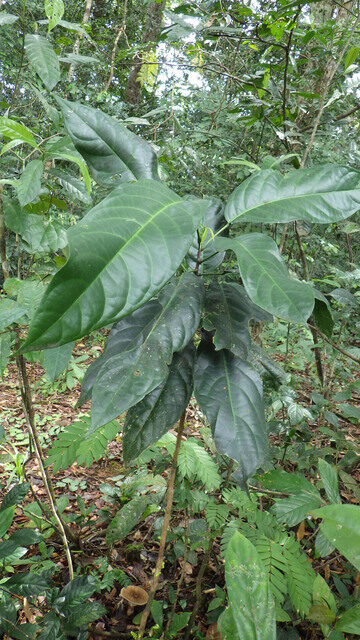
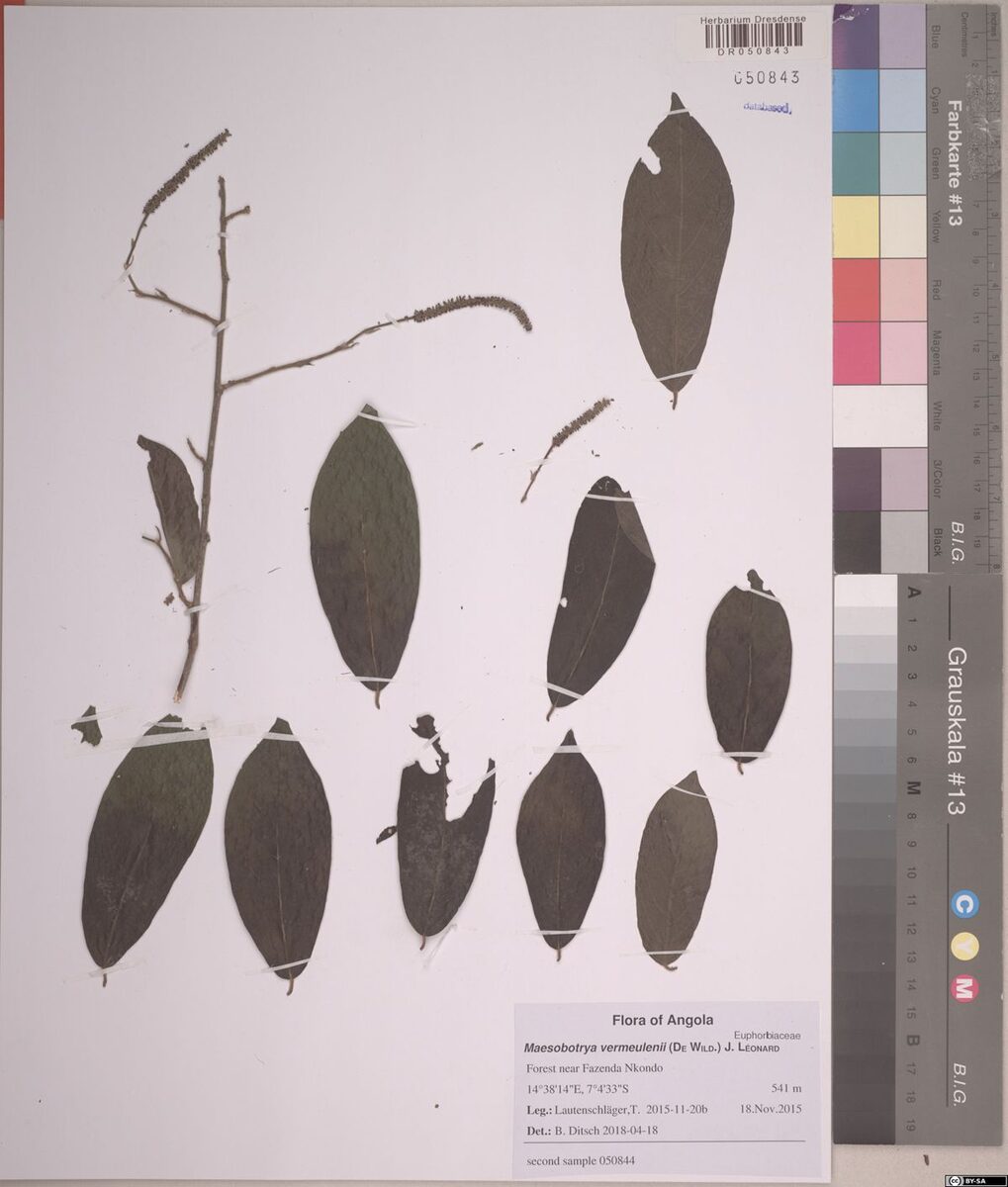
Bridelia ferruginea
Benth.
iNaturalist· cc-by-nc-sa
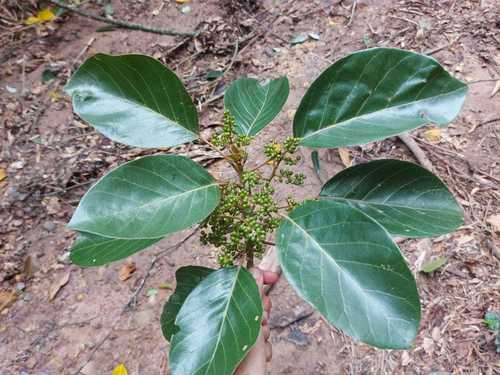
(c) Stefan Dressler, some rights reserved (CC BY-NC-SA)
iNaturalist· cc-by-nc-sa
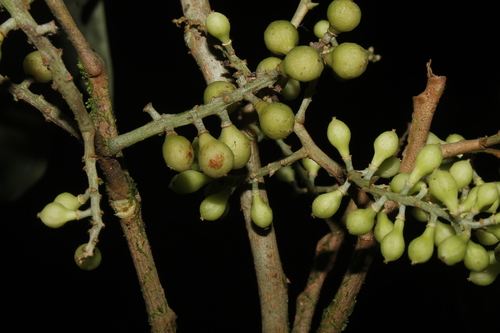
(c) Smithsonian Institution, National Museum of Natural History, Department of Botany, some rights reserved (CC BY-NC-SA)
iNaturalist· cc-by-nc
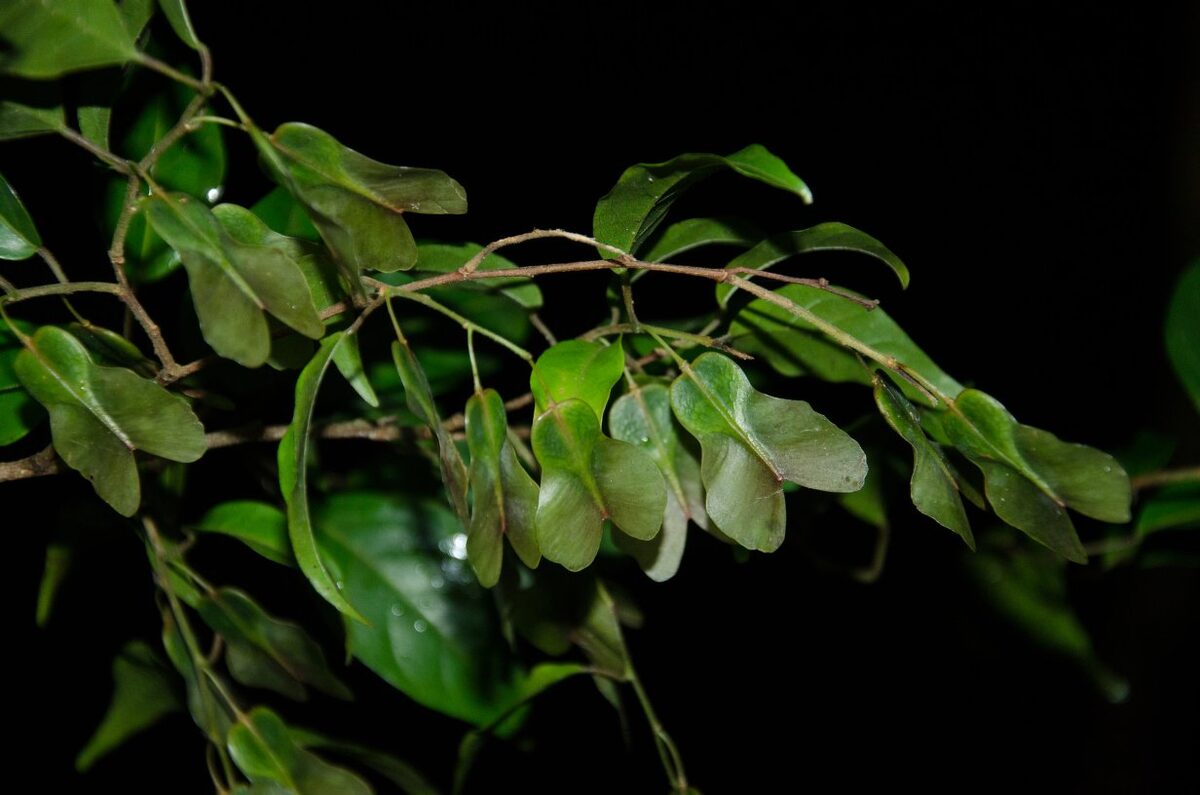
(c) Carel Jongkind, some rights reserved (CC BY-NC)
Description
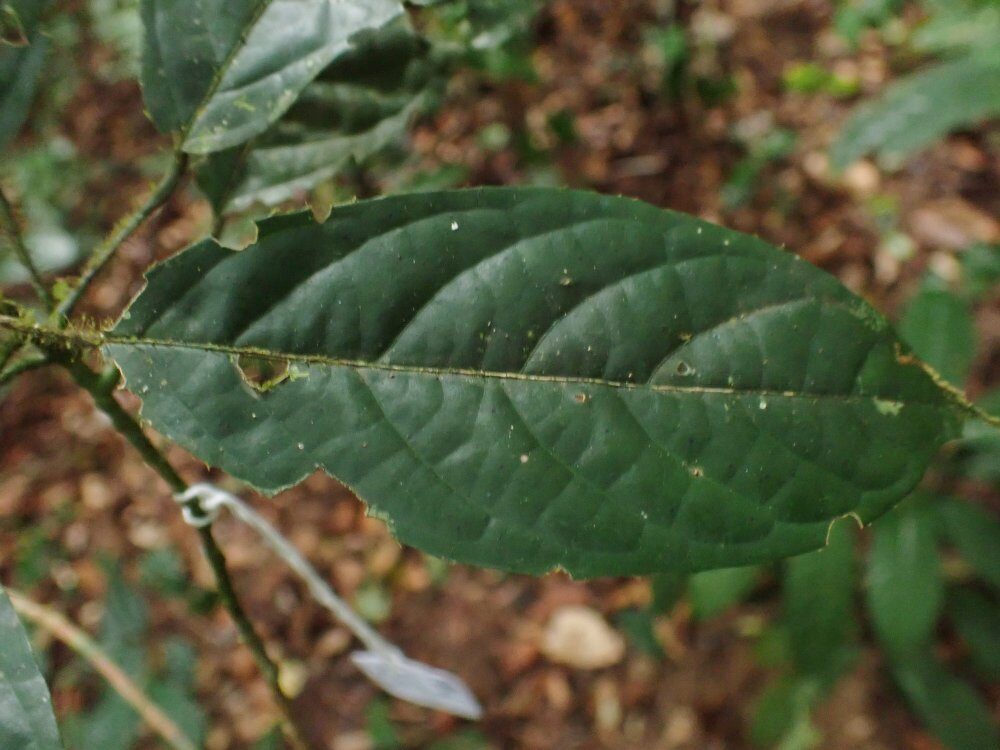
A gnarled shrub or small tree. It grows 6-15 m high. The trunk is crooked and it branches low down. The bark is dark grey and rough and often scaly. The small branches are long and thin. They can have short spines. The leaves are usually 3.5-10 cm long by 2.5-6 cm wide. The leaves have a tip which curves downwards. The leaf stalks are 5 mm long, stout and hairy. The flowers are creamy yellow and have a scent. The fruit are oval and 6-7.5 mm long. The fruit persist on the branches.
Edible Uses
The ripe fruit is eaten fresh. The bark is used as a spice in food processing and to strengthen wine.
Traditional Uses
The bark is used as a spice in food processing. It is also used to strengthen wine. The ripe fruit is eaten.
This uses section is brief — help expand it
Medicinal Uses
Bridelia ferruginea is a popular herbal remedy in parts of Africa, and the bark is commonly sold in local markets. The leaves, leafy twigs and bark are all employed, and the medical activity is believed to be mainly due to the presence of tannins (which are astringent) and saponosides. The main properties ascribed to the plant are aphrodisiac, astringent, diuretic, febrifuge, laxative and purgative. In tests, the boiled water extract of the plant has shown positive action against Gram +ve bacteria, Sarcina lutea and Staphylococcus aureus, but no fungistatic action, nor action on Gram -ve bacteria. A leaf-extract in saline solution has been shown to produce a marked reduction of blood-sugar in laboratory trials. Decoctions of the leaves, leafy twigs and bark are commonly used in the treatment of urethral discharges; dysentery and diarrhoea; fever and rheumatic pains. The preparations may be taken by draught, in baths, fumigations, or topical applications. The grated bark may be taken mixed with tapioca flour to treat dysentery. The bark, and the bright red infusion from it, are commonly used as a mouth-wash and remedy for thrush in children. Similar use is made of a root-decoction A decoction of the bark is used for toothache. The bark has a great reputation as an antidote against poisons. The bark is chewed and then applied to a wound caused by a poisoned arrow, after which the wound is sucked to remove any more poison. A bark-preparation called kirni is held to confer immunity against arrow-poisons and against syphilis. Igbo medicine-men use a cold-water extract of the bark, together with the stem of Costus afer, in the treatment of ose-nkenu, identified as minor epilepsy. Both the root-bark and stem bark are used externally to treat skin diseases, infections and eruptions.
Known Hazards
A fish-poison is prepared from the root-sap.
Distribution
It is a tropical plant. It grows in savannah or open woodland. In Nigeria it has been recorded at 230 and 1,060 m above sea level.
Where It Grows
Africa, Angola, Benin, Burkina Faso, Cameroon, Central Africa, Central African Republic, CAR, Chad, Congo DR, Côte d'Ivoire, East Africa, Ghana, Guinea, Guinée, Ivory Coast, Liberia, Malawi, Mali, Mozambique, Nigeria, Sierra Leone, Southern Africa, Sudan, Togo, West Africa, Zambia, Zimbabwe,
Cultivation
The tree is fire-resistant. In Sierra Leone the tree is reported to drip water (honeydew?) throughout the dry season.
Other Uses
The liquid obtained from an aqueous macerate of the wood is applied to locally-made pottery in Zaire for glazing. A substance in the bark confers an adhesive quality to a decoction. Such an extract is used to harden beaten laterite mud-floors, sometimes in a mixture with fruit-husks of Parkia spp, and also to glaze pots after firing. A mixture of this with clay is prepared which sets to a sort of cement of strength adequate to build terraces and houses. It is rain-proof and can be used for flat roofs of huts. Tannin concentration in the bark is recorded as 3.0 - 3.5%, low in comparison with other sources, but of good quality and the bark is used in Togo and Ghana to dye cloth a fast reddish-brown if iron extract is used as a mordant, or purplish with alum. The bark is used in Upper Guinea and in Gabon to blacken pottery. Leaves boiled up with rusty iron and shea-butter are used in Ghana to dye adinkera cloths a black colour. At Siguiri (Guinea) the teeth are blackened by a preparation of the plant which is called dafing saba: black mouth The roots are used by the Yoruba as chew-sticks, while the Maninka of the Upper Niger (Guinea) grind the wood to a fine powder for use as a dentifrice The wood is brown. It is said to be termite-proof, and is used for this reason in the soudano-guinean region to make granaries. In Sierra Leone it is used as a primary structural timber. In the Central African Republic it is recognised as a good firewood, indeed as a ‘woman’s firewood’, that is one good for the hearth and cooking place, long-lasting while the housewife is away on other chores, and picking up quickly from sleeping embers with a hot flame and minimal amount of smoke.
Other Information
It is fairly commonly eaten in West Africa.
Notes
There are about 60 Bridelia species.
Nutrition
| Part | Moisture | kJ | kcal | Protein | Vit A | Vit C | Iron | Zinc |
|---|---|---|---|---|---|---|---|---|
| Fruit | 92.3 | — | — | 7.3 | — | — | — | — |
Also Known As
Asha, Dafi sagwan, Du'upapa, Iralodan, Jiringbo, Kimwindu ki nseke, Kirni, Kizni, Kpine, Mudzinza, Mufukusi, Mukodokodo, Mukwandu, Mushungunu, Mutorarwizi, Mutsetsauta, Mutugusi, Ndiriwo, Ntibi, Nyirinwo, Sagwan baboni, Sawan