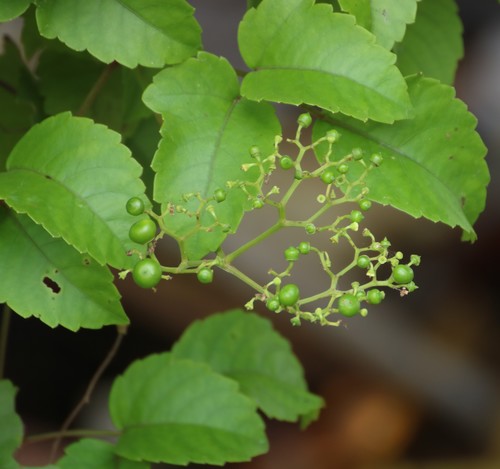
Cyphostemma bambuseti
(Gilg & Brandt) Wild & Drummond
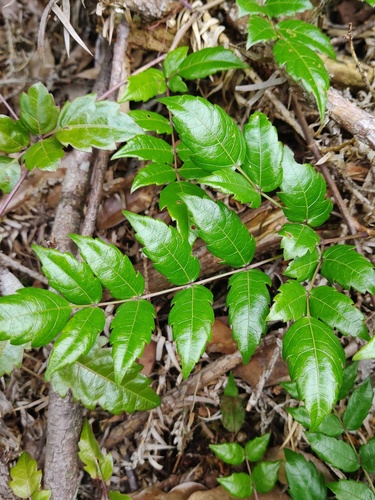
iNaturalist· cc-by-nc
(c) Bart Wursten, some rights reserved (CC BY-NC), uploaded by Bart Wursten
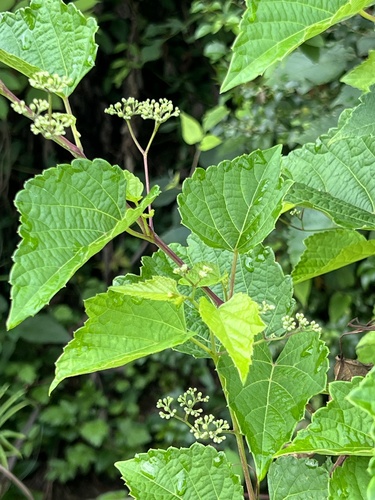
iNaturalist· cc-by-nc
(c) Bart Wursten, some rights reserved (CC BY-NC), uploaded by Bart Wursten
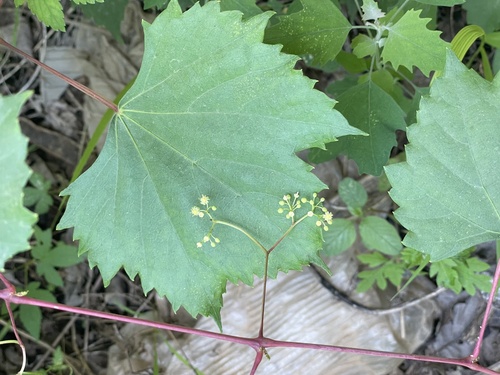
iNaturalist· cc-by-nc
(c) niyigaba, some rights reserved (CC BY-NC)
Description
A climber. It can grow 6 m long. The stems have lines along them and have rusty coloured hairs. They have tendrils. The leaves have 5 lobes. They are 2.5-12 cm long by 1.5-5 cm wide. The flowers are white or green. The fruit are purple and oval to round. They are 9 mm long by 8 mm wide. They are hairy.
Edible Uses
The leaves are boiled and eaten as a vegetable. The fruit are also eaten.
Traditional Uses
The leaves are boiled and eaten as a vegetable.
This uses section is brief — help expand it
Distribution
It is a tropical plant.
Where It Grows
Africa, Burundi, Congo DR, East Africa, Kenya, Rwanda, Sudan, Uganda, Zambia,
Synonyms
References (5)
- Bussman, R. W., 2006, Ethnobotanyof the Samburu of Mt Nyiru, South Turkana, Kenya. Journal of Ethnobiology and Ethnomedicine. 2:35
- East African Herbarium records, 1981,
- Mutie, F. M., et al, 2023, Important Medicinal and Food Taxa (Orders and Families) in Kenya, Based on Three Quantitative Approaches. Plants 2023, 12, 1145
- Peters, C. R., O'Brien, E. M., and Drummond, R.B., 1992, Edible Wild plants of Sub-saharan Africa. Kew. p 202
- Termote, C., et al, 2014, Assessing the potential of wild foods to reduce the cost of a nutritionally adequate diet: An example from eastern Baringo District, Kenya. Food and Nutrition Bulletin, vol. 35, no. 4