Polysphaeria parvifolia
Hiern
gbif· cc-by-nc-sa
MBG
gbif· cc-by
Royal Botanic Gardens, Kew
gbif· cc-by-nc-sa
MBG
Description
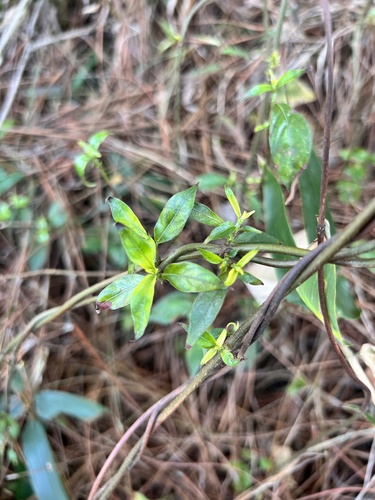
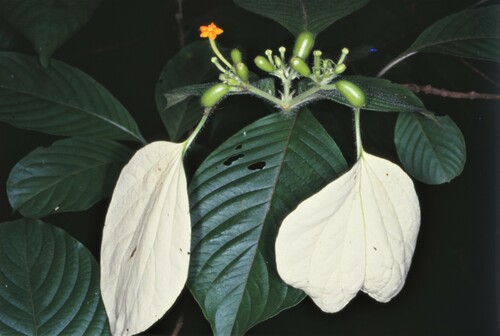
A shrub or small tree. It is 1-6 m tall. The stems are slender and often with a few short hairs. The side branches arise just above the nodes. The bark is red brown and peels off in long strips. The leaves are opposite and narrowly oval. They are 5-9 cm long. The base is rounded or heart shaped. The flowers are white. They appear with the leaves in small clusters. These do not have stalks and are at the nodes. The fruit are round berries 1 cm across. They are in dense clusters. They become orange red when ripe.
Edible Uses
Fruit - raw. Eaten as a snack. The round, orange-red berries are about 10mm in diameter, carried in dense clusters on the plant.
Traditional Uses
The ripe fruit are eaten as a snack.
This uses section is brief — help expand it
Medicinal Uses
The roots are used in the treatment of stomach aches.
Distribution
It is a tropical plant. It grows in the lowlands. It grows in evergreen forest and coastal woodlands. In Tanzania it grows from sea level to 1,400 m above sea level.
Where It Grows
Africa, East Africa, Ethiopia, Kenya, Somalia, Sudan, Tanzania,
Cultivation
Plants can be grown by seeds.
Other Uses
The wood is hard and tough. It is used for building poles, pegs, tool handles and animal traps. The wood is used for fuel.
Production
In Tanzania fruit are collected from April to June.
Notes
There are about 20 Polysphaeria species. They are in tropical Africa.
Also Known As
Mangi, Mchesi, Mganja, Mkame, Mkanja, Mlapaa, Mmangitovu, Mmangomango, Mrigi, Msamisami, Mtsonga-nyomba, Mumangwe, Muwangwi, Nchakachaka, Nkanja, Nshakashaka, Sasacha
References (8)
- East African Herbarium records, 1981,
- Kenya Trees, Shrubs, Lianas, 1994, nzdl.org
- Mutie, F. M., et al, 2023, Important Medicinal and Food Taxa (Orders and Families) in Kenya, Based on Three Quantitative Approaches. Plants 2023, 12, 1145
- Pakia, M., 2000, Plant Ecology and Ethnobotany of two sacred forests (Kayas) at the Kenya Coast. M. Sc. Thesis.
- Peters, C. R., O'Brien, E. M., and Drummond, R.B., 1992, Edible Wild plants of Sub-saharan Africa. Kew. p 173
Show all 8 references Hide references
- Ruffo, C. K., Birnie, A. & Tengnas, B., 2002, Edible Wild Plants of Tanzania. RELMA p 536
- Walsh, M., 2009, The Use of Wild and Cultivated Plants as famine Foods on Pemba Island, Zanzibar. Études océan Indien. 42-43
- World Checklist of Useful Plant Species 2020. Royal Botanic Gardens, Kew