Pseudeminia comosa
(Baker) Verdc.
gbif· cc0
Carnegie Museum of Natural History
gbif· cc-by
Royal Botanic Gardens, Kew
gbif· cc-by
Meise Botanic Garden
Description
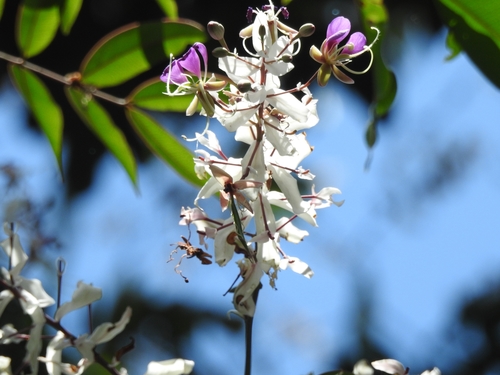
A herb. It can lie along the ground or be a climber. It can grow 2-9 m high. It grows between 780-1,800 m above sea level. The leaves have leaflets that are more pale underneath. There are 3 leaflets 4-13 cm long. They usually have rusty hairs. The flowers are pea shaped and green to dull purple brown outside. They are pale violet inside. The flower heads have long stalks. The flowers are in pairs. The fruit are narrow pods. They are 2 cm long and flattened. There are 2 dark brown seeds
Edible Uses
Roots - raw. The tubers are peeled and then chewed. The sweet juice is swallowed and the remains spat out..
Traditional Uses
The root tuber is eaten raw. It is the sweet juice that is eaten.
This uses section is brief — help expand it
Distribution
It is a tropical plant. It grows between 800-1,800 m above sea level. It can grow in arid places.
Where It Grows
Africa, East Africa, Malawi, Mozambique, Tanzania, Zimbabwe,
Cultivation
Plants can be grown by seeds.
Other Uses
The saponin containing roots are used for the preparation of soap. The plant has a creeping habit and is grown as a cover plant in sisal and manioc plantations.
Production
The tuber is dug up during the rainy season.
Synonyms
Also Known As
Limbizu, L'Indo
References (6)
- Famine Foods. (As Rynchosia comosa)
- Lim, T. K., 2015, Edible Medicinal and Non Medicinal Plants. Volume 9, Modified Stems, Roots, Bulbs. Springer p 74
- Newman, 1970, (Also as Rynchosia comosa)
- Peters, C. R., O'Brien, E. M., and Drummond, R.B., 1992, Edible Wild plants of Sub-saharan Africa. Kew. p 136
- Royal Botanic Gardens, Kew (1999). Survey of Economic Plants for Arid and Semi-Arid Lands (SEPASAL) database. Published on the Internet; http://www.rbgkew.org.uk/ceb/sepasal/internet [Accessed 29th April 2011]
Show all 6 references Hide references
- Ruffo, C. K., Birnie, A. & Tengnas, B., 2002, Edible Wild Plants of Tanzania. RELMA p 544