Pterolobium stellatum
(Forssk.) Brenan
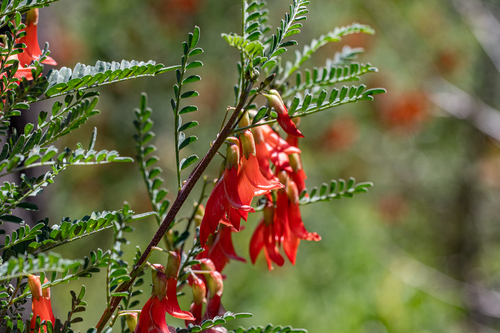
Redwing
iNaturalist· cc-by-nc
(c) Troos van der Merwe, some rights reserved (CC BY-NC), uploaded by Troos van der Merwe
iNaturalist· cc-by-sa
(c) M Kriek, some rights reserved (CC BY-SA)
iNaturalist· cc-by-sa
(c) M Kriek, some rights reserved (CC BY-SA)
Summary
Source: WikipediaPterolobium stellatum (Latin: stellatum, starry or star-like, suggesting the radial arrangement of inflorescences), the redwing, is a perennial flowering plant in the legume family, Fabaceae.
Description
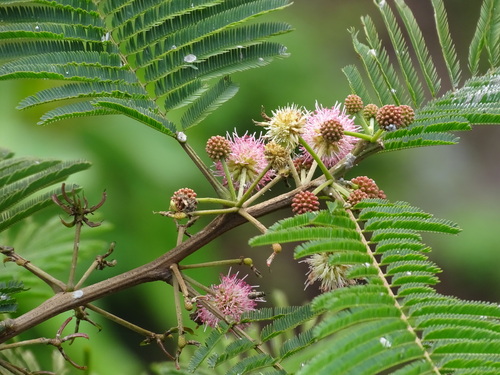
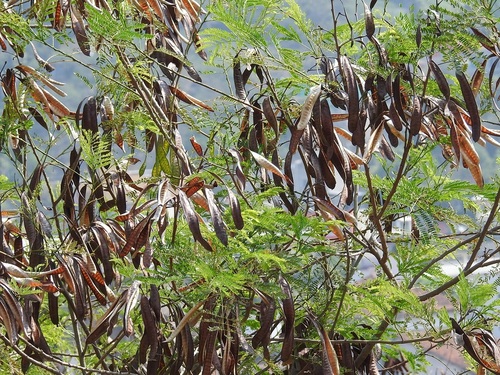
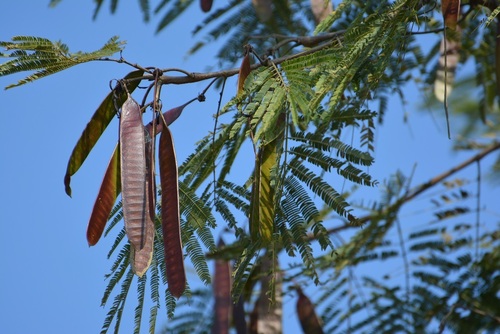
A scrambling shrub. It can grow 15 m high. The young stems are covered hairs and with prickles. The leaves are compound. The leaflets are 6-10 mm long and 2-4 mm wide with 7-16 pairs of leaflets per leaflet stalk. The fruit is a pod with wings. It is bright red. The pods are 3-5 cm long. The seed is at the base and is 10 mm long by 5-7 mm wide and 3 mm thick.
Edible Uses
The leaves are eaten.
Medicinal Uses
The shrubs are planted to provide impenetrable live fences, and shoots are collected for livestock fodder. In Ethiopia an infusion of the pounded bark has been used as a component in tanning leather, while providing it with a red colour. The leaves contain 20% tannin and yield a dark red dye when crushed, which has been used in textiles, basketry and as an ingredient in black ink. The plant is employed in traditional medicine, though its medicinal properties have not been formally investigated.
Distribution
It is a tropical plant. It grows on the edge of the forest. It grows up to 1,750 m altitude. In Zimbabwe it is between 850-1,750 m above sea level.
Where It Grows
Africa, Arabia, Central Africa, Congo, East Africa, Eritrea, Ethiopia, Malawi, Middle East, Mozambique, Rwanda, South Africa, Southern Africa, Sudan, Yemen, Zambia, Zimbabwe,
Cultivation
Although many species within the family Fabaceae have a symbiotic relationship with soil bacteria, this species is said to be devoid of such a relationship and therefore does not fix atmospheric nitrogen.
Propagation
Seed - germinates better when scarified mechanically or chemically. It is sensitive to high temperatures, so hot water treatment before germination is not recommended. The seeds can be easily stored in airtight containers for more than a year without loss of viability.
Other Uses
The leaves contain about 20%f tannins and have been used since historical times as a source of dyes. The leaves, ground and boiled in water to which a little oil or butter has been added to help fix the colour, are used to dye clothes for mourning, for dark colours in basketry and to colour mats made from doum palm (Hyphaene thebaica). Formerly the leaves were one of the main ingredients for making black ink, based on the chemical reaction of the tannins of the plant with iron slag or iron filings from the blacksmith. This ink is water resistant. Because of the sharp, recurved prickles, branches are used to make rat traps. The wood is used for fuel. The plant is used as a live fence. Hedges made of this plant are impenetrable because of the sharp prickles, and they can be pruned to a desired height and width. The plant competes strongly with Opuntia cactii and therefore can be useful for controlling Opuntia in areas where the latter has become a weed.
Notes
There are 10 Pterolobium species. 9 are in Asia and 1 in Africa. Also as Caesalpinaceae.
Synonyms
Also Known As
Gado, Kentefa, Rukato, Umufataangwe, Umugeyo, Uthathawe
References (7)
- East African Herbarium records, 1981,
- Flora Zambesiaca. http://apps.kew.org/efloras
- Fowler, D. G., 2007, Zambian Plants: Their Vernacular Names and Uses. Kew. p 31
- Molla, A., Ethiopian Plant Names. http://www.ethiopic.com/aplants.htm
- Peters, C. R., O'Brien, E. M., and Drummond, R.B., 1992, Edible Wild plants of Sub-saharan Africa. Kew. p 124
Show all 7 references Hide references
- White, F., Dowsett-Lemaire, F. and Chapman, J. D., 2001, Evergreen Forest Flora of Malawi. Kew. p 309
- www.zimbabweflora.co.zw 2011