Diospyros thomasii
Hutch. & Dalz.
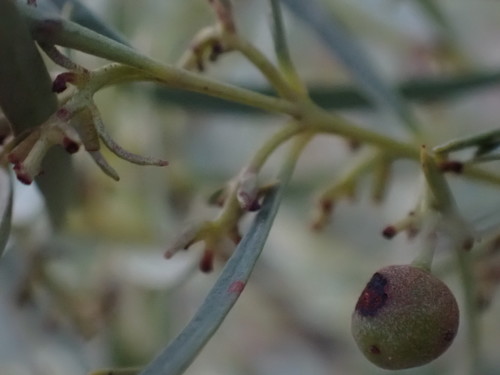
iNaturalist· cc-by-nc
(c) Carel Jongkind, some rights reserved (CC BY-NC), uploaded by Carel Jongkind
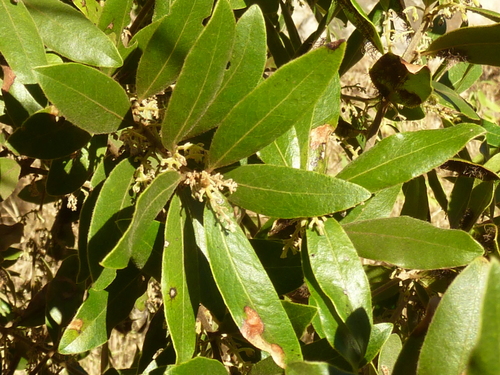
iNaturalist· cc-by-nc
(c) Carel Jongkind, some rights reserved (CC BY-NC), uploaded by Carel Jongkind
Description
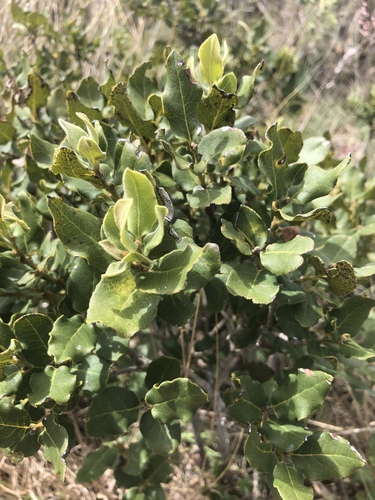
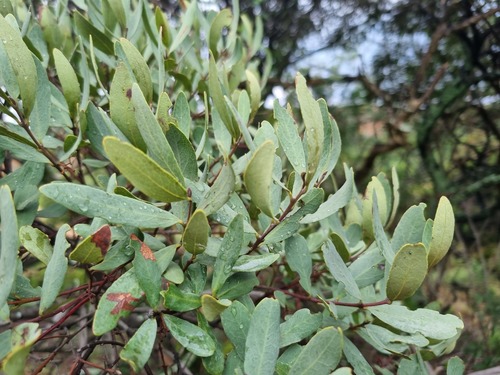
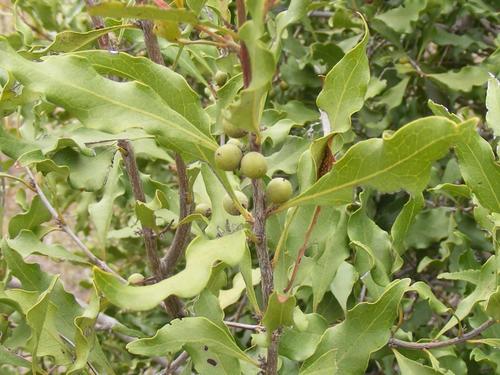
A tree. It grows 10 m high. The bark is smooth and dark green. The leaves are simple and entire. They are arranged alternately. They are bluish-grey underneath. The flowers are white. The fruit are yellow.
Edible Uses
The pulp of the fruit is eaten.
Traditional Uses
The pulp of the fruit is eaten.
This uses section is brief — help expand it
Medicinal Uses
The bark liquid (is this the sap or an infusion?) is used for treating diarrhoea.
Distribution
It is a tropical plant. It grows in the rain-forest in West Africa.
Where It Grows
Africa, Guinea, Guinée, Liberia, Sierra Leone, West Africa,
Cultivation
The newly-opened flush of leaves has a rank smell whereby this species is given various vernacular names in Sierra Leone referring to flatulence. We have seen no individual confirmation for this species, but in general Diospyros species are dioecious and require both male and female forms to be grown if fruit and seed are required.
Propagation
Seed - in general the seed of Diospyros species has a very short viability and so should be sown as soon as possible. The flesh should be removed since this contains germination inhibitors. Sow the seed in a shady position in a nursery seedbed. The sowing media for ebony uses soil and fine sand at the ratio 3:1. The seed is planted horizontally or vertically with the radicle end down, with a sowing depth of 1 - 1½ times the thickness of seed. Distance between the seeds is 3 - 5cm. Seeds are very sensitive to desiccation during germination and early growth, so must be regularly watered at this time. Normally the seed will germinate after one week. As a rule fresh seeds have a high percentage of fertility. The seedlings develop long taproots at an early stage, often before any appreciable elongation of the shoot takes place. The growth of the seedling is decidedly slow .
Other Uses
Sap from the inner bark stains the wood reddish. The wood is pink when first cut. The smaller branches are flexible and are used for making spring traps. Saplings are used to bind drum-heads to the hollowed log-base, and larger timbers are cut into oars.
Also Known As
Dib-bah, Gboe-kpay, Sefflay
References (4)
- Burkill, H. M., 1985, The useful plants of west tropical Africa, Vol. 2. Kew.
- Dalziel, J. M., 1937, The Useful plants of west tropical Africa. Crown Agents for the Colonies London.
- Peters, C. R., O'Brien, E. M., and Drummond, R.B., 1992, Edible Wild plants of Sub-saharan Africa. Kew. p 105
- World Checklist of Useful Plant Species 2020. Royal Botanic Gardens, Kew