Thilachium africanum
Lour.
Cucumber bush
iNaturalist· cc-by-nc
(c) Hillary somy, some rights reserved (CC BY-NC), uploaded by Hillary somy
iNaturalist· cc-by
(c) Alan Manson, some rights reserved (CC BY)
iNaturalist· cc-by-nc
(c) Troos van der Merwe, some rights reserved (CC BY-NC), uploaded by Troos van der Merwe
Summary
Source: WikipediaThilachium africanum is a species of flowering plant in the family Capparaceae. This shrub or small tree is native to Eswatini, Kenya, KwaZulu-Natal, Madagascar, Malawi, Mozambique, the Northern Provinces, Tanzania, and Zimbabwe.
Description
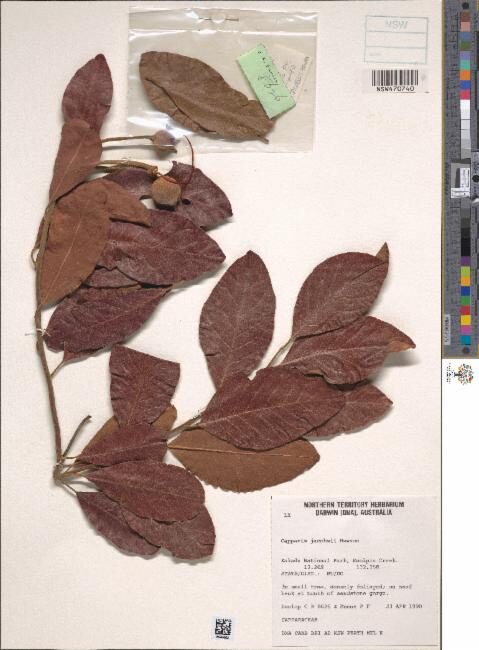
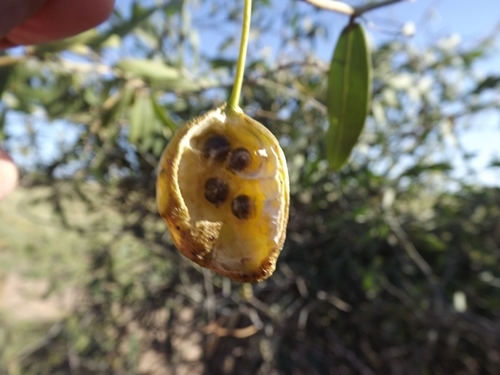
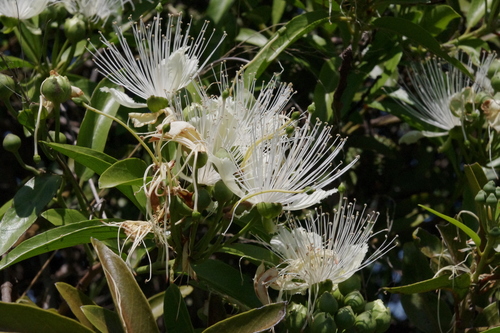
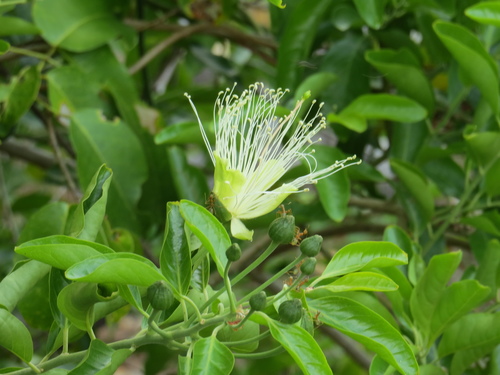
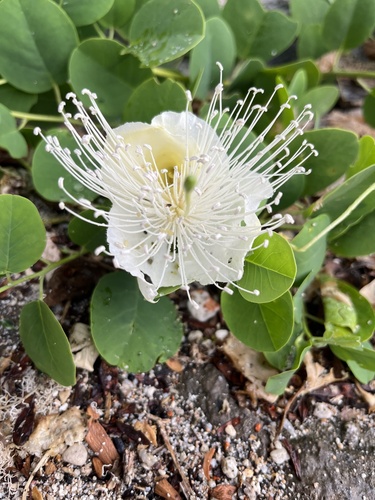
A shrub or tree. It can grow up to 7 m high. It loses its leaves during the year. The leaves are alternate and compound. There are 3 leaflets. The leaflets are 3-9 cm long by 1-5 cm wide. The edges of the leaves are rolled under. The leaves are dark green and leathery. The flowers are large and white. The fruit are like cucumbers. They have 12 ridges along them. They are 6 cm long.
Edible Uses
The roots are eaten as a famine food, prepared by removing the bark, pounding the centre, then soaking and boiling for several hours. The fruit is also edible.
Traditional Uses
The roots are a famine food. The bark is removed and the centre is cut and pounded the soaked and boiled for several hours.
This uses section is brief — help expand it
Medicinal Uses
Extracts of the species are used in preparations to ease pain, bark extracts are used to treat snake bites and diarrhoea among the Samburu people of Kenya. The tuberous roots are boiled and then drained a few times to reduce toxicity.
Known Hazards
The root requires caution in preparation.
Distribution
It is a tropical plant. It grows in forest and woodland. It grows between 25-1,550 m above sea level. It can grow in arid places. It is damaged by frost.
Where It Grows
Africa, East Africa, Eswatini, Kenya, Madagascar, Malawi, Mozambique, South Africa, Southern Africa, Swaziland, Tanzania, Zimbabwe,
Propagation
Seed - Cuttings.
Other Uses
The wood is used for making tool handles and spoons. The wood is used for fuel.
Also Known As
Chiombo, Mtongi, Mutunguu, Nancapuane, Nhedze, Sangaretei, Vuma
References (10)
- Cunningham, 1985,
- Lim, T. K., 2015, Edible Medicinal and Non Medicinal Plants. Volume 9, Modified Stems, Roots, Bulbs. Springer p 81
- Long, C., 2005, Swaziland's Flora - siSwati names and Uses http://www.sntc.org.sz/flora/
- Mutie, F. G., 2020, Conservation of Wild Food Plants and Their Potential for Combatting Food Insecurity in Kenya as Exemplified by the Drylands of Kitui County. Plants 2020, 9, 1017
- Mutie, F. M., et al, 2023, Important Medicinal and Food Taxa (Orders and Families) in Kenya, Based on Three Quantitative Approaches. Plants 2023, 12, 1145
Show all 10 references Hide references
- Peters, C. R., O'Brien, E. M., and Drummond, R.B., 1992, Edible Wild plants of Sub-saharan Africa. Kew. p 79
- Royal Botanic Gardens, Kew (1999). Survey of Economic Plants for Arid and Semi-Arid Lands (SEPASAL) database. Published on the Internet; http://www.rbgkew.org.uk/ceb/sepasal/internet [Accessed 7th April 2011]
- Schmidt, E., Lotter, M., & McCleland, W., 2007, Trees and shrubs of Mpumalanga and Kruger National Park. Jacana Media p 132
- Williamson, 1975,
- World Checklist of Useful Plant Species 2020. Royal Botanic Gardens, Kew