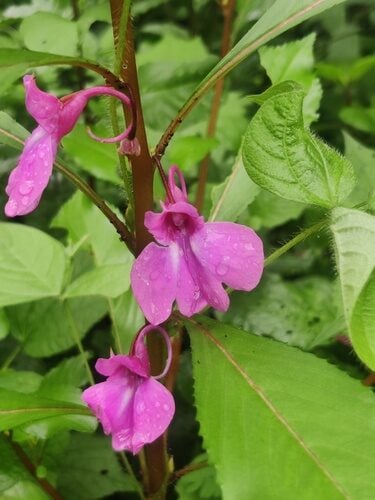
Impatiens irvingii
Hook. f.
iNaturalist· cc-by-nc
(c) Bart Wursten, some rights reserved (CC BY-NC), uploaded by Bart Wursten
iNaturalist· cc-by-nc
(c) Bart Wursten, some rights reserved (CC BY-NC)
Summary
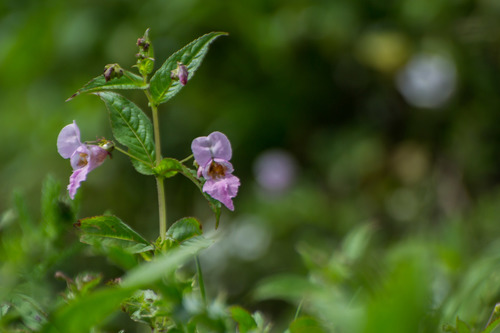
Source: WikipediaImpatiens irvingii is a species of flowering plant in the family Balsaminaceae. It is native to tropical Africa. This is a variable plant. In general, it is a perennial herb with stems up to 1.5 meters long, or occasionally longer. They are rarely erect, more often prostrate or somewhat upright. The stems are succulent with swollen nodes, often red in color or green tinged with red, and sometimes hairy or velvety. The spirally arranged leaves have generally lance-shaped, toothed blades up to 16 centimeters long. They are dark green and waxy on the upper surfaces and silvery green on the undersides. They are sometimes hairy. Light purple flowers grow in the leaf axils. They have hairy bracts and sepals. The back sepal tapers into a long spur. The petals are up to 3 centimeters long. The fruit capsule is up to 1.8 centimeters long. The natural habitat types of the plant include moist and wet areas such as moist forests and swamps. In Nigeria, this plant is associated with the introduced snail Indoplanorbis exustus. It is a host plant for the downy mildew fungus Pseudoperonospora cubensis, which causes red spots on the leaves and, in severe cases, necrosis.
Description
A damp-loving herb in the Balsaminaceae family growing about 1 m high. It is found in tropical regions near streams and swamps.
This description is brief — help expand it
Edible Uses
Leaves - cooked and eaten as a vegetable. The plant is used in the Democratic Republic of Congo, Gabon and Sudan to produce a high quality vegetable salt.
Medicinal Uses
The young leaves are used as a treatment for schistosomiasis and haematuria. The plant (part not specified) is used in the treatment of burns. The flavonoids procyanidin and prodelphidin have been isolated from the stems, sepals and petals.
Distribution
It is a tropical plant. It grows near streams and swamps.
Where It Grows
Africa, Cameroon, Central Africa, Central African Republic, CAR, Congo, Côte d'Ivoire, Gabon, Guinea, Guinée, Ivory Coast, Liberia, Nigeria, Sierra Leone, Sudan, West Africa,
Cultivation
An extremely variable plant, especially in pubescence, leaf shape and flower size. In its natural range the plant flowers throughout the year. In Nigeria aquatic snail species were found to be strongly associated with this plant, which is helpful in monitoring and controlling snails that host schistosoma.
Synonyms
References (4)
- Burkill, H. M., 1985, The useful plants of west tropical Africa, Vol. 1. Kew.
- Busson, 1965,
- Peters, C. R., O'Brien, E. M., and Drummond, R.B., 1992, Edible Wild plants of Sub-saharan Africa. Kew. p 68
- World Checklist of Useful Plant Species 2020. Royal Botanic Gardens, Kew