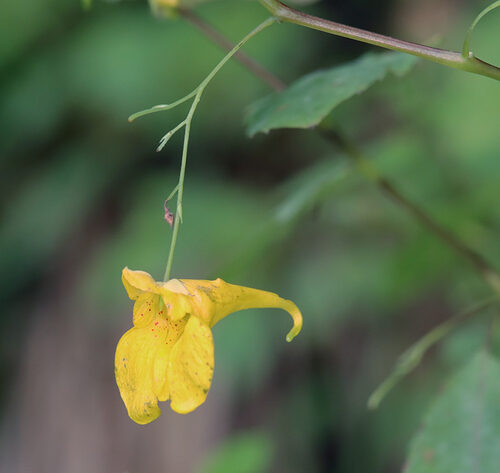
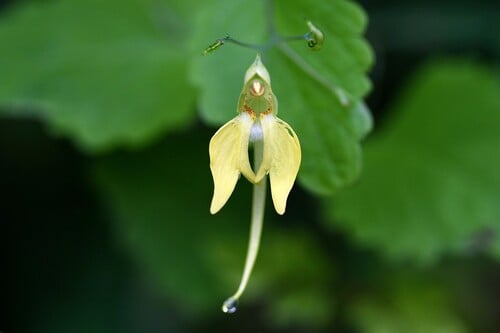
Impatiens capensis
Meerb.
Jewelweed
iNaturalist· cc-by-nc
(c) Thomas Shahan, some rights reserved (CC BY-NC), uploaded by Thomas Shahan
iNaturalist· cc-by
(c) Michael J. Papay, some rights reserved (CC BY), uploaded by Michael J. Papay
iNaturalist· cc-by-sa
(c) Douglas Goldman, some rights reserved (CC BY-SA), uploaded by Douglas Goldman
Description
Impatiens capensis is a ANNUAL growing to 1.2 m (4ft) at a fast rate. See above for USDA hardiness. It is hardy to UK zone 2. It is in flower from July to October. The species is hermaphrodite (has both male and female organs) and is pollinated by Bees. The plant is self-fertile. Suitable for: light (sandy), medium (loamy) and heavy (clay) soils and can grow in heavy clay soil. Suitable pH: mildly acid, neutral and basic (mildly alkaline) soils. It can grow in semi-shade (light woodland) or no shade. It prefers moist soil.
Edible Uses
The succulent stems, whilst still young and tender, can be cut up and cooked like green beans. Young leaves and shoots - cooked. They contain calcium oxalate crystals. Calcium oxalate is usually destroyed by thorough cooking. Large quantities of the leaves are purgative. See also the notes above on toxicity.
Medicinal Uses
Antidote Poultice Stings Warts. Jewelweed was commonly used as a medicinal herb by a number of native North American Indian tribes, and has been widely used in domestic medicine. Its main value lies in its external application for wounds and a range of skin complaints. However, it is little used in modern herbalism and is considered to be dangerous and 'wholly questionable' when used internally. The herb is antidote, cathartic, diuretic and emetic. An infusion has been used in the treatment of fevers, difficult urination, measles, stomach cramps, jaundice etc. The juice of the leaves is used externally in the treatment of piles, fungal dermatitis, nettle stings, poison ivy rash, burns etc[4, 172, 207, 213, 257]. The sap is used to remove warts. A poultice of the leaves is applied to bruises, burns, cuts etc.
Known Hazards
Regular ingestion of large quantities of these plants can be dangerous due to their high mineral content. This report, which seems nonsensical, might refer to calcium oxalate. This mineral is found in I. capensis and so is probably also in other members of the genus. It can be harmful raw but is destroyed by thoroughly cooking or drying the plant. People with a tendency to rheumatism, arthritis, gout, kidney stones and hyperacidity should take especial caution if including this plant in their diet.
Distribution
N. America - Newfoundland to Saskatchewan. Naturalized in Britain.
Where It Grows
NORTHERN AMERICA: Canada (Northwest Territories (southwest), Québec, Nova Scotia, Ontario, Prince Edward Island, New Brunswick, Newfoundland and Labrador, Saskatchewan, Alberta, Manitoba), United States (Connecticut, Indiana, Maine, Massachusetts, Michigan, New Hampshire, New Jersey, New York, Ohio, Pennsylvania, Rhode Island, Vermont, West Virginia, Illinois, Iowa, Kansas (east & north), Minnesota, Missouri, Nebraska, North Dakota (east), Oklahoma (east), South Dakota, Wisconsin, Alabama, Arkansas, Delaware, Florida, Georgia, Kentucky, Louisiana, Maryland, Mississippi, North Carolina, South Carolina, Tennessee, Virginia, Texas)
Cultivation
Succeeds in any reasonably good soil. Grows well in heavy clay soils. Prefers a moist well-drained humus rich soil in a cool shady site. Plants self-sow in areas where minimum winter temperatures go no lower than -15°c. This plant has seed capsules that spring open forcibly as the seed ripens to eject the seed a considerable distance. The capsules are sensitive to touch even before the seed is ripe, making seed collection difficult but fun.
Propagation
Seed - sow spring in a greenhouse. When they are large enough to handle, prick the seedlings out into individual pots and plant them out in the summer.
Other Uses
Dye Fungicide. The fresh juice obtained from the plant is a fungicide. This juice can be concentrated by boiling it. A yellow dye has been made from the flowers. It can be made from the whole plant.