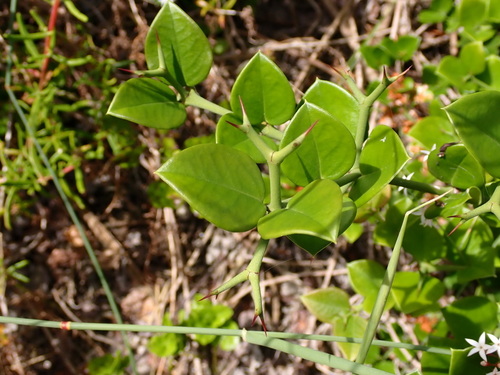
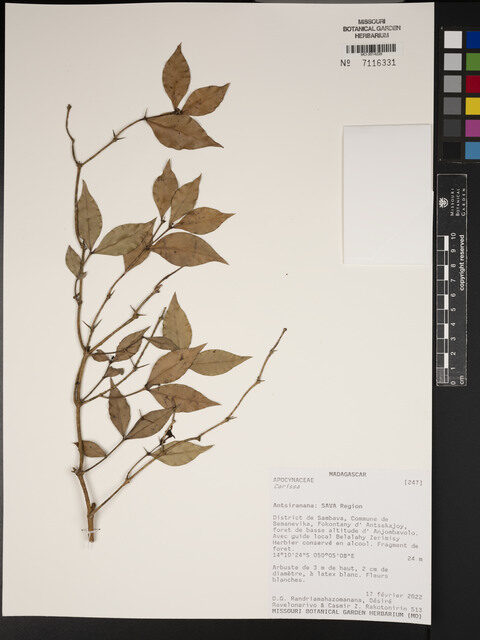
Carissa tetramera
(Sacleux) Stapf
Sand num-num
iNaturalist· cc-by-nc
(c) Malcolm, some rights reserved (CC BY-NC)
iNaturalist· cc-by-nc
(c) Malcolm, some rights reserved (CC BY-NC)
iNaturalist· cc-by-nc
(c) Malcolm, some rights reserved (CC BY-NC)
Summary
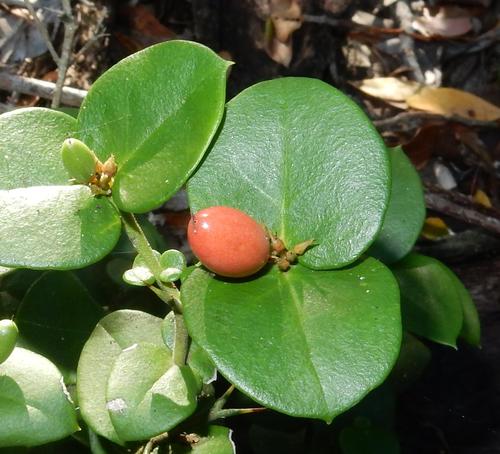
Source: WikipediaCarissa tetramera, the sand num-num, is a plant in the dogbane family Apocynaceae. The specific epithet tetramera means 'four parts', referring to the flower.
Description
A shrub. It grows up to 3 m high. The spines are usually forked and 5 cm long. The leaves are 4.5 cm long by 2.5 cm wide. They are rounded at the base and also often at the tip. They are more pale underneath. The flower clusters are rather small. The fruit are round and 1 cm across. They are purplish-black and have 4 or 5 seeds.
Edible Uses
The fruit are eaten raw and also used for a drink. The roots are also edible.
Traditional Uses
The fruit are eaten raw and also used for a drink.
This uses section is brief — help expand it
Distribution
It is a tropical plant. It grows in dry open woodland. It grows in coastal areas.
Where It Grows
Africa, East Africa, Eswatini, Kenya, Mozambique, South Africa, Southern Africa, Swaziland, Tanzania, Zimbabwe,
Notes
There about 20-37 Carissa species. All Carissa species bear edible fruit. They grow in the tropics and subtropics.
Synonyms
Also Known As
Muleo, Mtandamboo, Murungulu, Nvuje-ya-tsi
References (12)
- East African Herbarium records, 181,
- Ferns, Tropical Plants
- Magwede, K., van Wyk, B.-E., & van Wyk, A. E., 2019, An inventory of Vhavenḓa useful plants. South African Journal of Botany 122 (2019) 57–89
- Mutie, F. M., et al, 2023, Important Medicinal and Food Taxa (Orders and Families) in Kenya, Based on Three Quantitative Approaches. Plants 2023, 12, 1145
- Pakia, M., 2000, Plant Ecology and Ethnobotany of two sacred forests (Kayas) at the Kenya Coast. M. Sc. Thesis.
Show all 12 references Hide references
- Peters, C. R., O'Brien, E. M., and Drummond, R.B., 1992, Edible Wild plants of Sub-saharan Africa. Kew. p 57
- Ruffo, C. K., Birnie, A. & Tengnas, B., 2002, Edible Wild Plants of Tanzania. RELMA p 187
- Ruiters-Welcome, A. K., 2019, Food plants of southern Africa. Ph.D. thesis. Univ. of Johannesburg p 23
- Schmidt, E., Lotter, M., & McCleland, W., 2007, Trees and shrubs of Mpumalanga and Kruger National Park. Jacana Media p 560
- Swaziland's Flora Database http://www.sntc.org.sz/flora
- Welcome, A. K. & Van Wyk, B.-E., 2019, An inventory and analysis of the food plants of southern Africa. South African Journal of Botany 122 (2019) 136–179
- World Checklist of Useful Plant Species 2020. Royal Botanic Gardens, Kew