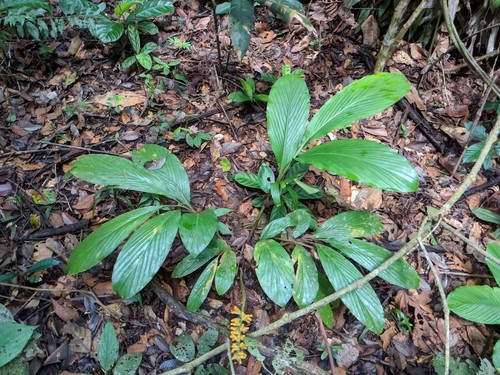
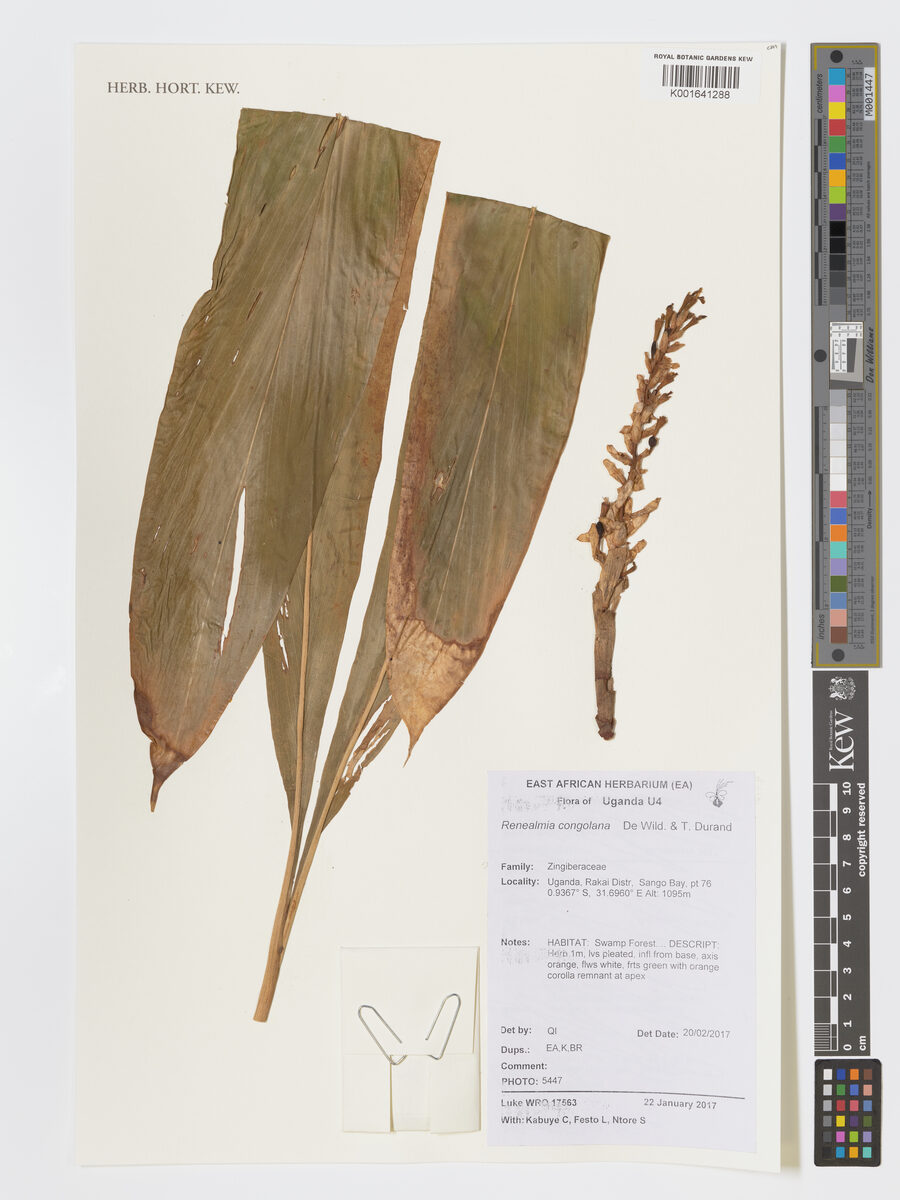
Aframomum corrorima
(Braun) Jansen
Korarima, Ethiopian cardamom
iNaturalist· cc-by-nc
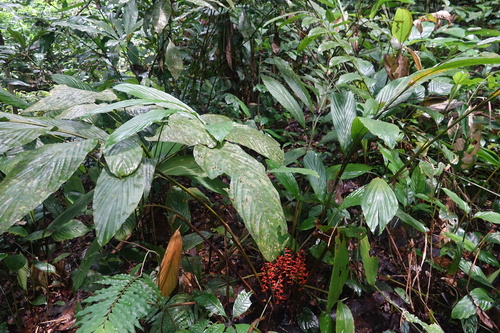
(c) Mitiku Muanenda, some rights reserved (CC BY-NC), uploaded by Mitiku Muanenda
wikimedia· cc-by-sa
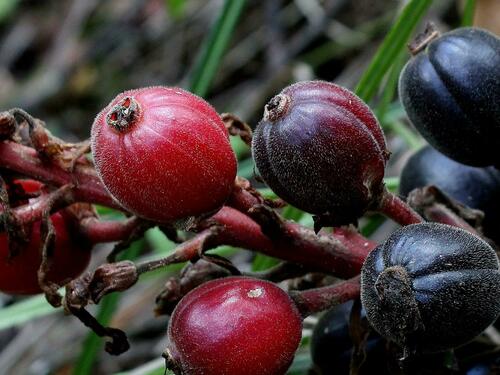
Wikimedia Commons - Joe Castleman (Gyrofrog)
wikimedia· cc-by-sa
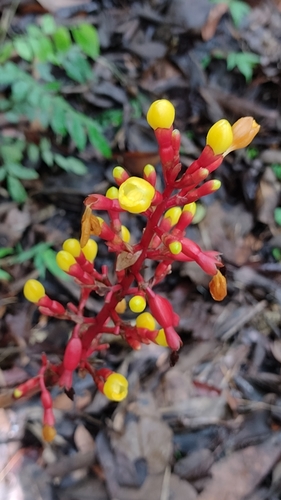
Wikimedia Commons - Joe Castleman (Gyrofrog)
Summary
Source: WikipediaAframomum corrorima is a species of flowering plant in the ginger family, Zingiberaceae. It is an herbaceous perennial that produces leafy stems 1–2 meters tall from rhizomatous roots. The alternately-arranged leaves are dark green, 10–30 cm long and 2.5–6 cm across, elliptical to oblong in shape. Pink flowers are borne near the ground and give way to red, fleshy fruits containing shiny brown seeds, which are typically 3–5 mm in diameter. The spice, known as Ethiopian cardamom, false cardamom, or korarima, is obtained from the plant's seeds (usually dried), and is extensively used in Ethiopian and Eritrean cuisine. It is an ingredient in berbere, mitmita, awaze, and other spice mixtures, and is also used to flavor coffee. Its flavor is comparable to that of the closely related Elettaria cardamomum or green cardamom. In Ethiopian herbal medicine, the seeds are used as a tonic, carminative, and laxative. The plant is native to Tanzania, western Ethiopia (in the vicinity of Lake Tana and Gelemso), southwestern Sudan, western Uganda. It is cultivated in both Ethiopia and Eritrea, although the fruits are typically harvested from wild plants. The dried fruits are widely sold in markets and are relatively expensive, while fresh fruits are sold in production areas. In dried seeds and pods, the major oil components are 1,8-cineole (eucalyptol) and (E)-nerolidol. In fresh seeds, the major component of the essential oil is 1,8-cineole, followed by sabinene and geraniol. In fresh pods, the major oil constituents are γ-terpinene, β-pinene, α-phellandrene, 1,8-cineole, and p-cymene.
Description
A ginger family herb that keeps growing from year to year. It has underground stems or rhizomes. It grows 1-2 m tall. The rhizome can be 1 cm across. The stem is mostly formed from sheaths of the leaves. The leaves are alternate and 10-30 cm long by 3-6 cm wide. They are dark green on top and paler underneath. The flowers are in a short stalked head. This is near the base of the leafy stem. The fruit is a cone shaped berry 6 cm long by 3.5 cm across. It has 3 cells and 45-65 seeds. The seeds are 2-5 mm across.
Edible Uses
The dried seeds and the layer around them are edible, used to flavour sauces, coffee, tea, bread, butter, cakes, sausages, stews, and spice mixtures.
Traditional Uses
The dried seeds are used to flavour sauces. They are also used to flavour coffee, tea, bread and butter. The layer around the seeds is edible. The fruit are used as seasoning for cakes, tea, sausages, stews and breads. It is also used in a spice mixture.
Medicinal Uses
The seeds are carminative, purgative and tonic.
Distribution
It is a tropical plant. In Ethiopia it grows between 1,700-2,000 m altitude. It is usually in slightly shaded spots in rainforest. It suits humid locations. The temperature is about 20°C.
Where It Grows
Africa, East Africa, Eritrea, Ethiopia, Somalia, Sudan, Tanzania, Uganda, Africa,
Cultivation
Plants can be grown from seeds or from part of the rhizome.
Propagation
Seed - Division of rhizomes.
Other Uses
Strings of the fruits are sometimes used as an ornament, or as rosaries. About 3 - 3.5% of a pale yellow essential oil can be obtained by distillation of the dried powdered fruits.
Production
Fruit mature about 2-3 months after flowering. The fruit are harvested when mature and red and then are well dried. Plants can last for 10 years.
Other Information
It is commonly sold in local markets. It is a cultivated food plant.
Notes
There are about 50 Aframomum species.
Synonyms
Also Known As
Guragi spice, Kewrerima, Nutmeg cardamom, Ogiyo, Ogiyoo
References (14)
- Brown, D., 2002, The Royal Horticultural Society encyclopedia of Herbs and their uses. DK Books. p 105 (As Aframomum korarima)
- Burkill, I.H., 1966, A Dictionary of the Economic Products of the Malay Peninsula. Ministry of Agriculture and Cooperatives, Kuala Lumpur, Malaysia. Vol 1 (A-H) p 61 (As Aframomum korarima)
- e-monocot.org/taxon/urn:kew.org:wcs:taxon:218357
- H. G. A. Engler & C. G. O. Drude, Veg. Erde 9(II):386. 1908 (Pflanzenw. Afrikas) (As (Baker) Cout. ex Engl.) (As Aframomum korarima)
- Facciola, S., 1998, Cornucopia 2: a Source Book of Edible Plants. Kampong Publications, p 247 (As Aframomum korarima)
Show all 14 references Hide references
- Jansen, P.C.M., 2002. Aframomum corrorima (Braun) P.C.M.Jansen. [Internet] Record from Protabase. Oyen, L.P.A. & Lemmens, R.H.M.J. (Editors). PROTA (Plant Resources of Tropical Africa / Ressources végétales de l’Afrique tropicale), Wageningen, Netherlands. < http://database.prota.org/search.htm>. Accessed 13 October 2009.
- Kunkel, (As Aframomum kokarima)
- Molla, A., Ethiopian Plant Names. http://www.ethiopic.com/aplants.htm (As Aframomum korarima)
- Peters, C. R., O'Brien, E. M., and Drummond, R.B., 1992, Edible Wild plants of Sub-saharan Africa. Kew. p 42
- Raghavan, S., 2007, Handbook of Spices, Seasonings, and Flavourings. Second Edition. CRC Press p 80
- Seidemann J., 2005, World Spice Plants. Economic Usage, Botany, Taxonomy. Springer. p 9 (As Aframomum korarima)
- Senbeta, F., et al, 2013, Diversity of Useful Plants in the Coffee Forests of Ethiopia. Ethnobotany Research & Applications 11:049-069
- Siegenthaler,
- Wiersema, J. H. & Leon, B., 2013, World Economic Plants. A Standard Reference CRC Press. 2nd Ed. p 22 World Checklist of Useful Plant Species 2020. Royal Botanic Gardens, Kew