Amyema congener
(Sieber ex Schult. & Schult.f.) Tiegh.
Mistletoe
iNaturalist· cc-by-nc
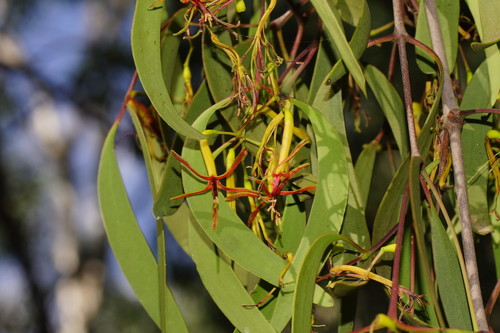
(c) Russell Cumming, some rights reserved (CC BY-NC), uploaded by Russell Cumming
iNaturalist· cc-by-nc
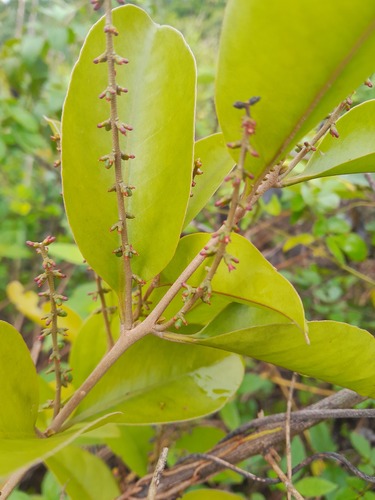
(c) cirolana, some rights reserved (CC BY-NC)
iNaturalist· cc-by-nc
(c) leithallb, some rights reserved (CC BY-NC), uploaded by leithallb
Summary
Source: WikipediaAmyema congener, commonly known as the variable mistletoe, is a species of flowering plant, an epiphytic hemiparasitic plant of the family Loranthaceae from eastern Australia. It is found on members of the genera Allocasuarina, Acacia and some exotic species. Franz Sieber first described this species as Loranthus congener in 1829, before Philippe Édouard Léon Van Tieghem gave it its current binomial name in 1894. It grows as shrubby plant, with either an erect or pendant (drooping) habit, from a tree branch or trunk. It is attached to the host tree by a globular woody base. The stems and foliage are smooth. The thick leathery leaves are spear-shaped (lanceolate) to oval or obovate and measure 4–11 cm (1.5–4.5 in) in length and 1–5.5 cm (0.39–2.17 in) across. Flowers can be seen at any time of year. The 0.8 cm (0.31 in) diameter round fruit ripen over the summer (December to February), and the single seed within is contained in a sticky membrane. The principal host plant of the variable mistletoe is the black sheoak (Allocasuarina littoralis) also forest oak (A. torulosa), gossamer wattle (Acacia floribunda), white feather honeymyrtle (Melaleuca decora), prickly-leaved tea tree (M. styphelioides), prickly-leaved paperbark (M. nodosa), snow-in-summer (M. linariifolia), green native cascarilla (Croton verreauxii), red olive plum (Elaeodendron australe), as well as introduced trees such as peach and plum trees, pear trees, and oleander (Nerium oleander). It is only occasionally on gum trees such as Eucalyptus obtusifolia and smooth-barked apple Angophora costata. The mistletoebird (Dicaeum hirundinaceum) eats the fruit. Scale insect species such as Ceroplastes cerciferus, C. rubens, and Aspidiotus aurantii can attack the plant. The seed immediately begins to germinate and soon penetrates the vascular system of the tree and creates a physiological connection with the xylem of the new host. From that point, the seedling begins to obtain water and mineral nutrients from the host.
Description
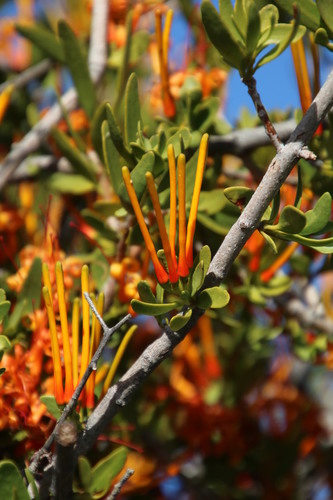
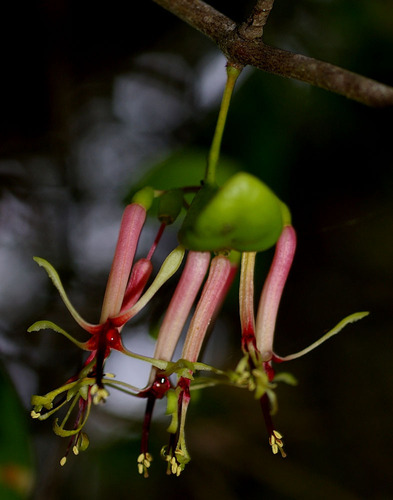
A shrub that grows attached to other plants. New growth can have white matted hairs. The leaves are opposite and leathery. They are oval to sword shaped and 3-10 cm long by 1-5.5 cm wide. The flowers are club shaped. They are red and yellow with green tips. They are clustered in groups of 3.
Edible Uses
The ripe fruit are eaten raw.
Traditional Uses
The ripe fruit are eaten raw.
This uses section is brief — help expand it
Distribution
It is a subtropical plant. It grows in NSW in Australia. It normally grows on Eucalypts.
Where It Grows
Australia*,
Cultivation
It grows by seed. It usually grows on Eucalyptus.
Synonyms
References (4)
- Bodkin, F., 1991, Encyclopedia Botanica. Cornstalk publishing, p 77
- Pearson, S. & A., 1992, Rainforest Plants of Eastern Australia. Kangaroo Press p 27
- Ryan, M. (Ed.), 2003, Wild Plants of Greater Brisbane. Queensland Museum. p 127
- Steenbeeke, Greg as part of the Plants Directory project. List of plant species from northern NSW that may be used as food plants p 5