Amyema bifurcata
(Benth.) Tieghem.
iNaturalist· cc-by-nc
(c) Geoffrey Sinclair, some rights reserved (CC BY-NC), uploaded by Geoffrey Sinclair
iNaturalist· cc-by-nc
(c) Heather Knowles, some rights reserved (CC BY-NC)
Summary
Source: WikipediaAmyema bifurcata is an epiphytic, flowering, hemiparasitic plant of the family Loranthaceae native to Australia and found in Western Australia, the Northern Territory, Queensland and New South Wales.
Description
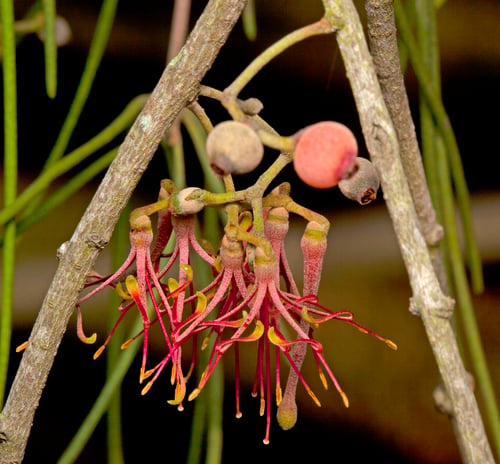
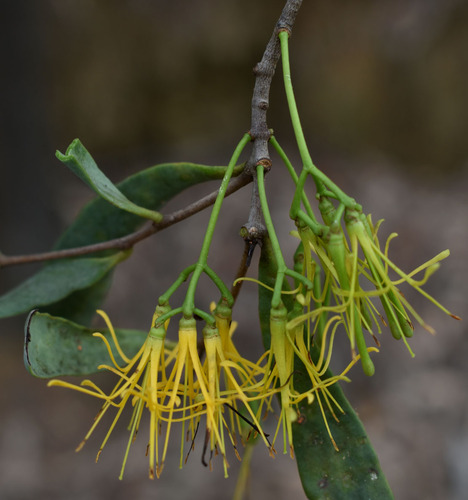
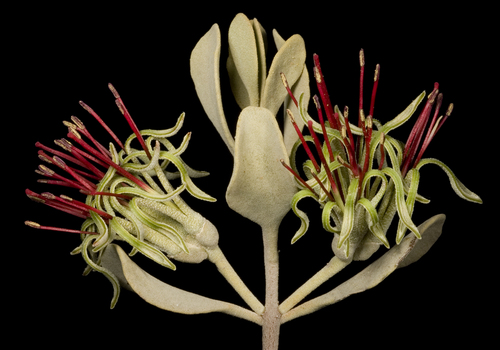
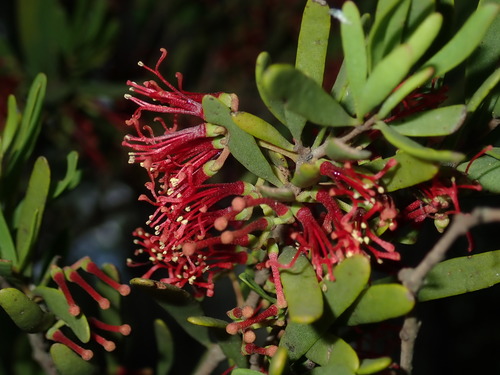
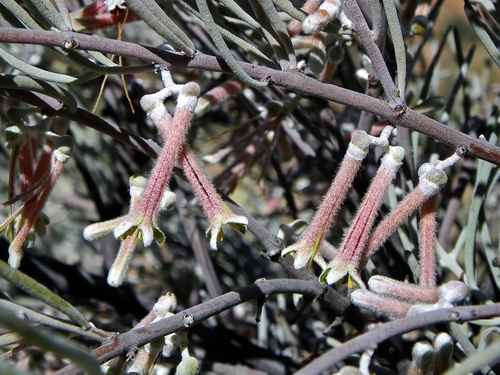
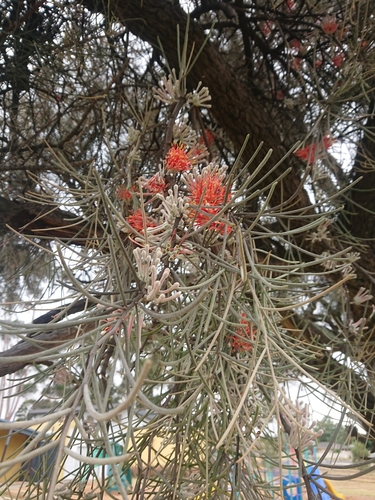
A mistletoe. It grows on Acacia, Angophora, Corymbia and Eucalyptus species. It hangs down and does not have runners. It can have rusty scales or hairs. The leaves are simple and 7-35 cm long by 1-2.5 cm wide. They do not have hairs. The leaf stalk is 1-4 cm long. The flowers are in a group in the axils of leaves or near the ends of branches. There are 5-6 red petals. The flowers are 2-3 mm long. The fruit is a yellow or orange berry. They are 1 cm long.
Edible Uses
The fruit is eaten raw and the flower nectar can be consumed.
Known Hazards
The seeds should not be eaten.
Distribution
It is a tropical and subtropical plant. In tropical Queensland it grows between 140-800 m altitude.
Where It Grows
Australia*,
Notes
There are about 90-100 Amyema species. In Australia there are about 70 species of mistletoe in the Amyema and Mullerina genera and they all have edible fruit. The seeds should not be eaten.
Synonyms
Also Known As
Nyilanyil
References (13)
- Cancilla, D., 2018, Ethnobotanical and Ethnozoological Values Desktop Assessment - Eliwana Project. p 10
- Cherikoff V. & Isaacs, J., The Bush Food Handbook. How to gather, grow, process and cook Australian Wild Foods. Ti Tree Press, Australia p 194, 198
- Cooper, W. and Cooper, W., 2004, Fruits of the Australian Tropical Rainforest. Nokomis Editions, Victoria, Australia. p 269
- Kenneally, K.E., Edinger, D. C., and Willing T., 1996, Broome and Beyond, Plants and People of the Dampier Peninsula, Kimberley, Western Australia. Department of Conservation and Land Management. p 116
- Lazarides, M. & Hince, B., 1993, Handbook of Economic Plants of Australia, CSIRO. p 19
Show all 13 references Hide references
- Paczkowska, G. & Chapman, A.R., 2000, The Western Australian Flora. A Descriptive Catalogue. Western Australian Herbarium. p 283
- Smith, M & Kalotas, A. C., 1985, Bardi Plants: An Annotated List of Plants and Their Use by the Bardi Aborigines of Dampierland, in North-western Australia. Rec. West Aust. Mus. 1985, 12(3): 317-359
- Steenbeeke, Greg as part of the Plants Directory project. List of plant species from northern NSW that may be used as food plants p 5
- Wheeler, J.R.(ed.), 1992, Flora of the Kimberley Region. CALM, Western Australian Herbarium, p 571
- Wightman, Glenn et al. 1991.Alawa Ethnobotany: Aboriginal Plant Use from Minyerri, Northern Australia. Northern Territory Botanical Bulletin No 11. Parks and Wildlife Commission of the Northern Territory. p 4
- Wightman, Glenn et al. 1992. Mudburra Ethnobotany: Aboriginal Plant Use from Kulumindini (Elliott) Northern Australia. Northern Territory Botanical Bulletin No 14. Parks and Wildlife Commission of the Northern Territory. p 10, 9
- Wightman, Glenn et al. 1992, Mangarrayi Ethnobotany: Aboriginal Plant Use from the Elsey Area Northern Australia. Northern Territory Botanical Bulletin No 15. Parks and Wildlife Commission of the Northern Territory. p 8, 9.
- Wightman, Glenn et al. 1994, Gurindji Ethnobotany: Aboriginal Plant Use from Daguragu Northern Australia. Northern Territory Botanical Bulletin No 18. Parks and Wildlife Commission of the Northern Territory. p. 12, 11.