Russula brevipes
Peck.
Short-stemmed Russula
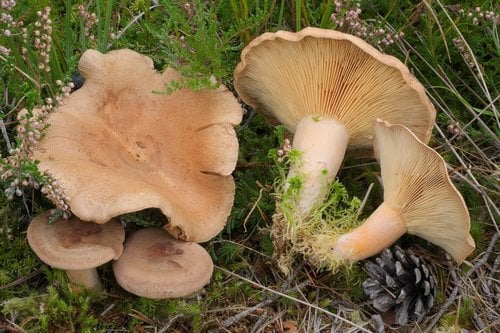
iNaturalist· cc-by-nc
(c) T. Abe Lloyd, some rights reserved (CC BY-NC)
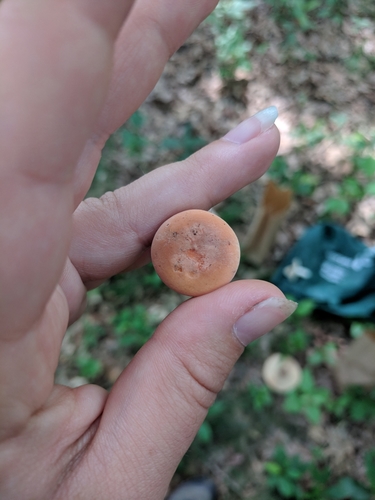
iNaturalist· cc-by-nc
(c) Harte Singer, some rights reserved (CC BY-NC)
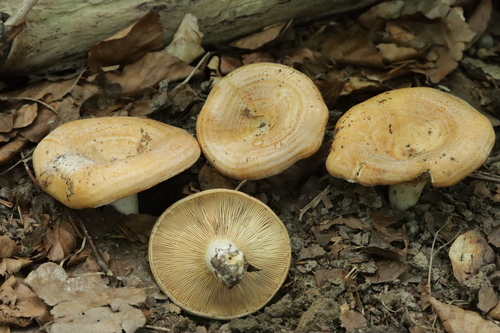
iNaturalist· cc-by-nc
(c) Harte Singer, some rights reserved (CC BY-NC)
Summary
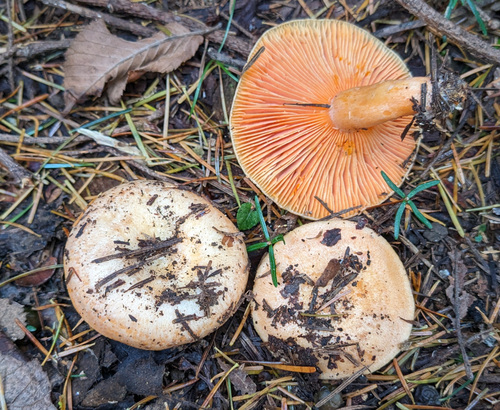
Source: WikipediaRussula brevipes is a species of mushroom commonly known as the short-stemmed russula or the stubby brittlegill. The fruit bodies are white and large, with convex to funnel-shaped caps measuring 7–30 cm (3–12 in) wide set atop a thick stipe up to 8 cm (3 in) long. The gills on the cap underside are closely spaced and sometimes have a faint bluish tint. The spores are roughly spherical and have a network-like surface dotted with warts. Forms of the mushroom that develop a bluish band at the top of the stipe are sometimes referred to as variety acrior. Fruiting from summer to autumn, the mushrooms often develop under masses of leaves or conifer needles in a mycorrhizal association with trees from several genera, including fir, spruce, Douglas-fir, and hemlock. It is widespread in North America, and was reported from Pakistan in 2006. Although edible, the mushrooms have a bland or bitter flavor. They become more palatable once parasitized by the ascomycete fungus Hypomyces lactifluorum, a bright orange mold that covers the fruit body and transforms them into lobster mushrooms.
Description
A mushroom in the Russulaceae family found in temperate regions and sold in local markets.
This description is brief — help expand it
Edible Uses
The mushroom is edible.
Distribution
It is a temperate plant.
Where It Grows
Alaska, Mexico, North America, USA,
Other Information
It is sold in local markets.
Also Known As
Borrego
References (10)
- Boa, E. R., 2004, Wild edible fungi and their importance to people. FAO Non Wood Forest Products Booklet 17
- Cortes, L.E.U., et al, 2018, Ethnomycology and mushroom selling in a market from Northwest Puebla, México. Scientia Fungorum vol. 47: 47-55
- Farfan B., et al, 2007, Mazahua Ethnobotany and Subsistence in the Monarch Butterfly Biosphere Reserve, Mexico. Economic Botany 61(2) pp 173-191
- Guild, B., 1979, The Alaskan Mushroom Hunter's Guide. Alaska Northwest Publishing Company. p 94
- Montoya, A., et al, 2014, Availability of Wild Edible Fungi in La Malinche National park, Mexico. Journal of Mycology. Article ID 241896, 15 pages
Show all 10 references Hide references
- Ostry, M. E., et al, 2010, Field Guide to Common Macrofungi in Eastern Forests and Their Ecosystem Functions. USDA Forest Service General Technical Report NRS-79 p 71
- Perez-Moreno, J. et al, 2008, Wild Mushroom Markets in Central Mexico and a Case Study at Ozumba. Economic Botany, 62(3), 2008, pp. 425–436
- Perez-Moreno, J., et al, 2009, Social and Biotechnological Studies of Wild Edible Mushrooms in Mexico. Acta Botanica Yunnanica Suppl. XV1: 55-61
- Quinonez-Martinez, M., et al, 2014, Knowledge and use of edible mushrooms in two municipalities of the Sierra Tarahumara, Chihuahua, Mexico. Journal of Ethniobiology and Ethnomedicine 10:6
- Zamora-Martinez, M. et al, 1995, Natural production of wild edible mushrooms in the southwestern rural territory of Mexico City, Mexico. Forest Ecology and Management 72:13-20