Solanum capsicoides
Allioni
Cockroach berry, Red popolo
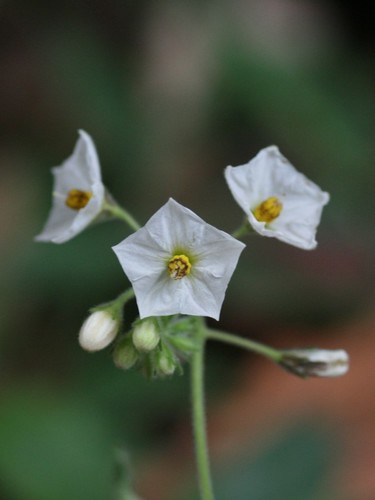
iNaturalist· cc-by
(c) Diogo Luiz, some rights reserved (CC BY), uploaded by Diogo Luiz
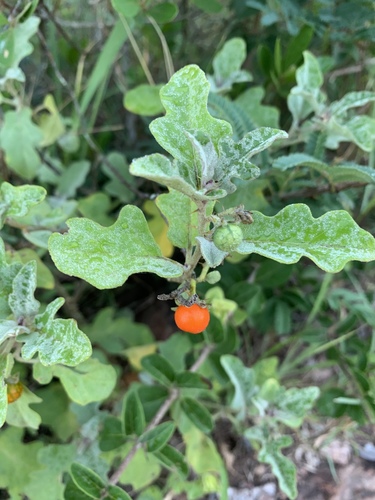
iNaturalist· cc-by-nc
(c) jg91, some rights reserved (CC BY-NC)
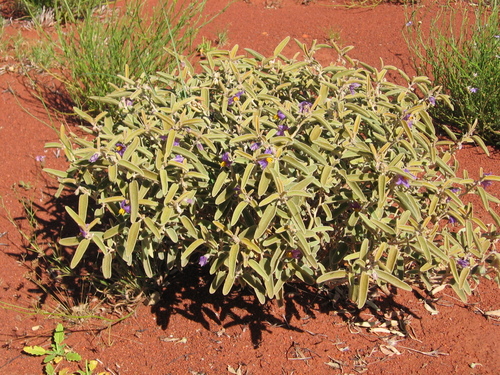
iNaturalist· cc-by-nc
(c) dannyz, some rights reserved (CC BY-NC)
Summary
Source: WikipediaSolanum capsicoides, the cockroach berry, is a species of flowering plant in the family Solanaceae. It is native to eastern Brazil but naturalized in other tropical regions, where it sometimes becomes an invasive weed.
Description
A shrub. It grows 1 m tall. It has soft hairs and also prickles. The leaf stalk is 8 cm long. The leaf blades are broadly oval and 15 cm long. They have coarse teeth or lobes. There are 2-5 flowers in a group. The flower calyx is deeply 5 lobed. The fruit are round and 2-4 cm across.
Edible Uses
The fruits are edible when roasted or cooked in curry.The fruit is poisonous. Children have been observed eating the soft inner pericarp which has a faint banana flavour. This practice cannot be condoned. The orange-red, globose to depressed globose fruit is 25 - 30mm in diameter.
Traditional Uses
The fruit are cooked and eaten as a vegetable. Caution: The fruit are probably poisonous unless cooked.
This uses section is brief — help expand it
Medicinal Uses
The fruits, charred and pounded in oil, are used to treat skin complaints. The pounded roots have been applied to the gums as a remedy against toothache. The smoke of dried, pounded and burned seeds has been inhaled to cure an ulcerated nose.
Known Hazards
The fruits are poisonous. Suspected of being poisonous to stock but the evidence is not conclusive. Although providing many well-known foods for people, including the potato, tomato, pepper and aubergine, most species in this genus also contain toxic alkaloids. Whilst these alkaloids can make the plant useful in treaing a range of medical conditions, they can also cause problems such as nausea, vomiting, salivation, drowsiness, abdominal pain, diarrhoea, weakness and respiratory depression. Unless there are specific entries with information on edible uses, it would be unwise to ingest any part of this plant.
Distribution
A tropical plant. It has become widespread as a self sown plant in the tropics. In Asia it grows up to 1,500 m altitude. In Argentina it grows from sea level to 700 m above sea level. In Sichuan and Yunnan.
Where It Grows
Africa, Argentina, Australia, Brazil*, Burundi, China, Colombia, Dominican Republic, East Africa, Ethiopia, Guianas, Guyana, Haiti, Hawaii, India, Indochina, Indonesia, Laos, Malaysia, Marquesas, Mexico, Pacific, Paraguay, Puerto Rico, North America*, SE Asia, South America*, Sri Lanka, Suriname, Taiwan, Thailand, USA, Vietnam, West Africa, West Indies*, Zimbabwe,
Cultivation
A lowland species of humid or seasonally humid warm subtropical or tropical areas nearly or quite free from frost at elevations up to 1,500 metres. Probably preferring sandy habitats but also recorded from wet alluvial clay and limestone derived soils. The plant is widely grown for its ornamental fruit, and is now naturalized in many areas of the tropics. Plants can flower all year round.
Propagation
Seed - sow in trays in a nursery. Prick out the seedlings into individual pots when they are large enough to handle and grow them on fast. Plant them out when 10cm or more tall.
Other Information
It is cultivated.
Synonyms
Also Known As
Akaaka, Akaka, Joa-vermelho, Jua-ti, Kikania lei
References (15)
- Auctarium synops. meth. stirp. horti reg. Taurine 12. 1773 (Melanges Philos. Math. Soc. Roy. Turin 5:64. 1774)
- Brack, P., et al, 2020, Frutas nativas do Rio Grande do Sul, Brasil: riqueza e potencial alimentício. Native fruits of Rio Grande do Sul, Brazil: richness and potential as food. Rodriguésia 71: e03102018
- Burkill, I. H., 1966,
- Gori, B., et al, 2022, Understanding the diversity and biogeography of Colombian edible plants. Scientific Reports 12:7835
- Guinand, Y., & Lemessa, D., 2000, Wild-food Plants in Southern Ethiopia. University of Pennsylvania - African Studies Center. UN-EUE Addis Ababa. (As Solanum khasianum)
Show all 15 references Hide references
- Kinupp, V. F., 2007, Plantas alimenticias nao-convencionais da regiao metropolitana de Porto Alegre, RS, Brazil p 103
- Nzigidahera, B., 2006, Assessment of Socio-cultural, Economic Characteristics and Livelihood of Riparian Population of the Kibira National Park. (Rukoma-Mutana locality). UNDP p 30
- Plants of Haiti Smithsonian Institute http://botany.si.edu/antilles/West Indies
- PROSEA 12(1)
- Roa, J. A. G. & Boada, D. S. G., 2018, Fundación para el Fortalecimiento de la Fruticultura y Plantas Alimenticias no Convencionales en Colombia.
- Staples, G.W. and Herbst, D.R., 2005, A tropical Garden Flora. Bishop Museum Press, Honolulu, Hawaii. p 536 (Drawing)
- Tanaka, Y. & Van Ke, N., 2007, Edible Wild Plants of Vietnam. Orchid Press. p 138
- Wiersema, J. H. & Leon, B., 2013, World Economic Plants. A Standard Reference CRC Press. 2nd Ed. p 643
- World Checklist of Useful Plant Species 2020. Royal Botanic Gardens, Kew
- www.colecionandofrutas.org (As Solanum ciliatum)