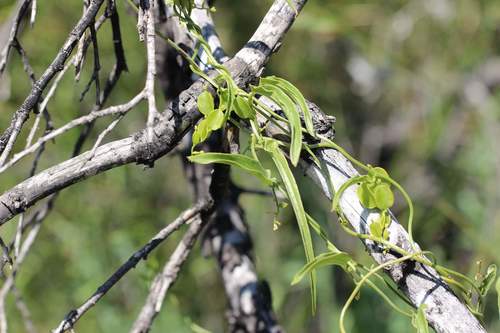
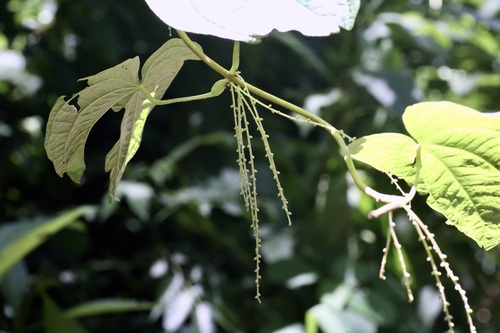
Tacca maculata
Seem.
Yabia sa
iNaturalist· cc-by-nc
(c) geoffbyrne, some rights reserved (CC BY-NC)
iNaturalist· cc-by-nc
(c) ksavo, some rights reserved (CC BY-NC)
iNaturalist· cc-by-nc
(c) ksavo, some rights reserved (CC BY-NC)
Summary
Source: WikipediaTacca maculata is a plant in the Dioscoreaceae family, native to Western Australia, the Northern Territory, Fiji and Samoa It was first described by Berthold Carl Seemann in 1866.
Description
A herb that keeps growing from year to year. It grows 1-2 m high. It forms tubers. The flowers are red to purple. It usually flowers after rain.
This description is brief — help expand it
Edible Uses
The tubers and roots are eaten.
Distribution
It is a tropical plant. It grows in sandy soils. It occurs in the Kimberley region in Western Australia. It grows in coastal areas but away from beaches.
Where It Grows
Australia, Fiji, Pacific, Samoa,
Notes
Also put in the family Taccaceae.
Synonyms
Also Known As
Langanggu
References (5)
- Crawford, I. M., 1982, Traditional Aboriginal Plant Resources in the Kalumburu Area: Aspects in Ethno-economics. Records of the Western Australian Museum Supplement No. 15
- Franklin, J., Keppel, G., & Whistler, W., 2008, The vegetation and flora of Lakeba, Nayau and Aiwa Islands, Central Lau Group, Fiji. Micronesica 40(1/2): 169–225, 2008
- RIRDC, 2010, New Root Vegetables for the Native Food Industry, Australian Government RIRDC Publication 9/161
- Smith, A.C., 1979, Flora Vitiensis Nova, Lawaii, Kuai, Hawaii, Volume 1 p 173
- Vigilante, T., et al, 2013, Island country: Aboriginal connections, values and knowledge of the Western Kimberley islands in the context of an island biological survey. Records of the Western Australian Museum Supplement 81: 145-182