Epiphyllum phyllanthus
(L.) Haw.
Alligator tail
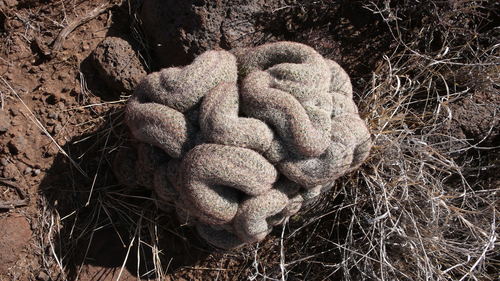
iNaturalist· cc-by
(c) Filipi Miranda Soares, some rights reserved (CC BY), uploaded by Filipi Miranda Soares
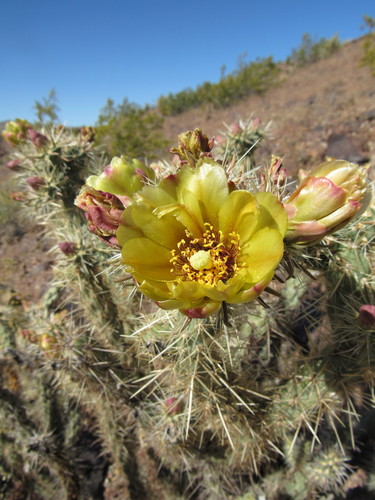
iNaturalist· cc-by-nc
(c) Marcus Athaydes, some rights reserved (CC BY-NC), uploaded by Marcus Athaydes
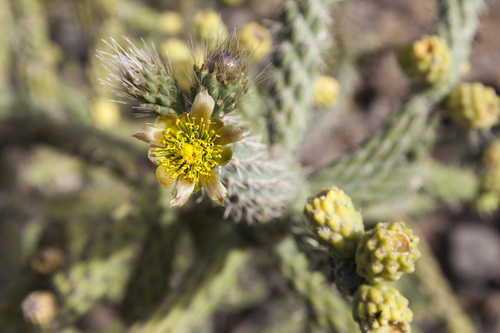
iNaturalist· cc-by-nc
(c) Alexandre Fonseca, some rights reserved (CC BY-NC), uploaded by Alexandre Fonseca
Summary
Source: WikipediaEpiphyllum phyllanthus, commonly known as the climbing cactus, is a species of epiphytic cacti. It has no leaves, instead having stems that photosynthesise. It is thought to be pollinated by hawkmoths, as the flowers only open at night and produce a strong fragrance. It is the most common epiphyte on the tree, Platypodium elegans, particularly growing in cavities in the trunk.
Description
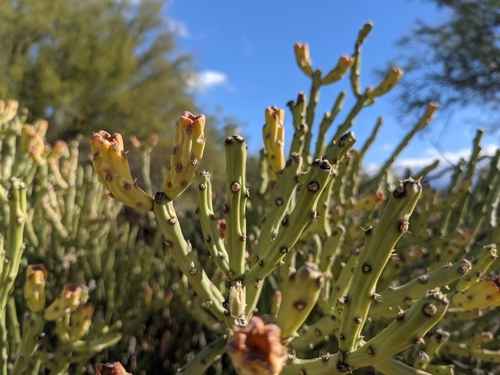
A succulent cactus. It grows attached to other plants but not feeding off them. The stems are flattened and branching. There are some aerial roots. Older plants have some spines. The flowers are tube shaped and occur singly. They open and night. The flowers have a scent. The fruit are narrowly oval. They are reddish-green and have an irregular surface. The sweet pulp has very small black seeds amongst it.
Edible Uses
Fruit - raw. A succulent, mucilaginous pulp with a slightly sweet flavour. The fruit is red with a white pulp.
Traditional Uses
The fruit are eaten fresh. They are sweet.
This uses section is brief — help expand it
Medicinal Uses
The leaves are used as a remedy for back pain, coughs and colds, as a laxative and as a remedy for whooping cough. The leaves are used to treat cripples and to heal cuts. An infusion of the plant is used to treat inflammation of the face, vaporizations are made and baths are also carried out. The plant is crushed, put on the fire and then placed on the body like a plaster, to immobilize the area affected by fractures. It is a common practice in Guatemala to bind the tough, wide stems of the various Epiphyllum species around fractures. They act as efficient bandages, hold the broken parts in place, and are popularly believed to aid in healing them. The fruit is eaten, accompanied by a glass of water, as a purgative.
Distribution
A tropical plant. It grows in forests in Brazil. In Argentina it grows from sea level to 1,000 m above sea level.
Where It Grows
Argentina, Bolivia, Brazil*, Central America, Colombia, Cuba, Ecuador, French Guiana, Guianas, Guyana, Mexico, Panama, Paraguay, South America, Suriname, Trinidad & Tobago, Uruguay, Venezuela, West Indies,
Cultivation
Plants are easily grow from cuttings.
Propagation
Seed - Stem cuttings.
Other Information
The fruit are not very popular.
Synonyms
Also Known As
Acutirem-biu, Akarerowai, Calaguala, Kaiukuchi hi, Matapalo, Nopalito de flor blanca, Pitahaya morada, Pitaia-rosea, Pitainha, Pitajaya, Punwi yuyu, Sacha pitajaya, Uccavo'si
References (13)
- Andel T. van, Non-timber forest products of the North-West District of Guyana. Part 2. A Field Guide. Tropenbos-Guyana Programme. p 257
- Bortolotto, I. M., et al, 2018, Lista preliminar das plantas alimenticias nativas de Mato Grosso do Sul, Brasil. Iheringia, Serie Botanica, Porto Alegre, 73 (supl.):101-116
- Brack, P., et al, 2020, Frutas nativas do Rio Grande do Sul, Brasil: riqueza e potencial alimentício. Native fruits of Rio Grande do Sul, Brazil: richness and potential as food. Rodriguésia 71: e03102018.
- Kermath, B. M., et al, 2014, Food Plants in the Americas: A survey of the domesticated, cultivated and wild plants used for Human food in North, Central and South America and the Caribbean. On line draft. p 338
- Lopez-Diago, D. & Garcia, N., 2021, Wild edible fruits of Colombia. Biota ColomBiana 22 (2) p 34
Show all 13 references Hide references
- Lorenzi, H., Bacher, L., Lacerda, M. & Sartori, S., 2006, Brazilian Fruits & Cultivated Exotics. Sao Paulo, Instituto Plantarum de Estuados da Flora Ltda. p 103
- Martin, F. W., et al, 1987, Perennial Edible Fruits of the Tropics. USDA Handbook 642 p 86 (As Epiphyllus)
- Roa, J. A. G. & Boada, D. S. G., 2018, Fundación para el Fortalecimiento de la Fruticultura y Plantas Alimenticias no Convencionales en Colombia.
- Segura, S. et al, 2018, The edible fruit species in Mexico. Genet Resour Crop Evol (2018) 65:1767–1793
- Syn. pl. succ. 197. 1812
- Torre, de la, L., et al, 2008, Enciclopedia de las Plantas Útiles del Ecuador. Herbario QCA. Pontificia Universidad Católica del Ecuador. p 267
- Vásquez, Ch. R. y S.G. Coimbra. 2002. Frutas silvestres comestibles de Santa Cruz, 2da edición.Editorial FAN, Santa Cruz de la Sierra, Bolivia.
- www.colecionandofrutas.org