Aspergillus oryzae
(Ahlburg) Cohn
Koji mould, Hama-natto mould, Hishio mould
iNaturalist· cc-by-nc
(c) Josh McGinnis, some rights reserved (CC BY-NC), uploaded by Josh McGinnis
wikimedia· cc-by-sa
Wikimedia Commons - Yulianna.x
Summary
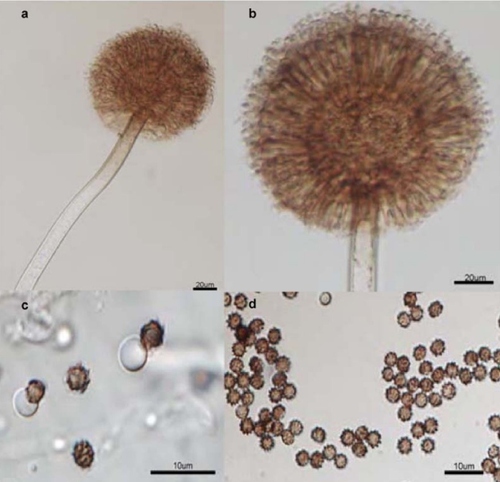
Source: WikipediaAspergillus oryzae, also known as kōji mold (Japanese: ニホンコウジカビ (日本麹黴), Hepburn: nihon kōji kabi), is a mold used in East Asia to saccharify rice, sweet potato, and barley in the making of alcoholic beverages such as sake and shōchū, and also to ferment soybeans for making soy sauce and miso. It is one of the different koji molds used for food fermentation. However, in the production of fermented foods of soybeans such as soy sauce and miso, Aspergillus sojae is sometimes used instead of A. oryzae. A. oryzae is also used for the production of rice vinegars. Barley kōji (麦麹) or rice kōji (米麹) are made by fermenting the grains with A. oryzae hyphae. The technique of solid-state cultivation using rice grains, soybeans, and wheat bran to propagate fungi for use in fermented foods is believed to have originated in China. However, there are two scholarly theories regarding the country that first employed A. oryzae in the production of fermented foods: one suggests it was China, while the other proposes it was Japan. Genomic analysis has led some scholars to believe that the Japanese domesticated the Aspergillus flavus that had mutated and ceased to produce toxic aflatoxins, giving rise to A. oryzae. While the two fungi share the same cluster of genes that encode for aflatoxin synthesis, this gene cluster is non-functional in A. oryzae. Eiji Ichishima of Tohoku University called the kōji fungus a "national fungus" (kokkin) in the journal of the Brewing Society of Japan, because of its importance not only for making the kōji for sake brewing, but also for making the kōji for miso, soy sauce, and a range of other traditional Japanese foods. His proposal was approved at the society's annual meeting in 2006. The Japanese word kōji (麹) is used in several meanings, and in some cases it specifically refers to A. oryzae and A. sojae, while in other cases it refers to all molds used in fermented foods, including Monascus purpureus and other molds, so care should be taken to avoid confusion.
Description
Koji is a blue mold in the family Aspergillaceae used in fermentation processes. It is found in temperate regions and is essential for producing traditional Asian fermented foods.
Edible Uses
The mold is used to ferment miso, amazake, shoyu, mirin, taosi, nuruk, and chiang-yiu. Koji pickles are eaten directly, and koji is used to remove odor from garlic which is then consumed as a nutritional supplement.
Traditional Uses
The mould is involved in the fermentation of miso, amazake, shoyu, mirin, taosi, nuruk, chiang-yiu and other products. Koji pickles are eaten. The Koji is used to remove odour from garlic which is then used for a nutritional supplement.
Distribution
It is a temperate plant.
Where It Grows
Asia, China, Japan,
References (3)
- Facciola, S., 1998, Cornucopia 2: a Source Book of Edible Plants. Kampong Publications, p 250
- Hu, Shiu-ying, 2005, Food Plants of China. The Chinese University Press. p 262
- Uphof,