Tamarix aphylla
(Linnaeus) H. Karsten
Athel tamarisk, Tamarix manna
iNaturalist· cc0
no rights reserved, uploaded by 葉子
iNaturalist· cc-by-nc
(c) Geoffrey Sinclair, some rights reserved (CC BY-NC), uploaded by Geoffrey Sinclair
iNaturalist· cc-by-nc
(c) Andrés Orduño, some rights reserved (CC BY-NC), uploaded by Andrés Orduño
Summary
Source: WikipediaTamarix aphylla is the largest known species of Tamarix, with heights up to 18 metres (59 ft). The species has a variety of common names, including Athel tamarisk, Athel tree, and Athel pine. It is an evergreen tree, native across North, East, and Central Africa, through the Middle East, and into parts of Western and Southern Asia.
Description
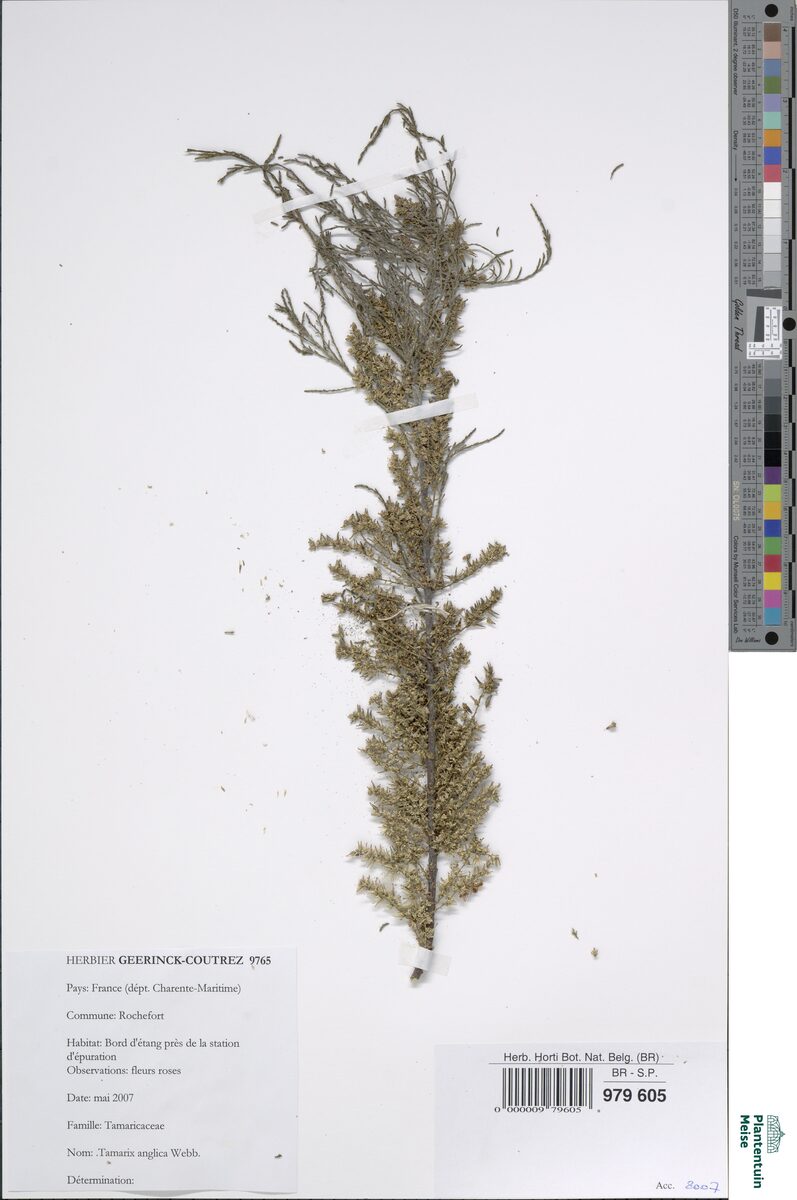
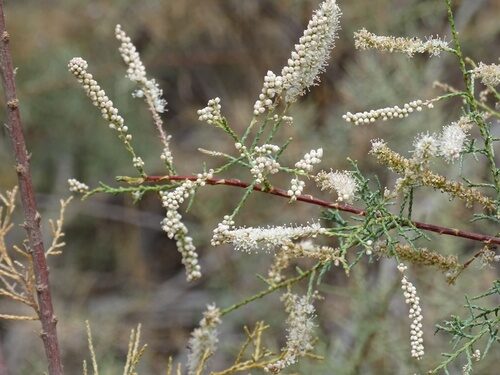
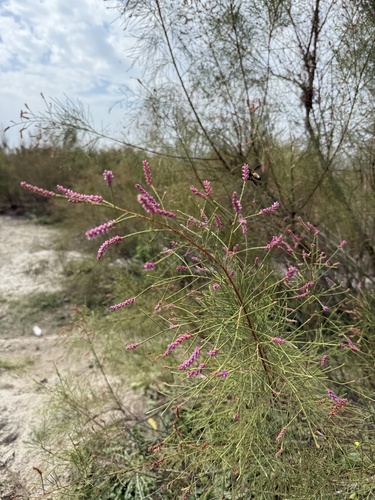
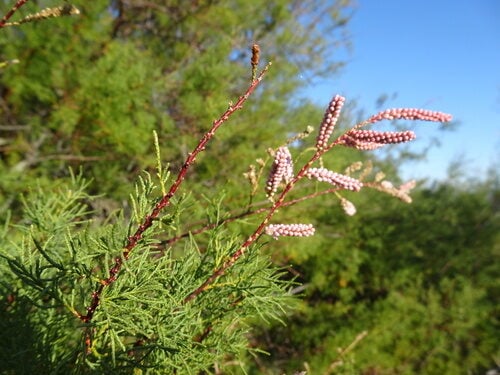
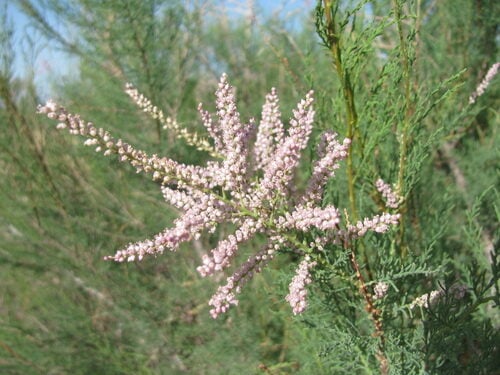
A shrub or tree. It grows 10 m tall. The bark is grey or reddish brown. The branches are erect and spreading. The leaves form a sheath around the small branches. The tip has an abrupt sharp point. The flowering shoot is 3-6 cm long. The flowers have 5 parts. They have a small flower stalk. The flowers are pinkish or white.
Edible Uses
A sweet, manna-like substance forms on the twigs and is used to adulterate cane sugar. It can also be eaten with porridge or mixed with water to make a refreshing drink.
Traditional Uses
The sweet manna from the twigs is eaten with porridge or mixed with water to make a drink.
This uses section is brief — help expand it
Medicinal Uses
The galls are astringent. The bark is astringent and bitter.
Distribution
It is a Mediterranean plant. It grows well in desert regions. It will tolerate salt spray and salty soils. It can grow in arid places. It grows in the Sahara. In Northeastern India it grows up to 900 m above sea level.
Where It Grows
Afghanistan, Africa, Algeria, Arabia, Asia, China, Dominican Republic, East Africa, Egypt, Eritrea, Ethiopia, Hawaii, India, Iran, Iraq, Israel, Jordan, Kenya, Kuwait, Libya, Mediterranean, Middle East, Morocco, North Africa*, Oman, Pacific, Pakistan, Saudi Arabia, Senegal, Somalia, Taiwan, Tunisia, USA, West Africa, West Indies, Yemen,
Cultivation
It can be grown from cuttings.
Propagation
Sow seed in spring in a cold frame, barely covering it. When large enough to handle, prick seedlings into individual pots and grow on in the greenhouse through their first winter, then plant out in late spring or early summer after the last expected frosts. Cuttings of half-ripe wood taken in July or August root very easily in a frame. Cuttings of mature wood from the current season's growth, 15–25cm long, can be planted outdoors in late autumn in a nursery bed or directly into their permanent position at a high success rate.
Other Uses
The plant is very tolerant of maritime exposure and makes a good shelter hedge in coastal gardens. Galls produced on the twigs and flowers — probably as a result of insect activity — contain up to 55% tannin. The wood has been used for fuel.
Synonyms
Also Known As
Dhuur, Ghaaz, Ghaz, Ghazga, Khora-gaz, Lathel
References (12)
- Barkatullah and Ibrar, M., 2011, Plants profile of Malakand Pass Hills, District Malakand, Pakistan. African Journal of Biotechnology Vol. 10 (73) pp. 16521-16535
- Deut. Fl. 641. 1882
- Facciola, S., 1998, Cornucopia 2: a Source Book of Edible Plants. Kampong Publications, p 240
- Flora of Pakistan. www.eFloras.org
- Guerrache, N., et al, 2014, Evaluation of the biodiversity and stabilization of the soil after the fixating of the dunes by Retama retam Webb., Tamarix gallica L. and Tamarix aphylla (L.) Karst in the dunes cordon of El-Mesrane (W. Djelfa) in Algeria. African Journal of Agricultural Research 9(19) pp. 1467-1479
Show all 12 references Hide references
- Hedrick, U.P., 1919, (Ed.), Sturtevant's edible plants of the world. p 320 (As Tamarix auriculata)
- Khalid, N., et al, 2023, Wild food plants gathered by four cultural groups in North Waziristan, Pakistan. Genet Resour Crop Evol. 70:1243–1276
- Miller, A. G., Morris, M. & Stuart-Smith, S., 1988, Plants of Dhofar. The Southern Region of Oman, Traditional, Economic and Medicinal Uses. Sultanate of Oman. p 282
- Nassif, F., & Tanji, A., 2013, Gathered food plants in Morocco: The long forgotten species in Ethnobotanical Research. Life Science Leaflets 3:17-54
- Staples, G.W. and Herbst, D.R., 2005, A tropical Garden Flora. Bishop Museum Press, Honolulu, Hawaii. p 545
- Rivera, D. et al, 2006, Gathered Mediterranean Food Plants - Ethnobotanical Investigations and Historical Development, in Heinrich M, Müller WE, Galli C (eds): Local Mediterranean Food Plants and Nutraceuticals. Forum Nutr. Basel, Karger, 2006, vol 59, pp 18–74
- World Checklist of Useful Plant Species 2020. Royal Botanic Gardens, Kew