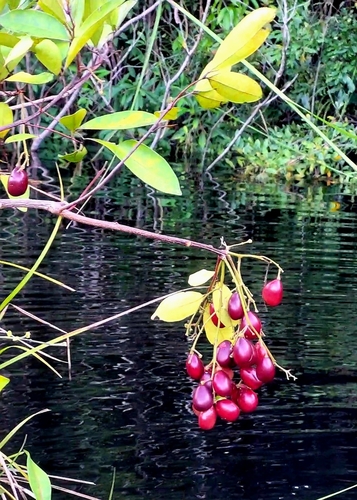
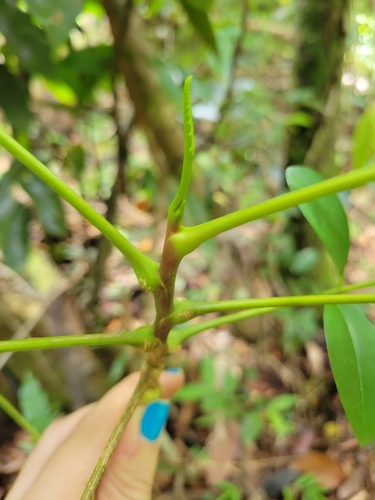
Picrasma excelsa
(Sw.) Planch.
Jamaica quassia, Bitter ash
iNaturalist· cc-by-nc-sa
(c) Mateo Hernandez Schmidt, some rights reserved (CC BY-NC-SA), uploaded by Mateo Hernandez Schmidt
wikimedia· cc0
Wikimedia Commons - Carson, Joseph; Colen, J. H.; Robert P. Smith.
wikimedia· cc-by-sa
Wikimedia Commons - Rawpixel
Summary
Source: WikipediaPicrasma excelsa is a species of Picrasma in the family Simaroubaceae. It is found in Cuba, the Dominican Republic, Haiti, Jamaica, Puerto Rico, Saint Vincent and the Grenadines, and Venezuela. It is threatened by habitat loss.
Description
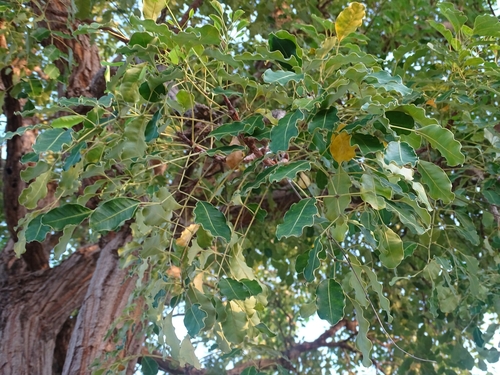
Jamaican quassia is a deciduous tree growing to 20 meters tall by 15 meters wide at a moderate rate. It is not frost tender and hardy to UK zone 10. It grows in light sandy and medium loamy soils preferring well-drained conditions. Tolerates mildly acid, neutral, and mildly alkaline soils. Requires full sun and prefers moist soil.
Edible Uses
A bitter extract of the bark is used as a flavouring in drinks, baked goods, candy, and similar products.
Traditional Uses
An extract from the wood is used in bitter tonics and liqueurs. It is also use commercially to flavour baked goods, candies, and frozen dairy products. It has been used to increase the bitterness or orange marmalade. It has been used as a substitute for hops.
Medicinal Uses
Jamaican quassia bark contains several medically active constituents including quassinoid bitter principles (among them quassin), alkaloids, the coumarin scopoletin, and vitamin B1. It is an intensely bitter, non-astringent, odourless herb that lowers fever, stimulates appetite, and improves digestion. It is an effective parasiticide and is reputedly antileukaemic; some of the quassinoids have demonstrated cytotoxic and antileukaemic actions. The strongly bitter principle in the bark supports weak digestive systems by increasing bile flow and stimulating secretion of salivary juices and stomach acids. Internally it is used for a wide range of conditions where digestion is a contributing factor, particularly convalescent debility, poor appetite, and anorexia. Its bitterness has also led to use in treating malaria and other fevers, and it is used to rid the body of nematode worms. Externally, it makes an effective lotion against parasites such as lice, and it is also used in an enema to expel threadworms and other parasites. The bark can be harvested at any time of year and dried for later use.
Known Hazards
Some care needs to be exercised when ingesting this plant since excess doses can lead to gastric irritation and vomiting.
Distribution
A tropical plant. It grows between 90-825 m above sea level. It grows in forests and near water.
Where It Grows
Africa, Caribbean, Central America*, Cuba, Dominican Republic, East Africa, Guiana, Haiti, Jamaica, Lesser Antilles, Mozambique, Puerto Rico, South America, Venezuela, Virgin Islands, West Indies,
Cultivation
Plants can be grown from fresh seeds and by semi-ripe cuttings.
Propagation
Seed is best sown as soon as it is ripe. Semi-ripe cuttings can also be used.
Other Uses
A decoction of the bark acts as an effective insecticide against flies, red spider mites, aphids, and woolly aphids, and is also used as an insect repellent. The wood is white to yellowish-white, soft, light, and loosely grained, and splits easily.
Notes
There are 9 Picrasma species. Also put in the family Picramniaceae. It is an at risk species.
Synonyms
Also Known As
Bitter-ash, Bitterwood, Jamaica quassiawood
References (9)
- Encyclopedia of Life.
- Facciola, S., 1998, Cornucopia 2: a Source Book of Edible Plants. Kampong Publications, p 230
- Hedrick, U.P., 1919, (Ed.), Sturtevant's edible plants of the world. p 495 (As Picraena excelsa)
- Kermath, B. M., et al, 2014, Food Plants in the Americas: A survey of the domesticated, cultivated and wild plants used for Human food in North, Central and South America and the Caribbean. On line draft. p 656
- London J. Bot. 5:574. 1846
Show all 9 references Hide references
- Plants of Haiti Smithsonian Institute http://botany.si.edu/antilles/West Indies
- Uphof,
- Useful Tropical Plants
- Wiersema, J. H. & Leon, B., 2013, World Economic Plants. A Standard Reference CRC Press. 2nd Ed. p 527