Quassia undulata
(Guill. & Perr.) D. Dietr.
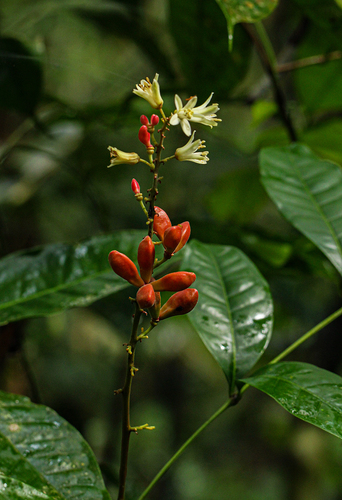
iNaturalist· cc-by-nc
(c) AMADOU BAHLEMAN FARID, some rights reserved (CC BY-NC), uploaded by AMADOU BAHLEMAN FARID
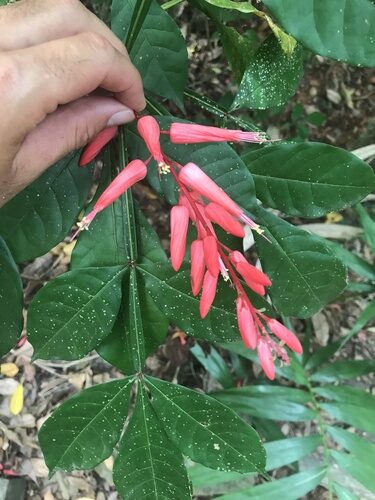
iNaturalist· cc-by-nc
(c) Elias, some rights reserved (CC BY-NC)
Description
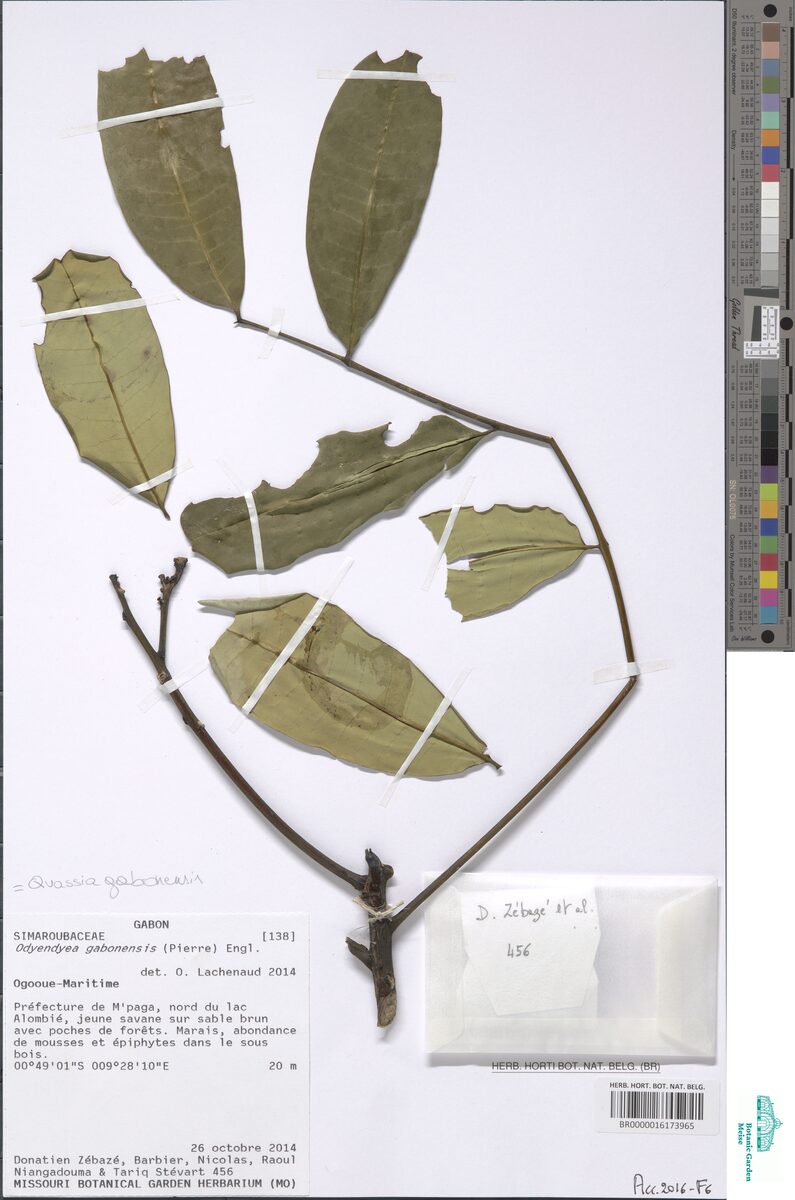
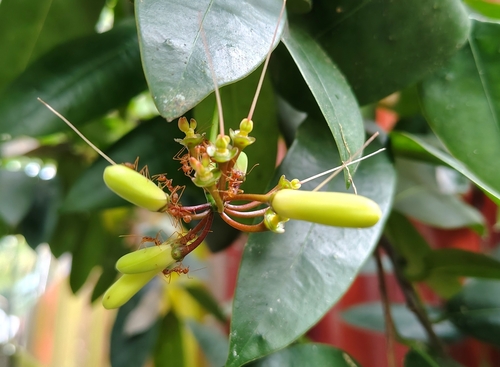
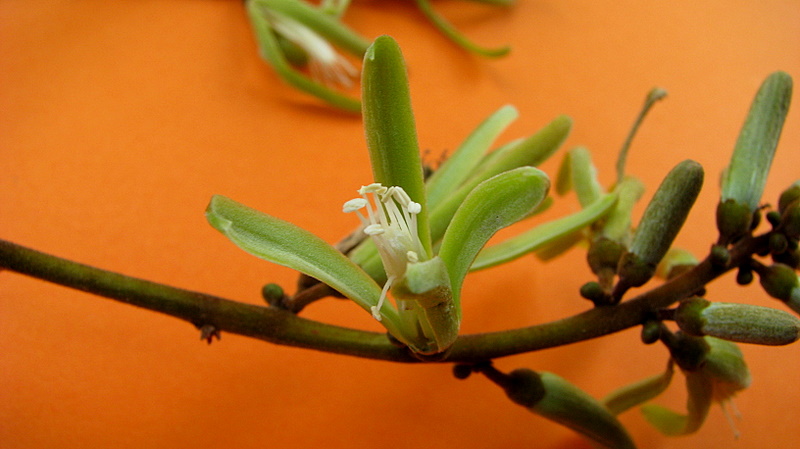
A shrub or large tree. It can be 42 m tall. The trunk can be without branches for 24 m. The trunk can be 120 cm across. The trunk is straight and cylinder shaped. The bark can be smooth or cracked. It is grey and flaking. The leaves are compound and arranged alternately. There are 2-9 pairs of leaflets with a leaflet at the end. The leaves are 8-40 cm long and the leaflets are 2-20 cm long by 1-8 cm wide. The leaflets at the base and at the end are the smallest. The flowers can have one or both sexes. They are white or yellow and have a scent. The fruit is made up of 1-3 fleshy sections 2-4 cm long by 1-3 cm wide. They are flattened and purple or black and shiny. There is one seed in each section. Plants vary in leaf shape, flowers and fruit.
Edible Uses
The fruit is recorded as eaten by some sources, though others claim it is not edible. Oil is extracted from seeds and the remaining seed cake is eaten.
Traditional Uses
The fruit is recorded as eaten but others claim it is not edible. The oil from the seed is extracted and then the seed cake is eaten. (The oil is used for soap.) Caution: It should probably only be eaten with proper preparation.
Medicinal Uses
Mjoho is a bitter-tasting plant that is often used in African traditional medicine. Modern research has shown the presence of various medically active substances in the plant. Stem, stem bark and root bark extracts, and various quassinoids isolated from the plant, have shown antimalarial activity against Plasmodium falciparum and Plasmodium berghei. The quassinoid 15-desacetylundulatone, isolated from the root bark, has shown antitumor activity against P388 mouse lymphocytic leukaemia cells and colon 38 adenocarcinoma. Eniotorin, a coumarin also isolated from the root bark, has shown antimalarial properties in vitro. Alkaloids have been isolated from the root bark. Hexane and methanol extracts of the leaves and stems exhibited marked antibacterial and antifungal activities, inhibiting the growth of Aspergillus niger, Escherichia coli, Staphylococcus aureus and Streptococcus faecalis. The quassinoid chaparrinone has shown in-vitro antiviral activity against the carcinogenic Rous sarcoma virus (RSV). The stem bark or root bark are considered to be antidote and purgative; as well as a treatment against leprosy. A decoction is drunk as a treatment against fever, cough and stomach complaints such as colic. A maceration or decoction of the stem bark is used as a wash for children to prevent abscesses. A maceration or decoction of the stem bark, root bark, combined with the leaves, is drunk or used in baths in cases of insanity or dementia. Sap from the root bark, diluted in water, is used as an enema against stomach problems. Root extracts are used for eye treatments and as aphrodisiac. A decoction of leaves is used as a stimulant and for the treatment of rickets, ankylosis and varicose veins. The fruit is used as a treatment against nocturnal enuresis. A mixture of the ground fruit or kernel, mixed with oil, is rubbed into the hair against head lice. The ash of the burnt fruit, mixed with shea butter, is used similarly. The seed is considered poisonous, but in Nigeria it is taken against fever.
Known Hazards
Excessive use of this plant can cause vomiting. Long term use should be avoided, as it can lead to weakness of the vision, leading towards total blindness. It should also be avoided during pregnancy and menstruation, because it may cause uterine colic. It has also shown to have negative effects on the fertility of rats, both male and females. It has been proven to reduce the weight of testis, epididymis and seminal vesicles of the rats. They also found a reduction of the epididymal sperm count, the level of testosterone, LH and FSH. These changes disappeared after some time. In female rats, a decrease of weight from the ovary and uterus was seen. There was also a decrease in the estrogen level. The litter number and weight were also reduced.
Distribution
A tropical plant. It can grow in open grassland and in forests. It grows from sea level to 2,500 m altitude. It needs light to get established.
Where It Grows
Africa, Angola, Benin, Burkina Faso, Cameroon, Central Africa, Central African Republic, CAR, Congo, Côte d'Ivoire, East Africa, Equatorial Guinea, Gabon, Gambia, Ghana, Guinea, Guinée, Guinea-Bissau, Ivory Coast, Kenya, Liberia, Mali, Nigeria, Senegal, Sierra Leone, Tanzania, Togo, Uganda, West Africa, Zambia,
Cultivation
Plants are grown from seed. Fresh seed should be sown. They germinate in 6-22 days. Seedlings grow slowly.
Propagation
Seed - for good germination, the seeds should be sown immediately after being collected, because they lose their viability rapidly. The seeds germinate in 6 - 22 days. Initial growth in the nursery is slow, with 5-month-old seedlings being only 11 - 12 cm tall. Seedlings are ready to be planted out when they are about 14 months old. They are planted in full sun in pure stands or mixed with other light-demanding and not too fast growing species.
Other Uses
The seed and oil from the seed are used in soap making. The seed yields 56% oil, with as main fatty acids: oleic acid (46 - 61%), stearic acid (20 - 26%), palmitic acid (8 - 11%) and linoleic acid (8 - 10%). A paste of the boiled bark and pulped seed is used in Nigeria as a hair pomade, and in Zimbabwe women use the seed oil similarly. A seed extract has shown insecticidal and arachnicidal properties. The quassinoid fraction of the seed (a mixture of chaparrinone, glaucarubolone and klaineanone) inhibits penetration of Meloidogyne javanica into tomato roots and reduces reproduction of the nematode. The heartwood is greyish white to pale yellow, somewhat lustrous, and is not clearly differentiated from the sapwood. The wood is straight-grained, light, soft, not strong, fibrous and occasionally brittle. It saws easily and works well with hand and machine tools. It planes to a nice surface, moulds well and sands well, but sanding must be done perpendicular to the direction of the fibres. It does not split on nailing and holds nails and screws well. It drills easily. The peeling and slicing properties are excellent, but the wood is too soft for turning. It glues and finishes well. The wood is not durable, being susceptible to attacks by fungi, marine borers and termites. The heartwood is resistant to impregnation with preservatives, the sapwood is permeable. It is mainly suitable for indoor construction, on account of its low durability, and for the production of shipping crates to transport easily bruised or breakable products, such as machinery and fruit, because of its softness. It is also suitable for veneer, plywood and modelling. Locally it is used for house construction, planks, doors, ceilings, (painted) carpentry, musical instruments, toys, stools, carvings, troughs and canoes. Poles obtained from the tree are used in northern Ghana as yam supports. The wood is used to keep heavier wood of other species floating. It is used as fuel wood and for making charcoal, and for paper making.
Notes
There are 40 Quassia species.
Synonyms
Also Known As
Kunmuni, Munyamba, Munyonga, Mupembewila
References (6)
- Aniama, S. O., et al, 2016, Ethnobotanical documentaton of some plants among Igala people of Kogi State (Nigeria). The International Journal Of Engineering And Science (IJES). 5(4) pp 33-42 (As Hannoa undulata)
- Burkill, H. M., 1985, The useful plants of west tropical Africa, Vol. 5. Kew.
- Fowler, D. G., 2007, Zambian Plants: Their Vernacular Names and Uses. Kew. p 61
- Gueye, M., et al, 2014, Wild Fruits Traditionally Gathered by the Malinke Ethnic Group in the Edge of Niokolo Koba Park (Senegal). American Journal of Plant Sciences 5, 1306-1317
- Gyakari, J.N. & Cobbinah, J.R., 2008. Quassia undulata (Guill. & Perr.) D.Dietr. [Internet] Record from Protabase. Louppe, D., Oteng-Amoako, A.A. & Brink, M. (Editors). PROTA (Plant Resources of Tropical Africa), Wageningen, Netherlands. < http://database.prota.org/search.htm>. Accessed 22 October 2009.
Show all 6 references Hide references
- World Checklist of Useful Plant Species 2020. Royal Botanic Gardens, Kew