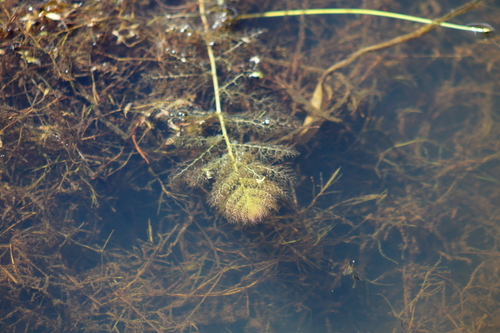
Pinguicula vulgaris
L.
Butterwort, Thickening grass
iNaturalist· cc-by-sa
(c) AJC1, some rights reserved (CC BY-SA)
iNaturalist· cc-by-nc
(c) wanderingeden, some rights reserved (CC BY-NC)
iNaturalist· cc-by-nc
(c) wanderingeden, some rights reserved (CC BY-NC)
Summary
Source: WikipediaPinguicula vulgaris, the common butterwort, is a perennial carnivorous plant in the butterwort genus of the family Lentibulariaceae.
Description
Small perennial reaching 0.1 m tall. Hardy to UK zone 3. Flowers May to July. Hermaphroditic. Tolerates light sandy, medium loamy, and heavy clay soils across mildly acidic to mildly alkaline pH ranges. Requires full sun and prefers wet soil conditions.
Edible Uses
Butterwort leaves can be used as a curdling agent for milk. Fresh leaves are laid across a strainer and milk is poured over them, then left for a day or two until it sours and sets solid, similar to yoghurt, with a reportedly delicious flavour. A small amount of the finished product can be reserved to inoculate further batches. An alternative method involves infusing the leaves directly in the milk for a period of time.
Traditional Uses
Cultured milk is poured over the leaves which provide lactic acid that acts as a thickening agent. It is also used instead of garlic.
This uses section is brief — help expand it
Medicinal Uses
Butterwort sees little use in contemporary herbal medicine, though it was historically used as a purgative in Wales. Its main application today is as a cough remedy. The leaves are antispasmodic and antitussive, and the plant is an effective treatment for whooping cough. Applied externally as a poultice, it has a healing effect on the skin. Leaves are harvested in early summer as the plant comes into flower and dried for later use. A homeopathic remedy prepared from the plant is used for whooping cough and nervous throat irritations.
Distribution
It is a temperate plant.
Where It Grows
Estonia, Europe, Iceland, Mongolia, Norway, Scandinavia, Slovenia, Sweden,
Cultivation
Requires a boggy soil. Because of their insectivorous habit, plants are able to succeed on soils very deficient in nitrogen. Butterwort is an insectivorous plant, the leaves are sticky and trap insects which are then digested by the plant. Plants overwinter as a tight winter-resting bud with virtually no roots.
Propagation
Seed — no specific information is available for this species, but sowing in a greenhouse as soon as seed is ripe in summer is recommended, or in early spring if that is not possible. Stand pots in shallow water to keep them moist. Prick seedlings out into individual pots once large enough to handle, and grow on in a greenhouse for at least the first two growing seasons. Plant out into permanent positions in late spring or early summer, after the last expected frosts. Division of resting buds can be done in winter. Leaf cuttings are also an option.
Other Uses
A colouring substance can be obtained from the leaves.
Also Known As
Navadna mastnica, Tettegras, Voipatakas
References (6)
- Facciola, S., 1998, Cornucopia 2: a Source Book of Edible Plants. Kampong Publications, p 140
- Girard, N. J., 2020, Sustainable Foraging of Wild Edible Plants in Norway. A Biocultural Approach. M. Sc. thesis Norwegian University. p 132
- http://www.botanic-gardens-ljubljana.com/en/plants
- Kalle, R. & Soukand, R., 2012, Historical ethnobotanical review of wild edible plants of Estonia (1770s-1960s) Acta Societatis Botanicorum Poloniae 81(4):271-281
- Sp. pl. 1:17. 1753
Show all 6 references Hide references
- Svanberg, I., et al, 2012, Edible wild plant use in the Faroe Islands and Iceland. Acta Societatis Botanicorum Poloniae 81(4): 233-238