Clinopodium grandiflorum
(L.) Kuntze
Mint savory, Showy savory, Showy calamint, Greater calamint
iNaturalist· cc-by-nc
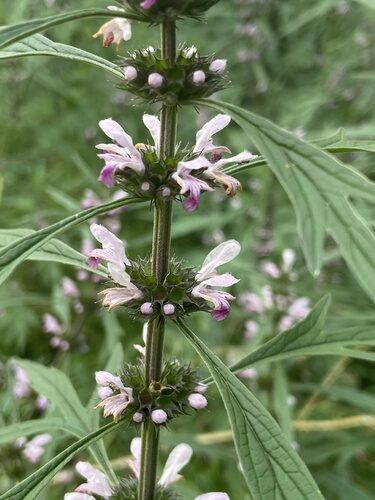
(c) CORDENOS Thierry, some rights reserved (CC BY-NC), uploaded by CORDENOS Thierry
iNaturalist· cc-by-nc
(c) Gennadiy Okatov, some rights reserved (CC BY-NC)
Summary
Source: WikipediaClinopodium grandiflorum, the large-flowered calamint, showy calamint or mint savory, is a species of ornamental plant.
Description
A small herb that keeps growing from year to year. It grows 50 cm high and spreads 50 cm wide. The stem is erect and branching. The leaves are simple and oval. There are teeth along the edge. The flowers are pink.
Edible Uses
The leaves have a mint-like flavor and are used as a seasoning or brewed as tea.
Traditional Uses
The leaves have a mint like flavour use as seasoning. They can be used as tea.
This uses section is brief — help expand it
Medicinal Uses
It can be used in cooking, and in herbal medicine for bruises and cramps.. In the Aubrac region of France, it is used as an infusion and called "thé d'Aubrac" (Aubrac tea); it is appreciated for its digestive properties.
Distribution
It is a temperate plant. It needs a well drained soil. It does best in an open sunny position. It is drought and frost resistant.
Where It Grows
Albania, Armenia, Azerbaijan, Asia, Australia, Austria, Balkans, Bulgaria, Caucasus, Crimea, Europe*, France, Georgia, Greece, Iran, Italy, Mediterranean, Middle East, Portugal, Romania, Spain, Switzerland, Turkey, Türkiye, Ukraine,
Cultivation
It can be grown from seed or by division.
Notes
There are 6 or 7 Calamintha species.
Synonyms
References (6)
- Bodkin, F., 1991, Encyclopedia Botanica. Cornstalk publishing, p 187 (As Calamintha grandiflora)
- Facciola, S., 1998, Cornucopia 2: a Source Book of Edible Plants. Kampong Publications, p 125 (As Calamintha grandiflora)
- GRIN (As Clinopodium grandiflorum)
- Methodus 408. 1794 (As Calamintha grandiflora)
- Seidemann J., 2005, World Spice Plants. Economic Usage, Botany, Taxonomy. Springer. p 74 (As Calamintha grandiflora)
Show all 6 references Hide references
- Wiersema, J. H. & Leon, B., 2013, World Economic Plants. A Standard Reference CRC Press. 2nd Ed. p 186