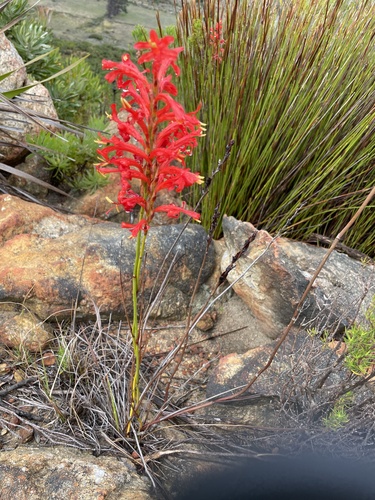
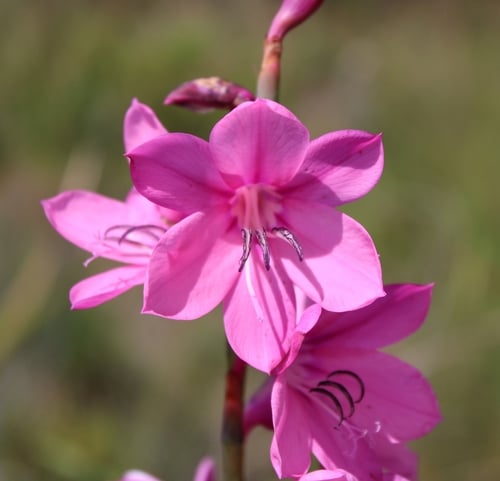
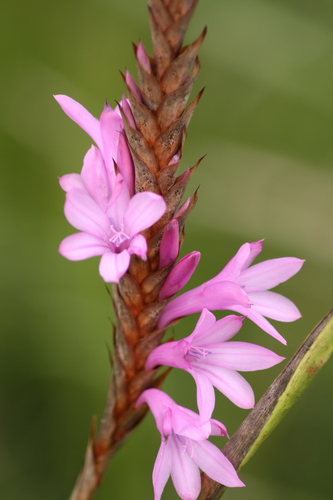
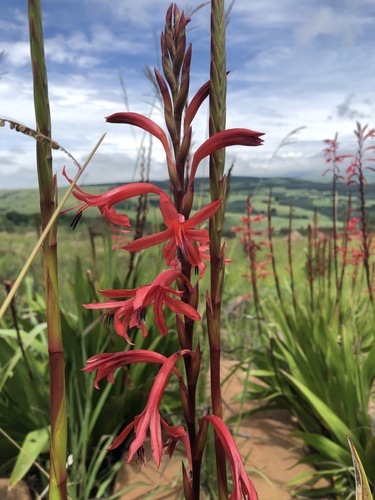
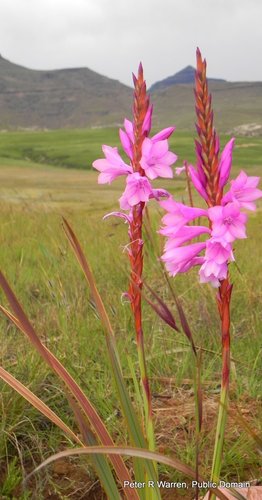
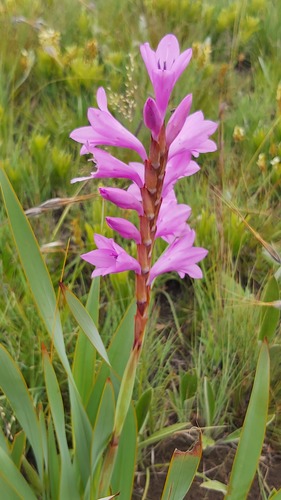
Crocosmia aurea
(W. J. Hooker) Planchon
Copper tips
iNaturalist· cc-by-nc-sa
(c) Bart Wursten, some rights reserved (CC BY-NC-SA)
iNaturalist· cc-by-nc
(c) setapion, some rights reserved (CC BY-NC)
Summary
Source: WikipediaCrocosmia aurea, common names falling stars, Valentine flower, or montbretia, is a perennial flowering plant belonging to the family Iridaceae.
Description
A herb. It keeps growing from year to year. It grows 60-100 cm tall. It has oval tubers or corms. It has creeping stems. The leaves are in 2 ranks. They clasp one another at the base. They are 2-3 cm wide. The leaf blades are ribbed. The flowers are trumpet shaped. They are orange or yellow.
Edible Uses
A yellow dye obtained from the flowers is used as a saffron substitute for colouring foods.
Traditional Uses
The flowers are the source of a yellow dye used as a substitute for saffron.
This uses section is brief — help expand it
Medicinal Uses
None known
Distribution
It is a tropical plant. It will grow in most well-drained soils. It needs an open sunny position. It is resistant to frost and drought. It grows between 1,500-2,000 m above sea level. It grows on the edges of forests.
Where It Grows
Africa, Australia, Central Africa, Congo, East Africa, Eswatini, Malawi, Mexico, Mozambique, South Africa*, Southern Africa, Swaziland, Tanzania, Zambia, Zimbabwe,
Cultivation
Plants are grown by seed.
Propagation
Sow seed as soon as it is ripe in a cold greenhouse; it usually germinates in 3–9 weeks at 20–25°C. Stored seed can be sown in early spring in a greenhouse. Sow thinly so plants can remain undisturbed in their pots for the first year, giving occasional liquid feeds to prevent nutrient deficiency. Once dormant in autumn, pot up bulbs 2–3 per pot and grow on for another year or two in the greenhouse before planting out when dormant in autumn. Divide in spring as new growth begins — larger clumps can go directly into permanent positions, while smaller clumps are best potted and grown on in a cold frame until well rooted, then planted out in summer or the following spring.
Other Uses
Dye: a yellow dye is obtained from the flowers.
Notes
There are 9 Crocosmia species. They come from Southern Africa.
Synonyms
Also Known As
Dvwendvweni, Golden monbretia, Montbretia, Tritonia, Umlunge
References (8)
- Bodkin, F., 1991, Encyclopedia Botanica. Cornstalk publishing, p 299
- Facciola, S., 1998, Cornucopia 2: a Source Book of Edible Plants. Kampong Publications, p 122
- Fl. des Serres 7:161. 1851
- Fowler, D. G., 2007, Zambian Plants: Their Vernacular Names and Uses. Kew. p 86
- Larios, et al., 2013, Plant management and biodiversity conservation in Náhuatl homegardens of the Tehuacán Valley, Mexico. Journal of Ethnobiology and Ethnomedicine 2013 9:74.
Show all 8 references Hide references
- Staples, G.W. and Herbst, D.R., 2005, A tropical Garden Flora. Bishop Museum Press, Honolulu, Hawaii. p 669
- Swaziland's Flora Database http://www.sntc.org.sz/flora
- World Checklist of Useful Plant Species 2020. Royal Botanic Gardens, Kew