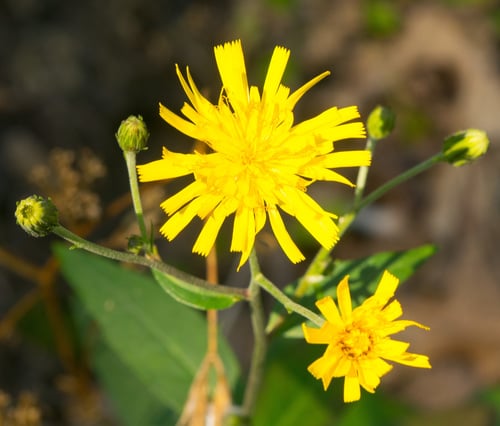
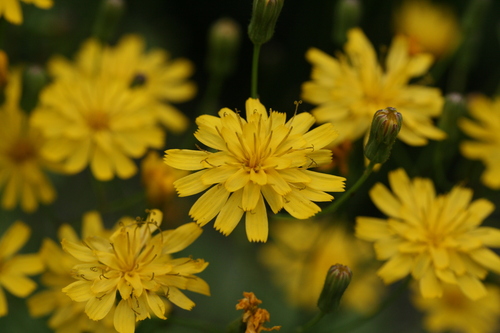
Blumea lacera
(Burm. f.) A. DC.
Kakronda, Malay blumea
iNaturalist· cc-by-nc
(c) Radha Veach, some rights reserved (CC BY-NC), uploaded by Radha Veach
iNaturalist· cc-by-nc
(c) Radha Veach, some rights reserved (CC BY-NC), uploaded by Radha Veach
Description
A herb which keeps growing each year. It can grow each year from seeds. It can be 20 cm to 2.5 m. The stems are hairy. They are erect and stiff and brittle. They have a woody rootstock and often grows to 1 m tall. There are many branches. The leaves are produced one after the other on opposite sides of the stem. They are hairy on both surfaces. There are irregular teeth along the edge of the leaf. The flowers develop at the top of the plant. The fruit are brown and with ribs and about 1 mm long.
Edible Uses
The leaves are cooked and eaten in soups. In Nepal, the plant is used to prepare a fermenting cake from which liquor is distilled. Leaves are sold in local markets.
Traditional Uses
The leaves are cooked and eaten. They are used in soups. In Nepal the plant is used to prepare a fermenting cake from which liquor is distilled.
This uses section is brief — help expand it
Medicinal Uses
Used in traditional preparations in Nepal for fermented cake and liquor distillation.
Distribution
A tropical plant. In Papua New Guinea it occurs between 100 and 2,000 m altitude. It Java it grows to 1,500 m above sea level. In Sichuan and Yunnan.
Where It Grows
Africa, Asia, Australia, Bangladesh, Bhutan, China, East Africa, Guam, Himalayas, India, Indochina, Indonesia, Japan, Laos, Malaysia, Mozambique, Myanmar, Nepal, Northeastern India, Pacific, Pakistan, Papua New Guinea, PNG, SE Asia, Sri Lanka, Taiwan, Thailand, Vietnam,
Cultivation
The plant is normally self sown from seed.
Other Uses
The plant contains a strong, camphor-like essential oil.
Other Information
It is not known if it is used for food in Papua New Guinea. Leaves are sold in local markets.
Nutrition
| Part | Moisture | kJ | kcal | Protein | Vit A | Vit C | Iron | Zinc |
|---|---|---|---|---|---|---|---|---|
| Leaves | 89.4 | 97 | 23 | 2.7 | — | 42 | — | — |
Synonyms
Also Known As
Anra mang, Batu linchar, Bugi, Burando, Cai ma, Cai triu, Gangrima, Kakradna, Kayu batu, Khicha bhwatha, Kopile jhar, Kukuradru, Kukursunga, Kurkure, Lalangkapan, Lumai hutan, Mugongreng, Peau, Sembung lalaki
References (27)
- Ambasta S.P. (Ed.), 2000, The Useful Plants of India. CSIR India. p 75
- Bircher, A. G. & Bircher, W. H., 2000, Encyclopedia of Fruit Trees and Edible Flowering Plants in Egypt and the Subtropics. AUC Press. p 60
- Borrell, O.W., 1989, An Annotated Checklist of the Flora of Kairiru Island, New Guinea. Marcellin College, Victoria Australia. p 62
- Burkill, I.H., 1966, A Dictionary of the Economic Products of the Malay Peninsula. Ministry of Agriculture and Cooperatives, Kuala Lumpur, Malaysia. Vol 1 (A-H) p 342
- Cribb, A.B. & J.W., 1976, Wild Food in Australia, Fontana. p 135
Show all 27 references Hide references
- Dangol, D. R. et al, 2017, Wild Edible Plants in Nepal. Proceedings of 2nd National Workshop on CUAOGR, 2017.
- Das, S. and Mohiuddin, M., 2012, Gender role in Home Garden Management in the Indigenous Community: A case study in Bandarban Hill District, Bangladesh. International Journal of Social Forestry. 5(1):22-37
- Dobriyal, M. J. R. & Dobriyal, R., 2014, Non Wood Forest Produce an Option for Ethnic Food and Nutritional Security in India. Int. J. of Usuf. Mngt. 15(1):17-37
- Gautam, R. S., et al, 2022, Ethnobotanical Review of Wild Edible Plants of Nepal. Journal of Natural History Museum Volume 32, 2021-22 p 106
- Henty, E.E., & Pritchard, G.S., 1973, Weeds of New Guinea and their control. Botany Bulletin No 7, Division of Botany, Lae, PNG. p 68
- Joshi, N., et al, 2007, Traditional neglected vegetables of Nepal: Their sustainable utilization for meeting human needs. Tropentag 2007. Conference on International Agricultural Research for Development.
- Joshi, N. & Siwakoti, M., 2012, Wild Vegetables Used by Local Community of Makawanpur District and Their Contribution to Food Security and Income Generation. Nepal Journal of Science and Technology Vol. 13, No. 1 (2012) 59-66
- Kuo, W. H. J., (Ed.) Taiwan's Ethnobotanical Database (1900-2000), http://tk.agron.ntu.edu.tw/ethnobot/DB1.htm
- Manandhar, N.P., 2002, Plants and People of Nepal. Timber Press. Portland, Oregon. p 114
- Martin, F.W. & Ruberte, R.M., 1979, Edible Leaves of the Tropics. Antillian College Press, Mayaguez, Puerto Rico. p 184
- Medhi, P. & Borthakur, S. K., 2012, Phytoresources from North Cachur Hills of Assam -3: Edible plants sold at Hflong market. Indian Journal or Natural Products and Resources. 3(1) pp 84-109
- Medhi, P. & Borthakur, S. K., 2013, Wild edible plants sold by the Zeme Nagas at the makeshift market of Mahur, Dima Hasao district of Assam. Pleione 7(1): 84 - 93. 2013.
- Medhi, P., Sarma, A and Borthakur, S. K., 2014, Wild edible plants from the Dima Hasao district of Assam, India. Pleione 8(1): 133-148
- Mot So Rau Dai an Duoc O Vietnam. Wild edible Vegetables. Ha Noi 1994, p 78
- Ochse, J.J. et al, 1931, Vegetables of the Dutch East Indies. Asher reprint. p 122
- Peekel, P.G., 1984, (Translation E.E.Henty), Flora of the Bismarck Archipelago for Naturalists, Division of Botany, Lae, PNG. p 559
- Tanaka, Y. & Van Ke, N., 2007, Edible Wild Plants of Vietnam: The bountiful garden. Orchid books. p 39
- Terra, G.J.A., 1973, Tropical Vegetables. Communication 54e Royal Tropical Institute, Amsterdam, p 29
- USDA, ARS, National Genetic Resources Program. Germplasm Resources Information Network - (GRIN). [Online Database] National Germplasm Resources Laboratory, Beltsville, Maryland. Available: www.ars-grin.gov/cgi-bin/npgs/html/econ.pl (10 April 2000)
- Wiersema, J. H. & Leon, B., 2013, World Economic Plants. A Standard Reference CRC Press. 2nd Ed. p 105
- R. Wight, Contr. bot. India 14. 1834
- World Checklist of Useful Plant Species 2020. Royal Botanic Gardens, Kew