Panax japonicus
(T. Nees) C. A. Mey.
Japanese ginseng, Bamboo ginseng
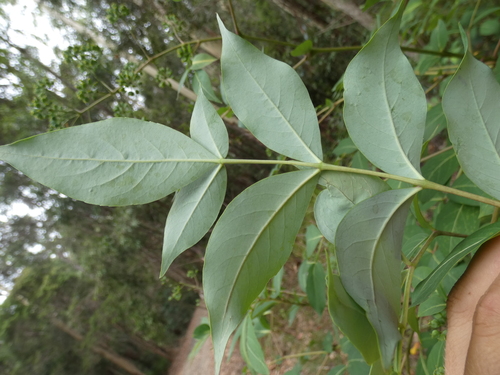
iNaturalist· cc-by-nc
(c) 空猫 T. N, some rights reserved (CC BY-NC), uploaded by 空猫 T. N
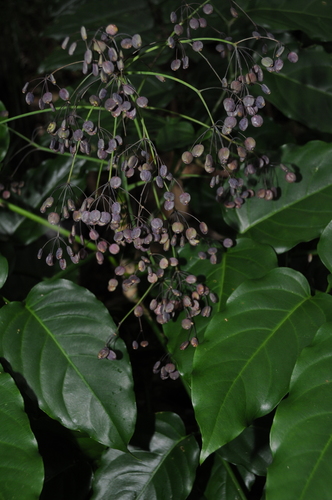
iNaturalist· cc-by-nc
(c) 空猫 T. N, some rights reserved (CC BY-NC)
Summary
Source: WikipediaPanax japonicus is a species of ginseng known for its bamboo-shaped, uneven-sized roots. It is found throughout Japan and Korea, and is also said to be endangered in China. Panax japonicus sees some use in Japanese Kampo medicine and traditional Chinese medicine. Like other ginsengs, it contains a number of ginsenosides. There is no English-language literature on its cultivation, though Baeg et al. (2013) lists it among cultivated ginseng species. There is, however, a considerable volume of Chinese literature on its cultivation under the name Zhújiéshēn.
Description
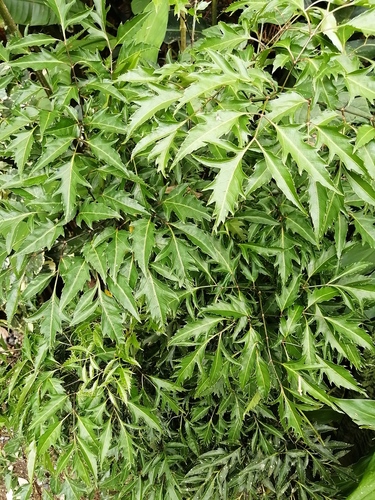
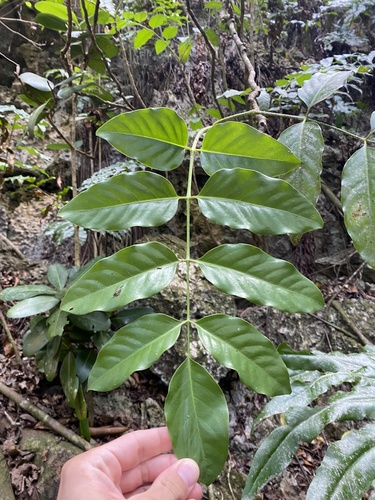
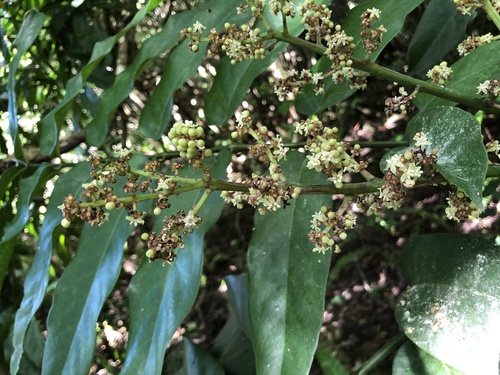
A herb. It grows 50-80 cm tall. The rootstock lies along parallel to the ground level. The stems are straight. There are 3-5 leaves. The are compound with 5 leaflets spread out like fingers in a hand. The are narrowly oval and 5-18 cm long by 2-7 cm wide. There are teeth along the edge. The flowers are in flat top groups of 50-80 flowers. The fruit are round and red. They are 5-7 mm across.
Edible Uses
The roots are used as a flavouring in teas and liqueurs. Some caution is advised regarding toxicity.
Traditional Uses
The dried roots are used in tonic teas and liqueurs. The rhizomes are stewed with pork or chicken.
This uses section is brief — help expand it
Medicinal Uses
A decoction of the root is expectorant, febrifuge, and stomachic.
Known Hazards
Some caution is advised due to toxicity concerns.
Distribution
It is a subtropical plant. In China it grows in forests in valleys between 1,200-3,600 m above sea level.
Where It Grows
Asia, Bhutan, China, Himalayas, India, Indochina, Japan, Korea, Myanmar, Nepal, SE Asia, Thailand, Tibet, Vietnam,
Propagation
Sow seed in a shady position in a cold frame, preferably as soon as it is ripe, otherwise as soon as it is obtained. Germination can be very slow and erratic. Prick out seedlings into individual pots when large enough to handle and grow on in a shady position in a greenhouse or frame for at least their first winter. Ensure pots are deep enough to accommodate the roots. Plant out into permanent positions in late summer. Alternatively, propagate by division in spring.
Other Uses
The root contains up to 5% saponins, which may have potential use as a soap.
Other Information
It is sold in local markets.
Also Known As
Dang sa wang, San qi
References (6)
- Bull. Cl. Phys.-Math. Acad. Imp. Sci. Saint-Petersbourg 1:340. 1843
- Cao, Y., et al, 2020, Ethnobotanical study on wild edible plants used by three trans-boundary ethnic groups in Jiangcheng County, Pu’er, Southwest China. Journal of Ethnobiology and Ethnomedicine (2020) 16:66
- Cheng, Z., et al, 2022, Ethnobotanical study on wild edible plants used by Dulong people in northwestern Yunnan, China. Journal of Ethnobiology and Ethnomedicine (2022) 18:3
- Facciola, S., 1998, Cornucopia 2: a Source Book of Edible Plants. Kampong Publications, p 26
- Lim, T. K., 2015, Edible Medicinal and Non Medicinal Plants. Volume 9, Modified Stems, Roots, Bulbs. Springer p 63
Show all 6 references Hide references
- Tanaka,