Heracleum persicum
Desf.
Persian cow-parsley
iNaturalist· cc-by-nc
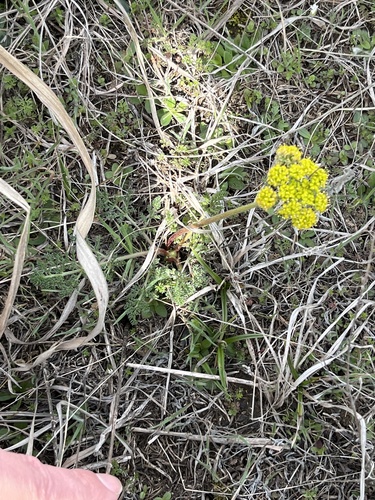
(c) ugress, some rights reserved (CC BY-NC)
iNaturalist· cc-by-nc
(c) ugress, some rights reserved (CC BY-NC)
iNaturalist· cc-by-nc
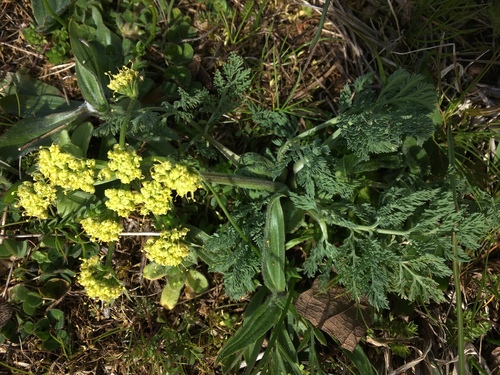
(c) psylvestris, some rights reserved (CC BY-NC)
Summary
Source: WikipediaHeracleum persicum, commonly known as Persian hogweed or by its native name golpar (Persian: گلپر), is a species of hogweed, a perennial herbaceous plant in the carrot family Apiaceae. It grows wild in humid mountainous regions in Iran and some adjacent areas. Having been introduced in the 1830s, it has spread across Scandinavia. It is now very common in northern Norway, where one of its names is Tromsø palm (after the city of Tromsø). The plant has also been spotted in Sweden. In Finland, it has been declared an invasive species. Persian hogweed is a polycarpic perennial, that is, a mature plant flowers and bears fruit season after season.
Description
A herb.
This description is brief — help expand it
Edible Uses
The seeds are used as a spice in Persian cooking. The very thin, small mericarps (seed-like fruits) are aromatic and slightly bitter. They are usually sold in powdered form and are often erroneously sold as "angelica seeds". The powder is sprinkled over broad beans, lentils and other legumes, and potatoes. Golpar is also used in soups and stews, or sprinkled over pomegranate arils. Golpar is also mixed with vinegar into which broad beans are dipped before eating. Golpar can be used in small amounts (1 or 2 tsp per pound) when cooking beans and is alleged to reduce the effect of gas in the digestive tract associated with consuming beans. In Persian cuisine, the petals are used in the spice mixture advieh to flavor rice dishes, as well as in chicken, fish, and bean dishes. The tender leaves and leaf stalks can also be pickled (known as golpar torshi).
Traditional Uses
The leaf stalks ad fleshy shoots are boiled and eaten. They are also used to flavour cheese. The seeds are ground into powder and sprinkled over potatoes, cooked broad beans or roasted watermelon seeds. Whole seeds are added to soups and stews and some kinds of pickles.
Known Hazards
The sap of the Tromsø palm contains furanocoumarins, which in combination with ultraviolet light, leads to phytophotodermatitis. There is some anecdotal evidence that H. persicum may be less dangerous than H. mantegazzianum with respect to phototoxicity.
Distribution
It is a temperate plant.
Where It Grows
Asia, Europe, Iran, Middle East, Turkey, Türkiye,
Other Information
It is a cultivated food plant.
Synonyms
Also Known As
Golpar, Sov, Soy
References (8)
- Bahadori, M. B. et al, 2016, The Genus Heracleum : A Comprehensive Review on Its Phytochemistry, Pharmacology, and Ethnobotanical Values as a Useful Herb. Comprehensive Reviews in Food Science and Food Safety. 15(6): p 1018-1039
- Coruh, et al., 2007, Antioxidant properties of Prangos ferulacea (L.) Lindl., Chaerophyllum macropodum Boiss. and Heracleum persicum Desf. from Apiaceae family used as food in Eastern Anatolia and their inhibitory effects on glutathione-S-transferase. Food Chemistry 100: 1237-1242
- Dogan, A., et al, 2014, A review of edible plants on the Turkish Apiaceae species. J. Fac. Pharm. Istanbul, 44(2) pp 251-262
- Facciola, S., 1998, Cornucopia 2: a Source Book of Edible Plants. Kampong Publications, 19
- Mukemre, M., et al, 2016, Survey of wild food plants for human consumption in villages of Catak, (Van-Turkey), Indian Journal of Traditional Knowledge. Vol. 15(2) pp. 183-191
Show all 8 references Hide references
- Seidemann J., 2005, World Spice Plants. Economic Usage, Botany, Taxonomy. Springer. p 176
- Tabl. Ecole bot. ed. 3:452. 1832
- World Checklist of Useful Plant Species 2020. Royal Botanic Gardens, Kew